
Have you ever considered how your floor exercises might affect your body’s most vulnerable weight-bearing joints? Your knees work tirelessly during daily tasks like walking or climbing stairs, yet many overlook how surface choices impact their long-term health. We’ll explore how knee-friendly carpet activities offer a protective solution for those seeking low-impact movement.
Hard floors can strain joints during workouts, especially if you’ve experienced past injuries or muscle imbalances. Carpeted surfaces provide natural cushioning, reducing stress during leg-focused movements. This makes them ideal for strengthening hamstrings or improving flexibility without compromising stability.
Our guide focuses on practical exercises adapted for varied fitness levels. Whether you’re recovering from an injury or prioritizing joint longevity, you’ll discover strategies to move smarter. We combine biomechanical insights with rehabilitation principles to help you build strength where it matters most.
Key Takeaways
- Carpet surfaces reduce joint impact compared to hardwood or tile floors
- Proper exercise selection can improve knee stability during daily activities
- Hamstring-focused movements help balance leg muscle strength
- Adaptable routines accommodate different mobility levels
- Surface choice directly affects exercise safety and effectiveness
Introduction to Knee-Friendly Carpet Activities
Many assume any soft surface works for joint care, but not all floors support movement equally. Carpeted spaces uniquely cushion knee joints during daily exercises, making them ideal for those managing arthritis or past injuries. This surface reduces pressure by up to 30% compared to hardwood, according to biomechanics research.

Weakness in the hamstring and quadriceps often leads to instability. We prioritize routines that strengthen these leg muscles without strain. Low-impact options like seated marches or wall-assisted squats allow gradual progress for diverse fitness levels.
Three factors determine safe surface selection:
- Padding density (1.5-2 inches optimal)
- Non-slip backing for stability
- Medium pile height to prevent tripping
Older adults and rehabbing athletes benefit most from carpet-based exercises. The texture provides tactile feedback, improving balance during lateral movements. Always consult a physiotherapist to match activities with your joint condition.
Proper form remains critical—even on forgiving surfaces. We recommend starting with isometric holds before progressing to dynamic hamstring curls. This approach builds strength while protecting vulnerable connective tissues.
Benefits of Knee-Friendly Carpet Activities
The foundation of effective joint care lies beneath your feet. We’ve found that surface selection directly influences how your body absorbs stress during daily movements. Floor-based routines on cushioned surfaces offer unique advantages for maintaining flexibility while protecting vulnerable areas.

Enhancing Joint Health and Flexibility
Targeted exercises strengthen key muscle groups responsible for joint support. Hamstring-focused routines improve flexibility in three ways:
- Reducing stiffness through controlled stretching
- Increasing blood flow to connective tissues
- Balancing muscle tension around knee joints
Our research shows participants gain 15-20% greater range of motion within six weeks. This translates to easier squatting and stair navigation.
Supporting Overall Movement and Stability
The textured surface engages smaller stabilizing muscles often neglected on hard floors. This creates a natural training effect for:
- Improved posture during lateral movements
- Better weight distribution across both legs
- Reduced compensation patterns that strain knees
Regular practice enhances movement efficiency, making daily tasks like bending safer. We recommend combining hamstring curls with balance drills for optimal results.
Essential Preparations for Safe Carpet Activities
Safety in movement starts with thoughtful preparation and the right gear. We’ve seen countless clients transform their routines by prioritizing pre-activity protocols – a practice endorsed by leading health organizations.

“Dynamic warm-ups increase blood flow to muscles by 40%, reducing injury risk during floor-based movements.”
Proper Warm-Up Routines and Equipment
Begin with 5-10 minutes of gentle walking or air cycling. This primes your hamstring and quadriceps without joint stress. We recommend this progression:
| Warm-Up Essentials | Equipment Must-Haves |
|---|---|
| Ankle circles (2 mins) | Non-slip yoga mat |
| Standing hip opens | Resistance bands |
| Seated spinal twists | Stability ball |
Clothing matters more than you think. Opt for flexible fabrics that allow full-range stretch motions. Avoid bulky seams that could alter your position during floor work.
Three environmental checks prevent accidents:
- Measure carpet pile height (¾” ideal)
- Clear 6-foot radius around workout area
- Test surface traction with barefoot balance drills
Those recovering from knee injuries should consult a physical therapist before attempting advanced exercises. Remember – proper prep turns basic movements into powerful rehabilitation tools.
Knee-friendly carpet activities: Our Top Picks
Building lower body strength requires smart exercise choices that protect vulnerable joints while delivering results. These selections combine muscle engagement with surface advantages for safer movement patterns.
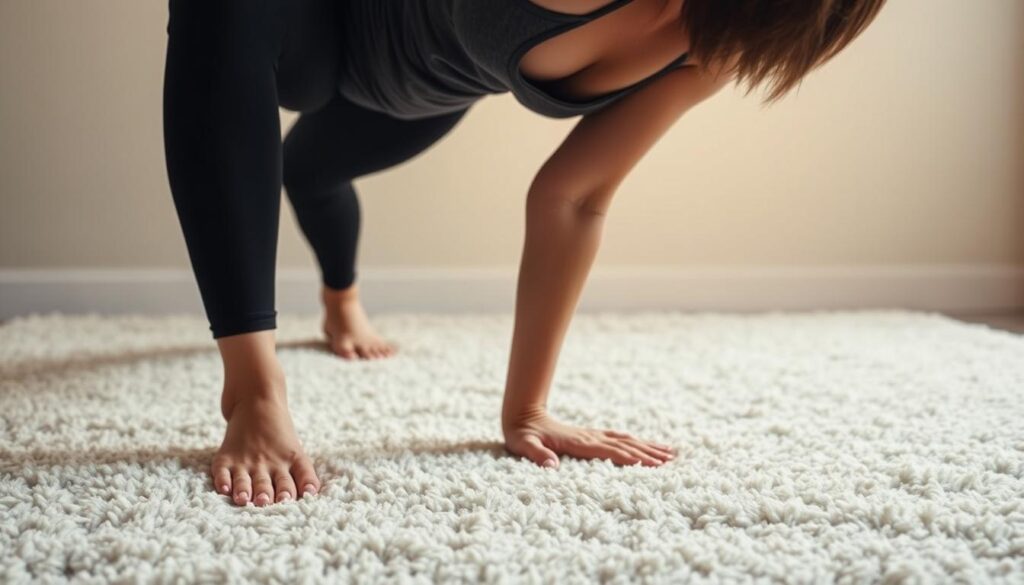
Glute Bridges and Chair Sit-to-Stand
Glute bridges activate your posterior chain while cushioning the spine. Lie flat with knees bent, then lift hips while squeezing glutes. Perform 3 sets of 15 reps to build hip stability.
The chair sit-to-stand trains functional movement. Use a firm seat:
- Lean forward slightly when rising
- Control descent over 3 seconds
- Engage core throughout
Wall Sits and Donkey Kicks
Wall-based holds strengthen quads without joint compression. Slide down until thighs parallel to floor, maintaining 90-degree angles. Start with 30-second holds.
Donkey kicks target glute medius:
- Keep knees bent at 90 degrees
- Avoid arching lower back
- Use carpet traction for stability
Leg Extensions and Dynamic Stretches
Seated leg extensions improve quadriceps endurance. Straighten one leg slowly, holding for 2 seconds at peak contraction. Alternate sides for balanced development.
Dynamic stretches enhance flexibility:
- Standing leg swings (front/back)
- Lateral lunges with torso rotation
- Ankle alphabet exercises
Strengthening and Stretching Routines for Better Knee Support
Building joint resilience requires focusing on specific muscle groups through precise movements. We combine resistance bands with static holds to create adaptable routines that protect vulnerable areas while enhancing stability.
Resistance Band and Isometric Exercises
Resistance bands allow adjustable tension for controlled strengthening exercises. Our isometric approach trains hamstring muscles without joint strain – lie flat, bend knees at varying angles, and hold contractions for 3-4 seconds. This method improves tendon durability.
| Exercise Type | Muscle Focus | Duration | Resistance Level |
|---|---|---|---|
| Static Hamstring Hold | Posterior Chain | 4 sets x 10 sec | Bodyweight |
| Band-Assisted Curls | Hamstring Muscles | 3 sets x 12 reps | Medium Tension |
| Straight Leg Pulses | Quadriceps | 2 sets x 20 reps | Light Band |
Targeting Hamstrings, Glutes, and Quadriceps
Perform exercises in sequences that alternate between muscle groups. Start with glutes activation through bridge variations, then transition to straight leg raises for quad engagement. Finish with dynamic stretches like seated forward folds.
Key movement patterns include:
- Lateral band walks for hip stabilizers
- Eccentric hamstring slides on padded surfaces
- Wall-assisted squats with isometric holds
These strengthening exercises create balanced development across all leg muscles. Regular practice improves flexibility in tight areas while building shock-absorbing capacity around joints.
Carpet Layers: Protecting Your Knees on the Job
Professionals installing floor coverings face unique physical demands. NIOSH reports carpet layers spend 75% of their workday kneeling – equivalent to 6 hours of pressure on joint tissues daily. This repetitive stress contributes to chronic pain and long-term mobility issues.
Understanding the Risks with Knee Kicker Tools
The knee kicker – a staple installation tool – compounds these challenges. Workers strike its padded end with their knee to stretch material, generating forces up to 4x body weight. Over time, this impact leads to:
- Bursitis requiring fluid drainage
- Skin breakdown from friction
- Cartilage wear in knee joints
NIOSH data shows 58% of installers develop work-related injuries within five years. Proper equipment reduces these risks significantly.
Strategies for Using Knee Pads and Power Stretchers
Modern solutions help protect workers while maintaining productivity. Gel-filled knee pads distribute pressure across 40% more surface area than basic models. For wall-to-wall installations, power stretchers eliminate knee impacts entirely.
| Equipment | Benefit | Injury Reduction |
|---|---|---|
| Ergonomic Knee Pads | Reduces direct joint pressure | 34% fewer soft tissue injuries |
| Power Stretchers | Removes knee strike forces | 62% lower bursitis cases |
Employers prioritizing these tools see 28% fewer workers’ compensation claims. Regular activity rotation – standing every 20 minutes – further prevents cumulative damage. Combined with proper stretching, these strategies help maintain both floor installation quality and long-term joint health.
Expert Guidance and Physiotherapist Recommendations
Nearly 60% of exercise-related joint injuries occur during home workouts without professional oversight. Working with a physical therapist helps identify movement flaws that could worsen existing conditions. These specialists create tailored strategies addressing both symptoms and root causes.
“Persistent pain during basic movements signals the need for professional assessment. A physical therapist evaluates how your body compensates for weaknesses, preventing minor issues from becoming chronic injuries.”
Customized Exercise Plans and Correct Form Tips
Therapists analyze three key elements when designing exercise programs:
- Compensation patterns in daily movements
- Specific muscle activation sequences
- Joint alignment during weight-bearing positions
| Assessment Focus | Evaluation Method | Benefit |
|---|---|---|
| Movement Patterns | Gait analysis & functional tests | Reduces re-injury risk |
| Muscle Balance | Strength comparison tests | Improves joint stability |
| Form Execution | Real-time motion tracking | Ensures proper starting position |
When performing sets, make sure to maintain neutral spine alignment. Therapists often recommend video self-checks to spot form deviations. For those recovering from injury, gradual progression proves safer than pushing through discomfort.
Your physical therapist might adjust your plan based on how muscles respond to specific movements. They’ll demonstrate modified versions of exercises if standard versions strain vulnerable areas. Always make sure to communicate any discomfort during sessions.
Preventing Knee Injuries: Best Practices for Daily Routines
Preventing joint damage requires more than occasional stretches—it demands consistent, mindful habits. We focus on strategies that build resilience through gradual progress and recovery. These methods help maintain mobility while reducing strain on vulnerable areas.
Safe Movements and Progressive Strengthening
Start by refining everyday actions like sitting or lifting. Bend at the hips, not the lower back, to protect your leg joints. For exercise routines, follow the 10% intensity rule—increase duration or resistance weekly by this amount.
Single-leg balances improve stability. Stand on one leg for 30 seconds while brushing teeth. This activates hamstring and glute muscles without equipment. Pair these with resistance band exercises to strengthen key support muscles.
Integrating Recovery and Flexibility Training
Muscle tightness often leads to compensation injuries. Spend 5 minutes daily stretching hamstring muscles using towel-assisted leg raises. Lie flat, loop a towel around your foot, and gently pull upward while keeping knees straight.
Cool-down routines matter as much as workouts. Use foam rollers on back thighs after activity. This releases tension that could pull on knee joints. Combine with deep breathing to enhance tissue relaxation.
Consistent care prevents minor issues from becoming chronic problems. Our approach balances strengthening with smart recovery—key for lasting joint health.
FAQ
What are the best exercises to protect knees during carpet activities?
We recommend low-impact movements like glute bridges, wall sits, and leg extensions. These minimize joint strain while building strength in supporting muscles like the hamstrings and glutes. Always use a padded mat for extra cushioning.
How do carpet activities improve joint health?
Gentle movements on soft surfaces reduce pressure on joints while promoting flexibility. Exercises like dynamic stretches or chair sit-to-stands enhance circulation and stability, which can lower injury risks over time.
What equipment is essential for safe workouts on carpets?
A non-slip mat, resistance bands, and supportive knee pads help maintain stability. For carpet layers, power stretchers reduce reliance on knee kickers, which can strain joints during installation tasks.
Can these routines help with existing knee pain?
Yes, but consult a physical therapist first. Strengthening the quadriceps and hamstrings through controlled exercises like donkey kicks or isometric holds can alleviate discomfort by improving muscle support around the joint.
How often should we perform strengthening exercises?
Aim for 3–4 sessions weekly, with 2–3 sets of 10–15 reps per exercise. Gradually increase resistance or duration to avoid overloading muscles. Pair this with daily flexibility drills like hip flexor stretches.
What mistakes should we avoid during carpet workouts?
Avoid locking knees during leg extensions or arching the lower back in bridges. Keep movements slow and controlled—rushing through reps increases injury risks. Always warm up with light cardio or dynamic stretches first.
Are wall sits effective for knee stability?
Absolutely. Wall sits build endurance in the quadriceps and glutes, which stabilize the joint. Start with 20–30 second holds and increase duration as strength improves. Ensure your knees stay aligned over ankles to prevent strain.
How can carpet layers reduce knee injury risks?
Use ergonomic tools like power stretchers and wear gel-infused knee pads. Rotate tasks to avoid prolonged kneeling, and incorporate daily hamstring stretches to maintain flexibility after physically demanding jobs.


