Bruised Knee No Impact: What It Means, What to Watch for, and How to Protect Your Knee Pain in 2026
A Bruised knee no impact can still feel alarming, especially when your knee hurt but you did not fall or hit it. In 2026, more people are sharing “it came out of nowhere” knee pain stories, and we want you to know what that symptom pattern can mean and when to get checked.
Key Takeaways
| What to know | Why it matters for knee pain |
|---|---|
| A bruise-like spot without a clear hit can still come from soft-tissue irritation. | Even a “no impact” injury can irritate tissue and create knee pain. |
| Time expectations are important. | Many soft-tissue knee injuries take weeks to settle, so don’t assume it should be better tomorrow. |
| Know the checkpoint for getting help. | If pain does not improve in the usual window, you may need a clinician or knee pain evaluation plan. |
| Bruise does not always equal a harmless issue. | Some ligament or meniscus problems can present with pain after minor strain, not only a big crash. |
| Use the right support for the right suspicion. | For instability concerns, we often discuss braces and targeted management, such as ligament knee injury guidance. |
| Keep your routine safe. | Modify load, avoid painful ranges, and use symptom-based progression to protect your knee. |
What “Bruised knee no impact” usually means

When people describe Bruised knee no impact, they usually mean two things: the knee looks bruised or feels tender, but there was no obvious direct blow. Many causes start with knee hurt that appears after everyday movements, like stairs, twisting, kneeling, or increased activity.
In practice, “no impact” does not mean “no injury.” Inside the knee, small tissues can be strained when forces change suddenly or when you move through a painful range. A visible bruise can also reflect irritation of small blood vessels from twisting or repetitive pressure, even without a fall.
Common symptom pattern
- Knee pain localized to one area (front, inside, outside, or back of the knee)
- Tenderness when pressing the bruise-like spot
- Stiffness after sitting, then a bit better with gentle movement
- More pain with stairs, squatting, or quick direction changes
Why people get misled by the “no impact” story
We see this a lot: someone assumes only a big hit can cause a bruise or tissue injury. But the knee is a joint built for load, and it can react to force changes you may not notice at the time.
Bruise, strain, or deeper issue: sorting knee hurt from knee pain
With Bruised knee no impact, our key job is to separate “likely irritation” from “something more structural.” That distinction matters because the management approach differs, and we want your knee pain to improve instead of lingering.
A bruised-feeling area can come from soft tissue (skin, fat, muscle), but pain can also be driven by joint structures like cartilage, meniscus, or ligaments. If your symptoms include swelling, locking, instability, or a clear mechanical pattern, the “no impact” story should not delay assessment.
Clues that point toward a soft-tissue cause
- Pain is mainly tender on the skin or around one small region
- No catching, locking, or giving way
- Range of motion is painful but not mechanically blocked
- Swelling is mild and gradually improves
Clues that suggest a structural concern
- Knee hurt increases with twisting or pivoting
- You feel buckling or instability, especially on uneven ground
- You have trouble straightening fully (possible meniscus or ligament patterns)
- Swelling appears quickly after a specific movement (even if no impact)
If you suspect cartilage involvement, you may find background context helpful in chondromalacia patella knees and what it can feel like during knee use.
What to do in the first days (self-care for Bruised knee no impact)
If your case fits Bruised knee no impact and you do not have red flags, the early focus is symptom calming and protecting the knee. We recommend a simple, consistent plan that respects how your knee hurt responds to load.
In 2026, we also see people doing too much research and then changing everything at once. A steady plan for a few days helps you understand what the knee can tolerate.
Try a short, safe routine
- Relative rest for 24 to 72 hours. Avoid stairs, deep squats, and twisting if they trigger knee pain.
- Cold for comfort, if tender or warm. Use brief sessions, especially if the area feels irritated.
- Gentle range of motion. Move the knee through comfortable limits, no forcing.
- Support if it helps. A brace can reduce discomfort in certain patterns, especially when you worry about ligament strain.
If you want a structured starting point for “what helps knee pain,” we share broader guidance in understanding, managing, and overcoming knee pain (your comprehensive guide).
What to avoid
- “Testing” the knee with aggressive stretching that increases knee hurt
- Running or jumping while the bruise spot is still tender
- Adding strength training before you can walk stairs with tolerable pain
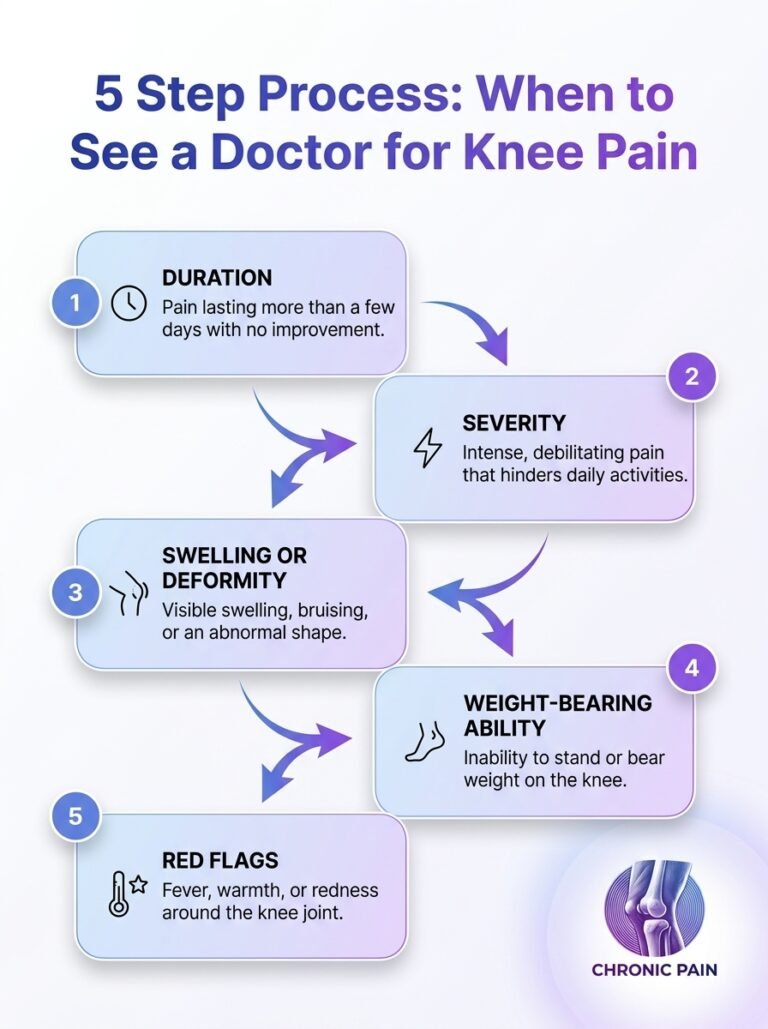
When to get medical help for knee pain after no impact
For Bruised knee no impact, we advise using both symptom severity and time as decision tools. If your knee pain is not improving, or you develop functional problems, a clinician can help rule out ligament or meniscus involvement.
In 2026, many people prefer a quick “is this serious?” check when symptoms are persistent, because waiting can sometimes prolong recovery.
Go for assessment sooner if you have any of these
- Inability to bear weight or worsening pain day by day
- Rapid swelling, especially after a specific movement
- Locking (the knee gets stuck) or repeated buckling
- Fever, redness spreading, or severe tenderness to touch
- New numbness or significant changes in sensation
A practical timeline for knee hurt
If your symptoms do not improve in the expected window, we recommend you seek help rather than “pushing through.” A physiotherapy plan can be especially useful when pain changes with activity.
For people who want a focused overview of “what knee pain can come from,” we also cover patterns in knee pain.
Could this be ACL, PCL, meniscus, or other knee structures?
Even with Bruised knee no impact, it is possible to irritate or injure deeper structures. The difference is often in what the knee does during movement, such as instability, catching, or a specific motion that triggers knee hurt.
We can help you map symptoms to possibilities, but we still recommend a proper evaluation if your pattern matches concerning signs.
Ligament strain and stability concerns
Ligaments help stabilize the joint, so pain with giving way may point toward ligament involvement. If your knee feels unstable, explore our practical information on ligament knee injury and how clinicians think about stability.
Some readers specifically suspect an ACL-type mechanism when they notice instability during pivots or directional changes. Our guide on anterior cruciate ligament (ACL) injury knee brace can help you understand how support may be considered when instability is a factor.
Others worry about PCL patterns when symptoms relate to changes in the knee behind the joint. See posterior cruciate ligament (PCL) knee injury for more context.
Meniscus irritation can appear without a big event
If your knee pain is linked to twisting, and you feel catching or difficulty fully straightening, meniscus involvement is worth considering. Our page on torn meniscus covers common symptom patterns that people often describe, including “it started after a twist” even when no major impact occurred.
Cartilage-related pain may mimic “bruise” tenderness
Cartilage problems can feel like deep soreness, and the front of the knee may be especially sensitive with stairs. If your symptoms are front-focused, our background on chondromalacia patella knees can help explain why
Additionally, for people who think “this is just traumatic bruising,” we discuss how different mechanisms can lead to knee pain in traumatic knee. This can be useful when the bruise-like feeling appears after a movement, not a direct collision.
How we protect recovery: activity modification for knee pain
With Bruised knee no impact, the goal is not to stop using your knee forever. The goal is to find an activity level that lets the tissue calm down while keeping you moving.
We often suggest a “pain-guided” approach. That means you reduce or change movements that cause sharper knee hurt, and you gradually bring activity back as symptoms settle.
Load ideas that are usually easier
- Short, flat walking sessions instead of long walks
- Gentle cycling with minimal resistance (only if it does not increase knee pain)
- Isometrics (holding a position) if they feel stabilizing rather than irritating
- Strength work that avoids painful knee angles
Load ideas to pause
- Deep knee bending, especially with added weight
- Twisting sports or drills while the bruise area is tender
- Jumping, sprinting, and hard cutting until you can do daily stairs comfortably
When a “brace” or support can help your knee hurt
Support is not a cure, but it can reduce discomfort and remind your knee to move safely while you recover. For Bruised knee no impact, the right choice depends on why you hurt in the first place.
If your symptoms suggest instability concerns, support may help you feel more confident during daily movement. That is one reason people look at guidance like ACL injury knee brace considerations or browse related ideas in ligament knee injury content.
If your pain is more cartilage-related, support and rehab may focus on technique and tolerance rather than “blocking motion.” For those patterns, our page on chondromalacia patella knees can be a helpful reference point.
Prevention tips in 2026 for knee pain after minor strains
Once your Bruised knee no impact episode improves, prevention is how we reduce the chance of repeat knee pain. In 2026, most prevention plans focus on three simple levers: load, movement quality, and recovery time.
Practical steps we recommend
- Build intensity gradually. Add distance, speed, or resistance slowly so your knee adapts.
- Train around the painful range. Choose exercises that do not aggravate the bruise-like tender spot.
- Protect twisting movements. If your knee hurt is sensitive, reduce pivoting until strength and mobility return.
- Use footwear that matches your activity. Stable shoes can reduce unwanted motion during walking.
Use symptom tracking to guide progress
We encourage you to note where the pain is (front, inside, outside, back) and what movements trigger it. Over time, that becomes a map for what to avoid and what to strengthen.
Conclusion: treating Bruised knee no impact with patience and smart caution
Bruised knee no impact can be confusing, because it feels like something should not be wrong when you did not hit the knee. But in real life, knee hurt and knee pain can appear from minor strains, twists, or load changes that happen without a dramatic “incident.”
In 2026, we recommend a steady early routine, careful activity modification, and a clear timeline for getting help if symptoms do not improve. If your pattern suggests deeper involvement, such as ligament or meniscus-related issues, our resources like torn meniscus, PCL injury, or traumatic knee can help you understand what clinicians often consider. With the right approach, your knee can recover safely and comfortably.
Frequently Asked Questions
Why do I have a bruised knee with no impact?
A Bruised knee no impact can happen when small soft-tissue structures are irritated from twisting, kneeling, or sudden load changes. The area may look bruised or feel very tender, even though you did not have a direct hit.
Can knee pain start out of nowhere even if I didn’t fall?
Yes. With Bruised knee no impact, knee pain can begin after routine movements that still create internal stress in the knee. If symptoms persist, we recommend an evaluation plan rather than waiting indefinitely.
How long does bruised knee pain last in 2026?
Many soft-tissue knee injuries take weeks to settle, and patience is part of the process. If your knee hurt is not improving after the expected window, physiotherapy or medical assessment may help guide recovery.
When should I see a doctor for Bruised knee no impact?
See a clinician sooner if you have swelling that worsens quickly, locking, repeated buckling, or trouble bearing weight. For ongoing knee pain, a check is reasonable when improvement is not happening in the usual time window.
Is a bruised knee without impact ever a torn meniscus?
It can be. A Bruised knee no impact episode sometimes matches meniscus irritation when pain is tied to twisting, catching, or limited motion, even if there was no obvious collision.
What exercises should I avoid with knee pain after no impact?
Avoid deep knee bending, high-impact activity, and twisting drills while your bruise spot is still tender and your knee pain is active. We suggest sticking to symptom-calming movement and only progressing when the knee tolerates load well.