Knee Pain Relief and Strengthening Exercises: A Comprehensive Guide
Knee pain is a widespread issue that affects people of all ages, from athletes to office workers. Whether caused by injury, overuse, or degenerative conditions, knee pain can significantly impact one’s quality of life. This comprehensive guide will explore the anatomy of the knee, common causes of knee pain, and effective exercises for relief and strengthening. By understanding the mechanics of the knee and implementing targeted exercises, you can take control of your knee health and improve your overall well-being.
I. Introduction
The knee joint is one of the most complex and heavily used joints in the human body. It bears our weight, allows us to move, and absorbs shock during activities like walking, running, and jumping. Given its crucial role in our daily lives, it’s no surprise that knee pain is a common complaint among people of all ages and activity levels.
Knee pain can arise from various sources, including acute injuries, chronic conditions, or simply the wear and tear of daily life. Regardless of the cause, proper care and targeted exercises are essential for maintaining knee health and function. This guide aims to provide a thorough understanding of knee anatomy, common causes of pain, and effective strategies for relief and strengthening.
By the end of this article, you’ll have a comprehensive toolkit of knowledge and exercises to help you address knee pain, improve knee strength, and enhance your overall lower body function. Whether you’re an athlete looking to prevent injuries, someone dealing with chronic knee issues, or simply interested in maintaining healthy knees as you age, this guide has something for everyone.
II. Understanding Knee Anatomy and Biomechanics
To effectively address knee pain and implement strengthening exercises, it’s crucial to have a basic understanding of knee anatomy and biomechanics. The knee is a complex hinge joint that connects the thigh to the lower leg and allows for various movements essential for walking, running, and other activities.
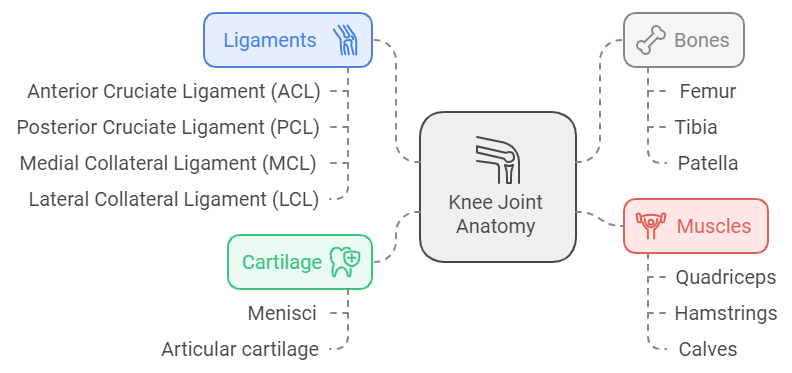
Key Components of the Knee Joint
- Bones:
- Femur (thighbone)
- Tibia (shinbone)
- Patella (kneecap)
- Ligaments:
- Anterior Cruciate Ligament (ACL): Prevents the tibia from sliding forward relative to the femur
- Posterior Cruciate Ligament (PCL): Prevents the tibia from sliding backward relative to the femur
- Medial Collateral Ligament (MCL): Provides stability to the inner knee
- Lateral Collateral Ligament (LCL): Provides stability to the outer knee
- Muscles:
- Quadriceps: Located on the front of the thigh, extends the knee
- Hamstrings: Located on the back of the thigh, flexes the knee
- Calves: Located on the back of the lower leg, assists in knee flexion
- Cartilage:
- Menisci: Two C-shaped pieces of cartilage that act as shock absorbers between the femur and tibia
- Articular cartilage: Smooth tissue that covers the ends of the bones, allowing for smooth movement
Biomechanics of the Knee
The knee joint primarily allows for flexion (bending) and extension (straightening) movements. However, it also permits a small degree of rotation when the knee is bent. The complex interplay of bones, ligaments, muscles, and cartilage allows for these movements while providing stability and shock absorption.
Proper alignment and posture are crucial for reducing stress on the knee joint. When standing, the knee should be in a neutral position, with the kneecap facing forward and aligned with the hip and ankle. During movement, maintaining proper alignment helps distribute forces evenly across the joint, reducing the risk of injury and wear and tear.
Understanding the anatomy and biomechanics of the knee is essential for recognizing potential sources of pain and implementing effective exercises for relief and strengthening. In the following sections, we’ll explore common causes of knee pain and how targeted exercises can address these issues.
III. Common Causes of Knee Pain
Knee pain can result from a variety of factors, ranging from acute injuries to chronic conditions. Understanding the common causes of knee pain can help in identifying the source of discomfort and determining the most appropriate treatment approach. Here are some of the most frequent causes of knee pain:
Acute Injuries
- Ligament Sprains: Overstretching or tearing of the knee ligaments, often occurring during sports or sudden movements. The ACL and MCL are commonly affected.
- Meniscus Tears: Damage to the cartilage that cushions the knee joint, often caused by twisting motions or direct impact.
- Fractures: Broken bones in the knee area, typically resulting from high-impact trauma or falls.
Overuse Conditions
- Patellofemoral Pain Syndrome: Also known as “runner’s knee,” this condition is characterized by pain around or behind the kneecap, often caused by repetitive stress on the joint.
- Patellar Tendinitis: Inflammation of the tendon connecting the kneecap to the shinbone, common in athletes who perform jumping activities.
- Iliotibial Band Syndrome: Irritation of the iliotibial band, a thick band of tissue that runs from the hip to the knee, often affecting runners and cyclists.
Degenerative Conditions
- Osteoarthritis: The most common form of arthritis, characterized by the breakdown of cartilage in the knee joint, typically affecting older adults.
- Rheumatoid Arthritis: An autoimmune disorder that causes inflammation in the joints, including the knees.
Other Factors
- Muscle Imbalances: Weakness or tightness in certain muscle groups can lead to improper knee alignment and increased stress on the joint.
- Poor Alignment: Structural issues such as flat feet or high arches can affect knee alignment and contribute to pain.
- Obesity: Excess body weight puts additional stress on the knee joints, increasing the risk of pain and degenerative conditions.
- Lack of Flexibility: Tight muscles around the knee can contribute to improper joint mechanics and pain.
Understanding the underlying cause of knee pain is crucial for developing an effective treatment plan. In many cases, a combination of stretching, strengthening exercises, and proper alignment can help alleviate pain and improve knee function. In the following sections, we’ll explore specific exercises and techniques to address these common causes of knee pain.
IV. The Importance of Stretching for Knee Health
Stretching plays a vital role in maintaining knee health and preventing pain. Regular stretching can help improve flexibility, reduce muscle tension, and enhance overall mobility of the knee joint. Here’s why stretching is crucial for knee health and how to incorporate it into your routine:
Benefits of Stretching for Knee Health
- Improved Flexibility: Stretching helps increase the range of motion in the knee joint and surrounding muscles, allowing for smoother and more efficient movement.
- Reduced Muscle Tension: Tight muscles around the knee can pull the joint out of alignment and contribute to pain. Regular stretching helps alleviate this tension.
- Enhanced Blood Flow: Stretching increases blood circulation to the muscles and tissues around the knee, promoting healing and reducing stiffness.
- Better Posture and Alignment: Flexible muscles contribute to better overall posture and knee alignment, reducing stress on the joint.
- Injury Prevention: By improving flexibility and reducing muscle imbalances, stretching can help prevent knee injuries during physical activities.
Key Muscle Groups to Focus On
When stretching for knee health, it’s important to target the following muscle groups:
- Hamstrings: Located on the back of the thigh, these muscles play a crucial role in knee flexion.
- Quadriceps: Found on the front of the thigh, these muscles are responsible for knee extension.
- Calves: The muscles in the lower leg assist in knee flexion and ankle movement.
- Hip Flexors: While not directly connected to the knee, tight hip flexors can affect knee alignment and function.
- IT Band: This thick band of tissue runs from the hip to the knee and can contribute to knee pain when tight.
Effective Stretching Techniques
- Static Stretching: Hold a stretch for 15-30 seconds without bouncing. This is best done after a workout or when muscles are warm.
- Dynamic Stretching: Involves moving parts of your body and gradually increasing reach, speed of movement, or both. This is ideal as a warm-up before exercise.
- PNF (Proprioceptive Neuromuscular Facilitation): A more advanced technique that involves alternating contraction and relaxation of muscle groups.
Sample Stretching Routine for Knee Health
- Hamstring Stretch:
- Sit on the floor with one leg extended and the other bent.
- Reach for your toes on the extended leg, feeling the stretch in the back of your thigh.
- Hold for 30 seconds, then switch legs.
- Quadriceps Stretch:
- Stand on one leg, holding onto a wall or chair for balance.
- Bend your other knee, bringing your heel towards your buttocks.
- Grasp your ankle with your hand and gently pull, feeling the stretch in the front of your thigh.
- Hold for 30 seconds, then switch legs.
- Calf Stretch:
- Stand facing a wall, placing your hands on the wall at shoulder height.
- Step one foot back, keeping it straight, while bending the front knee slightly.
- Lean forward, keeping your back heel on the ground, until you feel a stretch in your calf.
- Hold for 30 seconds, then switch legs.
- Hip Flexor Stretch:
- Kneel on one knee with the other foot in front of you, knee bent at a 90-degree angle.
- Keeping your back straight, gently push your hips forward until you feel a stretch in the front of your hip.
- Hold for 30 seconds, then switch legs.
- IT Band Stretch:
- Stand upright and cross your right leg behind your left.
- Lean to your left side, pushing your hip out to the right.
- Reach your right arm overhead, feeling the stretch along the outside of your right leg.
- Hold for 30 seconds, then switch sides.
- Remember to perform these stretches gently and never stretch to the point of pain. It’s best to incorporate stretching into your daily routine, ideally after a light warm-up or following your main workout. Consistency is key in reaping the benefits of stretching for knee health.
V. Strengthening Exercises for Knee Stability
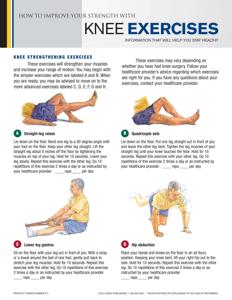
Strengthening the muscles that support the knee is crucial for maintaining joint stability, reducing pain, and preventing injuries. A well-rounded knee strengthening program should focus on the quadriceps, hamstrings, calves, and hip muscles. Here are some effective exercises to improve knee stability and function:
Isometric Exercises
Isometric exercises involve contracting muscles without moving the joint. These are excellent for building strength and can be particularly useful in the early stages of rehabilitation or for those with significant knee pain.
- Quad Sets:
- Sit or lie with your leg straight.
- Tighten your thigh muscle, pressing the back of your knee into the floor.
- Hold for 5-10 seconds, then relax.
- Repeat 10-15 times.
- Hamstring Sets:
- Lie on your stomach with your knee bent slightly.
- Gently press your heel into the floor, engaging your hamstring.
- Hold for 5-10 seconds, then relax.
- Repeat 10-15 times.
Dynamic Exercises
Dynamic exercises involve movement and can help improve strength through a range of motion.
- Short Arc Quads:
- Lie on your back with a rolled towel under your knee.
- Straighten your knee, lifting your foot off the surface.
- Hold for 5 seconds, then slowly lower.
- Repeat 10-15 times.
- Straight Leg Raises:
- Lie on your back with one leg straight and the other bent.
- Tighten your thigh muscle and lift the straight leg about 6 inches off the ground.
- Hold for 5 seconds, then slowly lower.
- Repeat 10-15 times, then switch legs.
- Bridges:
- Lie on your back with your knees bent and feet flat on the floor.
- Lift your hips off the ground, squeezing your glutes.
- Hold for 5 seconds, then slowly lower.
- Repeat 10-15 times.
- Wall Squats:
- Stand with your back against a wall, feet shoulder-width apart.
- Slowly slide down the wall until your thighs are parallel to the ground.
- Hold for 30-60 seconds, then slowly return to standing.
- Repeat 3-5 times.
Hip and Ankle Exercises
Strengthening the hip and ankle muscles can improve overall leg alignment and reduce stress on the knee joint.
- Clamshells:
- Lie on your side with your knees bent at a 45-degree angle.
- Keep your feet together and lift your top knee, keeping your pelvis stable.
- Hold for 2 seconds, then lower.
- Repeat 15-20 times, then switch sides.
- Lateral Band Walks:
- Place a resistance band around your thighs, just above your knees.
- Stand with your feet shoulder-width apart, knees slightly bent.
- Take small steps to the side, maintaining tension in the band.
- Do 10-15 steps in each direction.
- Calf Raises:
- Stand with your feet hip-width apart, holding onto a chair for balance if needed.
- Rise up onto your toes, then slowly lower back down.
- Repeat 15-20 times.
Progression and Variation
As you build strength, you can progress these exercises by:
- Increasing the number of repetitions or sets
- Adding resistance (e.g., using ankle weights or resistance bands)
- Performing single-leg variations of exercises
- Incorporating more complex movements, such as lunges or step-ups
Remember to start slowly and gradually increase the intensity and complexity of your exercises. It’s essential to maintain proper form throughout each exercise to maximize benefits and prevent injury. If you experience pain during any exercise, stop immediately and consult a healthcare professional.
VI. Comprehensive Approach to Knee Pain Management
Managing knee pain effectively requires a holistic approach that combines various strategies. While strengthening and stretching exercises form the foundation of knee health, other factors play crucial roles in overall knee pain management. Here’s a comprehensive approach to addressing knee pain:
1. Balanced Exercise Routine
Combine stretching and strengthening exercises for a well-rounded routine. This helps improve flexibility, build strength, and enhance overall knee function. Remember to:
- Start with a proper warm-up to increase blood flow to the muscles.
- Perform stretching exercises to improve flexibility.
- Include strengthening exercises for the quadriceps, hamstrings, and surrounding muscles.
- Cool down with gentle stretches to prevent muscle soreness.
2. Proper Form and Technique
Emphasize correct form during all exercises to prevent injury and ensure maximum benefit. Key points to remember:
- Maintain proper alignment of your hips, knees, and ankles during exercises.
- Avoid letting your knees collapse inward during squats or lunges.
- Control your movements, especially during the lowering phase of exercises.
- If unsure about proper form, consider working with a physical therapist or certified fitness professional.
3. Gradual Progression
Slowly increase the intensity and complexity of your exercises to build endurance safely:
- Start with basic exercises and master proper form before progressing.
- Gradually increase the number of repetitions, sets, or resistance.
- Introduce more challenging variations of exercises as you build strength.
- Listen to your body and avoid pushing through pain.
4. Low-Impact Cardiovascular Exercise
Incorporate low-impact cardio to improve overall fitness without stressing the knees:
- Swimming or water aerobics
- Cycling (stationary or outdoor)
- Elliptical machines
- Rowing machines
5. Weight Management
Maintaining a healthy weight reduces stress on the knee joints:
- Follow a balanced, nutritious diet.
- Engage in regular physical activity.
- Consult with a nutritionist if you need help with weight management.
6. Proper Footwear
Wear appropriate shoes that provide adequate support and cushioning:
- Choose shoes that fit well and provide good arch support.
- Replace athletic shoes regularly, especially if you’re active.
- Consider orthotic inserts if you have flat feet or high arches.
7. Rest and Recovery
Allow time for your body to recover and repair:
- Get adequate sleep each night.
- Take rest days between intense workouts.
- Apply ice to sore knees after exercise to reduce inflammation.
8. Mind-Body Techniques
Incorporate stress-reduction techniques to manage pain perception:
- Practice mindfulness meditation.
- Try gentle yoga or tai chi for improved body awareness and balance.
- Use deep breathing exercises to relax tense muscles.
9. Lifestyle Modifications
Make adjustments to your daily activities to reduce stress on your knees:
- Use proper lifting techniques, bending at the knees and hips.
- Avoid prolonged periods of sitting or standing. Take regular breaks to move and stretch.
- Use assistive devices like a cane or knee brace if recommended by your healthcare provider.
- 10. Professional Guidance
- Seek advice from healthcare professionals when needed:
- Consult a physical therapist for a personalized exercise program.
- See an orthopedic specialist if you have persistent or severe knee pain.
- Work with a sports medicine doctor if you’re an athlete with knee issues.
- By incorporating these strategies into your knee health regimen, you can create a comprehensive approach to managing knee pain and improving overall knee function.
- VII. Bed-Based Exercises for Knee Pain Relief
- For those days when getting out of bed is challenging due to knee pain, or for individuals with limited mobility, bed-based exercises can be an excellent option. These exercises offer comfort and accessibility while still providing benefits for knee health. Here are some effective bed-based exercises for knee pain relief:
- Hamstring Stretches:
- Lie on your back and lift one leg straight up.
- Loop a towel or strap around your foot.
- Gently pull the leg towards you until you feel a stretch in the back of your thigh.
- Hold for 30 seconds, then switch legs.
- Quad Sets:
- Lie on your back with your legs straight.
- Tighten the muscles on the front of your thigh, pressing the back of your knee into the bed.
- Hold for 5 seconds, then relax.
- Repeat 10-15 times on each leg.
- Heel Slides:
- Lie on your back with your legs straight.
- Slowly bend one knee, sliding your heel towards your buttocks.
- Hold for 5 seconds, then slowly straighten your leg.
- Repeat 10-15 times on each leg.
- Straight Leg Raises:
- Lie on your back with one leg bent and foot flat on the bed.
- Keep the other leg straight and lift it about 6 inches off the bed.
- Hold for 5 seconds, then lower slowly.
- Repeat 10-15 times, then switch legs.
- Inner Thigh Squeezes:
- Lie on your back with your knees bent and feet flat on the bed.
- Place a pillow between your knees.
- Squeeze the pillow with your knees, holding for 5 seconds.
- Relax and repeat 10-15 times.
- Remember to perform these exercises gently and stop if you experience any pain. While bed-based exercises are convenient, they should complement, not replace, a more comprehensive exercise routine when possible.
- VIII. The Role of Hip and Ankle Stability in Knee Health
- The knee doesn’t function in isolation; it’s part of a kinetic chain that includes the hip and ankle. The stability and strength of these neighboring joints significantly impact knee health. Understanding this interconnectedness can help in developing a more effective approach to knee pain management and prevention.
- Hip Stability and Knee Health
- Strong and stable hips provide a solid foundation for knee function. Here’s how hip stability affects the knee:
- Alignment: Strong hip muscles, particularly the gluteus medius, help maintain proper knee alignment during movement.
- Force Distribution: Stable hips ensure even distribution of forces across the knee joint.
- Shock Absorption: The hips play a crucial role in absorbing shock during activities like running, reducing stress on the knees.
- Exercises for hip stability:
- Clamshells
- Hip Bridges
- Side-Lying Leg Lifts
- Monster Walks with Resistance Band
- Ankle Stability and Knee Health
- Ankle stability is equally important for knee health:
- Balance: Stable ankles contribute to overall lower body balance, reducing awkward movements that could stress the knee.
- Force Transmission: The ankle helps transmit forces from the ground up through the leg, affecting how these forces impact the knee.
- Range of Motion: Adequate ankle mobility allows for proper movement patterns, preventing compensation that could stress the knee.
- Exercises for ankle stability:
- Calf Raises
- Ankle Circles
- Single-Leg Balance
- Heel-to-Toe Walks
- By incorporating exercises that target hip and ankle stability into your routine, you can create a more comprehensive approach to knee health.
- IX. Addressing Different Types of Knee Pain
- Different types of knee pain may require specific approaches. Here are some common knee conditions and exercises that can help:
- Patellofemoral Pain Syndrome (Runner’s Knee)
- Focus on strengthening the quadriceps and hip muscles.
- Include exercises like straight leg raises, wall sits, and clamshells.
- Stretch the IT band and quadriceps regularly.
- Osteoarthritis
- Low-impact exercises are key.
- Try water-based exercises, stationary cycling, and gentle yoga.
- Focus on range of motion exercises and gentle strengthening.
- Meniscus Tears
- Consult with a healthcare provider before starting exercises.
- Begin with isometric exercises like quad sets.
- Progress to range of motion exercises as tolerated.
- Ligament Injuries (e.g., ACL, MCL)
- Follow a rehabilitation program prescribed by a physical therapist.
- Focus on regaining range of motion and gradually building strength.
- Include proprioception exercises to improve joint awareness.
- Remember, it’s crucial to get a proper diagnosis and treatment plan from a healthcare professional before starting any exercise program for specific knee conditions.
- X. Integrating Knee Exercises into Daily Life
- Making knee exercises a part of your daily routine can significantly improve knee health over time. Here are some tips for integrating knee exercises into your daily life:
- Morning Routine: Start your day with gentle stretches and mobility exercises.
- Desk Breaks: If you have a desk job, set reminders to do simple exercises like ankle pumps or seated leg lifts.
- Commercial Break Workouts: Use TV commercial breaks as an opportunity to do quick exercises like wall sits or calf raises.
- Everyday Objects as Props: Use household items like chairs for support during exercises or water bottles as light weights.
- Walking Meetings: Suggest walking meetings at work to increase daily movement.
- Evening Wind-Down: End your day with gentle stretching exercises to relieve tension.
- Remember, consistency is key. Even small amounts of exercise done regularly can lead to significant improvements in knee health over time.
- XI. When to Seek Professional Help
- While exercise and self-care strategies can be very effective for managing knee pain, there are times when professional help is necessary. Seek medical attention if:
- Pain is severe or persists for more than a few weeks.
- You experience significant swelling or redness around the knee.
- You can’t bear weight on the affected leg.
- You have a fever along with knee pain and swelling.
- You experience locking or catching sensations in the knee.
- There’s a visible deformity in the knee or leg.
- A healthcare professional, such as a physical therapist or orthopedic specialist, can provide a proper diagnosis and develop a tailored treatment plan. They may use various techniques, including:
- Manual therapy
- Specialized exercises
- Ultrasound or electrical stimulation
- Recommendations for braces or orthotics
- In some cases, consideration of surgical options
- Remember, early intervention can often prevent minor issues from becoming major problems.
- XII. Conclusion
- Maintaining healthy knees is crucial for overall mobility and quality of life. By understanding knee anatomy, recognizing common causes of pain, and implementing targeted exercises and strategies, you can take significant steps towards improving knee health and function.
- Key takeaways from this guide include:
- The importance of both stretching and strengthening exercises for knee health.
- The interconnectedness of the hip, knee, and ankle in lower body function.
- The value of a comprehensive approach that includes proper form, gradual progression, and lifestyle modifications.
- The benefits of integrating knee exercises into daily life for consistent improvement.
- The importance of recognizing when to seek professional help.
- Remember, everyone’s journey to better knee health is unique. What works best for you may depend on factors like your age, overall health, and specific knee conditions. Be patient with your progress, listen to your body, and don’t hesitate to seek guidance from healthcare professionals when needed.
- By prioritizing knee health and incorporating the strategies discussed in this guide, you can work towards stronger, more stable knees that allow you to enjoy your daily activities with greater comfort and confidence. Here’s to healthier knees and a more active lifestyle!