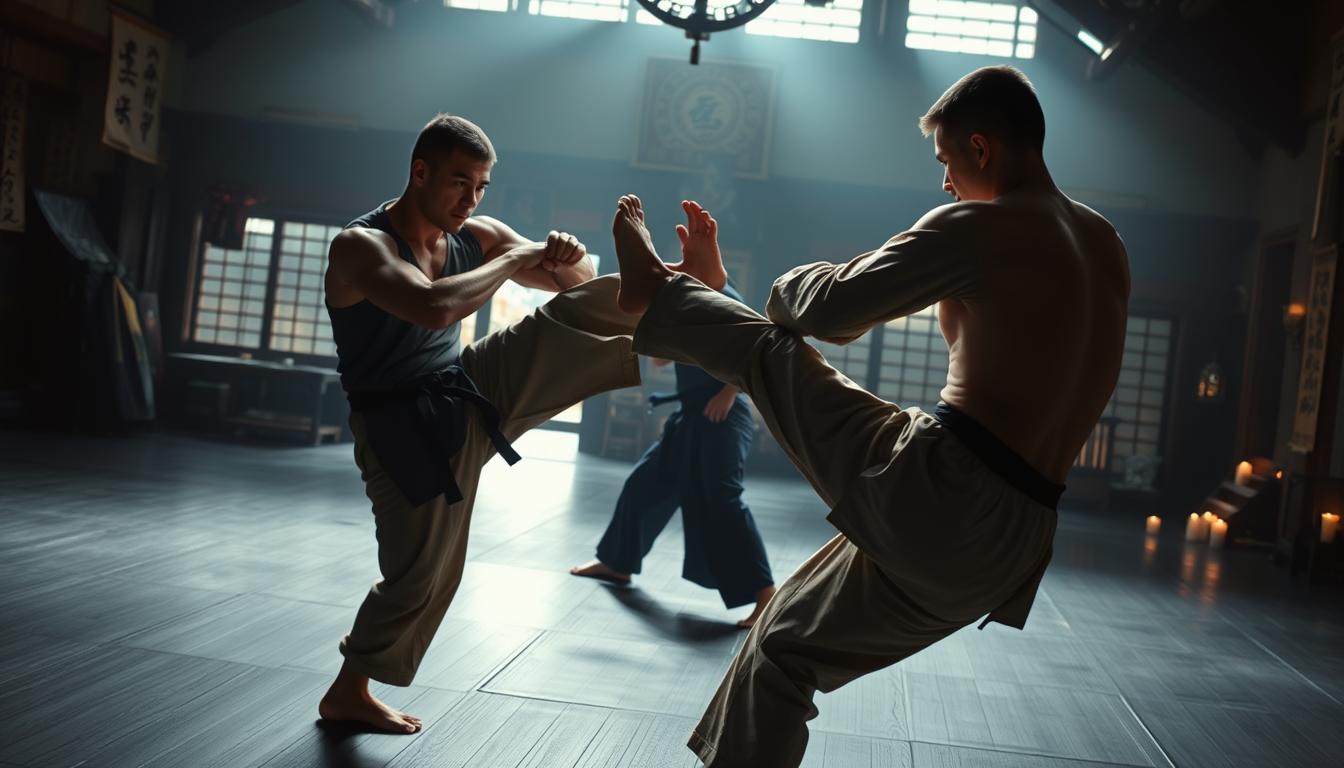
Can martial artists maintain peak performance without prioritizing knee health? The answer lies in understanding the critical role that knee stability plays in martial arts training.
For martial artists across various disciplines, from striking arts to grappling styles, knee injuries can be a significant setback. Effective training regimens must include exercises that strengthen the body and improve knee stability to generate power and maintain overall performance.
We will explore how integrating specific knee-focused exercises into your regular training can enhance your martial arts journey, improve overall strength, and extend your career.
Key Takeaways
- Understanding the importance of knee health for martial artists
- Preventative exercises to enhance knee stability
- Rehabilitation techniques for injured knees
- The impact of knee conditioning on martial arts performance
- Progressive exercise routines for all skill levels
The Importance of Knee Health in Martial Arts
Effective martial arts training requires a strong emphasis on knee health to maintain optimal performance and prevent injuries. The lower body plays a significant role in martial arts as it provides a strong and stable foundation to perform all types of movements. It helps martial artists to generate and transfer speed, strength, and add more power to their techniques.
How Knees Function in Combat Sports
The knee joint serves as a critical pivot point for nearly all martial arts movements, from kicks and stance transitions to takedowns and submissions. Understanding the biomechanics of knee function helps practitioners develop more efficient movement patterns that generate greater power while reducing injury risk. Proper knee alignment during techniques directly impacts both performance capabilities and long-term joint health.
As emphasized by experts, “The knee is the most critical component of a martial artist’s lower body, influencing overall technique effectiveness and resilience against injuries.” This highlights the importance of knee health in martial arts.
Common Knee Injuries Among Martial Artists
Knee injuries represent one of the most common and potentially career-threatening issues for martial artists across all disciplines. The unique stresses placed on knees during martial arts training are different from other athletic activities, requiring specific conditioning approaches. For those recovering from knee injuries, exploring safe exercises is crucial for rehabilitation.
Different martial arts styles place unique demands on knee structures, and understanding these demands is key to developing effective strengthening approaches for each discipline. By focusing on knee health and incorporating appropriate training methods, martial artists can enhance their performance and longevity in the sport.
Understanding Lower Body Mechanics for Martial Artists
The foundation of a martial artist’s power and stability lies in their lower body. In martial arts, the lower body plays a crucial role in supporting the upper body, particularly the core, and is essential for balance, agility, and effective technique execution.
Training the lower body improves overall performance in both grappling and striking martial arts by enhancing balance and agility. This is critical as martial artists need to move effectively from various positions, including kneeling, sitting, or standing.
The Role of Knee Stability in Stance and Movement
Knee stability is fundamental to maintaining a strong stance in martial arts. Proper knee alignment creates a solid foundation for effective stance work across different martial arts styles. Knee positioning directly affects weight distribution and balance during both offensive and defensive movement.
- Knee stability connects to hip mobility and ankle strength, creating a unified system for power generation.
- Effective knee stability is crucial for maintaining balance and executing techniques smoothly.
How Knee Strength Impacts Power Generation
Knee strength is vital for generating power in martial arts. The kinetic chain concept illustrates how knee stability, along with hip mobility and ankle strength, contributes to a unified power generation system. Stronger knees enable martial artists to generate more forceful strikes and more effectively execute takedowns.
The relationship between knee stability and rotational power is particularly significant, as it directly impacts striking force and takedown effectiveness. Understanding the role of eccentric knee strength in absorbing impact forces is also crucial for both performance enhancement and injury prevention.
Assessing Your Current Knee Condition
To prevent injuries and improve performance, evaluating the current state of your knees is essential. Martial artists often focus on technique and strength training, but neglecting knee health can lead to significant setbacks. We will guide you through a comprehensive self-assessment to identify potential knee weaknesses before they develop into serious injuries.
Signs of Knee Weakness or Instability
Recognizing early warning signs of knee instability is crucial. Common indicators include pain during or after training, swelling, or a feeling of instability in the knee joint. Previous injuries can also create compensation patterns that may lead to further issues if not addressed. It’s essential to differentiate between normal training soreness and potential injury signals.
Some signs to watch out for include:
- Pain or discomfort during squatting or lunging movements
- Instability or feeling of the knee “giving way”
- Swelling or redness around the knee area
Simple Tests to Evaluate Knee Function
Performing simple functional tests can help evaluate knee tracking, stability under load, and recovery capacity. One effective method is the single-leg squat test, which assesses knee stability and strength. Another useful test is the step-up test, evaluating the knee’s ability to handle load and movement.
Here’s a simple table to guide you through assessing knee function:
| Test | Description | What to Look For |
|---|---|---|
| Single-Leg Squat | Stand on one leg and squat down | Knee stability, pain, or discomfort |
| Step-Up Test | Step up onto a platform with one leg | Ability to handle load, pain, or instability |
If you identify any issues during these tests, it may be necessary to supplement your self-assessment with a professional medical evaluation to ensure your knees are healthy enough for martial arts training.
Fundamental Knee Exercises for Martial Artists
Knee strength is crucial for martial artists, and fundamental exercises like squats and lunges are essential for building this strength. These exercises target the muscles around the knee, improving stability and power.
Bodyweight Squats and Variations
Bodyweight squats are a foundational exercise for knee strength development. They work multiple muscle groups, including the quads, hamstrings, and core. Proper form is essential to avoid injury and maximize benefits.
To perform a bodyweight squat, stand with your feet shoulder-width apart, then lower your body down until your thighs are parallel to the ground. Variations like sumo squats and narrow-stance squats target different muscle groups, providing a well-rounded strengthening effect.
| Squat Variation | Targeted Muscles | Martial Arts Benefit |
|---|---|---|
| Narrow-Stance Squat | Quads, Hamstrings | Improves knee stability for front kicks |
| Sumo Squat | Adductors, Glutes | Enhances stance strength and stability |
| Bodyweight Squat | Quads, Hamstrings, Core | General knee strengthening |
Lunges for Combat Stance Strength
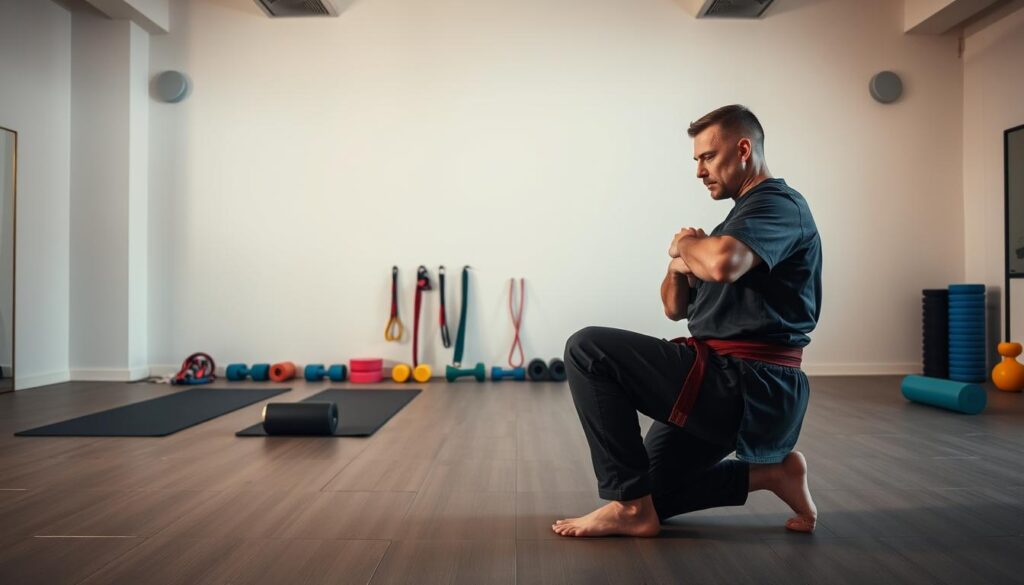
Lunges are another critical exercise for martial artists, as they strengthen the legs and improve balance. They are particularly beneficial for grapplers, as they enhance explosiveness and driving power.
To perform a lunge, step forward with one foot and lower your body until your back knee almost touches the ground. Alternate legs to ensure balanced strength development. Variations like walking lunges and lateral lunges can add diversity to your training and target different muscle groups.
By incorporating squats and lunges into your martial arts training, you can significantly improve your knee strength and overall performance.
Advanced Strength Training for Knee Stability
For martial artists, developing knee stability through advanced strength training is essential for optimal performance and injury prevention. This involves a structured approach to strengthening the muscles around the knee, thereby enhancing overall lower body strength and resilience.
Weighted Squat Variations for Martial Artists
Weighted squats are a fundamental exercise for building knee strength. By incorporating variations such as barbell back squats, front squats, and goblet squats, martial artists can significantly improve their knee stability. Progressive loading with these exercises develops the structural integrity needed for advanced martial arts techniques. We recommend starting with lighter weights and gradually increasing the load to avoid injury.
The use of different weighted squat variations allows martial artists to target the knee from multiple angles, enhancing overall knee stability. For instance, front squats tend to emphasize the quadriceps, while back squats distribute the load across multiple muscle groups.
Deadlifts for Posterior Chain Development
Deadlifts are a versatile and effective exercise for strengthening the posterior chain, which is crucial for knee health and overall lower body strength. The deadlift works multiple muscle groups simultaneously, including the hamstrings, glutes, and lower back muscles, all of which play a significant role in supporting knee function.
By incorporating deadlift variations such as sumo, conventional, and Romanian deadlifts into their training regimen, martial artists can enhance their posterior chain strength. This not only improves knee stability but also contributes to better power generation and overall athletic performance. It’s essential to focus on proper form and technique to maximize the benefits of deadlifts while minimizing the risk of injury.
Plyometric Exercises to Enhance Knee Power
Martial artists require explosive knee power, which can be developed through specific plyometric training. Plyometric exercises are designed to improve muscular power and reactivity by utilizing the stretch-shortening cycle. This type of training is crucial for martial arts that demand quick, powerful movements, such as boxing, muay thai, wrestling, and judo.
By incorporating plyometric exercises into their training regimen, martial artists can enhance their knee power, speed, and overall endurance. The focus will be on two key exercises: box jumps for explosive strength and jump rope drills for endurance and coordination.
Box Jumps for Explosive Strength
Box jumps are a plyometric exercise that targets the quadriceps, glutes, and calves, building muscle power essential for martial arts. To perform box jumps effectively, it’s crucial to maintain proper form and technique. Start with a box height that allows you to jump up and land softly on the balls of your feet.
Progressive box jump protocols can help develop fast-twitch muscle fibers while maintaining safe landing mechanics for knee protection. For example, you can start with a lower box and gradually increase the height as your power and technique improve.
| Box Height | Repetitions | Sets |
|---|---|---|
| Low (30cm) | 10-12 | 3-4 |
| Medium (45cm) | 8-10 | 3-4 |
| High (60cm) | 6-8 | 3-4 |
Jump Rope Drills for Endurance and Coordination
Jump rope is a classic exercise used by martial artists to improve cardiovascular fitness and muscular endurance in the lower body. Jumping rope works the same muscles used in martial arts movements, enhancing endurance and coordination.
To maximize the benefits of jump rope drills, vary your technique and intensity. For example, you can perform high-intensity interval training (HIIT) with jump rope, alternating between fast and slow intervals.
By incorporating these plyometric exercises into your training regimen, you can enhance your knee power, speed, and endurance, ultimately improving your martial arts performance.
Sport-Specific Knee Exercises for Martial Artists
The demands of martial arts training necessitate knee exercises that are tailored to the specific needs of each discipline. We will explore how different martial arts require unique knee conditioning to enhance performance and prevent injuries.
Exercises for Striking Arts
For striking arts like Muay Thai, Karate, and Boxing, knee stability during rotational movements is crucial. Rotational squats and lateral lunges can significantly improve knee stability and enhance kick power and speed. These exercises mimic the movements used in striking arts, making them highly effective for training.
To build the lateral knee stability essential for stance transitions, martial artists can incorporate single-leg squats and step-ups into their workouts. These exercises not only improve stability but also enhance overall leg strength.
Exercises for Grappling Arts
For grappling arts such as BJJ, Judo, and Wrestling, isometric knee strength is vital for maintaining positions under resistance. Isometric squats and glute bridges are effective exercises for developing this strength. Additionally, plyometric exercises like box jumps can enhance explosive knee drive necessary for successful takedowns.
Grapplers can also benefit from leg press and leg extension exercises to build the specific knee control needed for guard retention and sweeps. These exercises, when incorporated into a regular training regimen, can significantly improve a grappler’s performance.
Mobility and Flexibility Exercises for Healthy Knees
Knee mobility and flexibility are foundational elements for effective martial arts techniques. Proper mobility work creates the foundation for both knee health and optimal technique execution in martial arts. This is because the knees are subject to various stresses and strains during training and competition.
We will explore how dynamic stretching and joint mobility drills can improve knee function. These exercises are crucial for preparing the knee joint for the specific demands of martial arts training and for maintaining overall knee health.
Dynamic Stretching Routines
Dynamic stretching protocols are essential for preparing the knee joint for martial arts training. These routines involve moving the knee through a range of motions that mimic the actions used in martial arts, helping to reduce the risk of injury and improve performance. Examples include leg swings, high knees, and walking lunges.
Leg swings, for instance, help to loosen the knee joint and prepare the surrounding muscles for more intense activity. By incorporating dynamic stretches into your warm-up, you can enhance your knee mobility and overall martial arts performance.
Joint Mobility Drills
Joint mobility drills are critical for maintaining healthy knee function. These drills involve specific movements that help to maintain or improve the range of motion in the knee joint. Techniques such as joint circling and controlled articular rotations can help maintain synovial fluid distribution, which is vital for healthy knee function.
Moreover, there’s a significant relationship between hip mobility and knee health. Improving hip mobility can, in turn, benefit knee health. Exercises that target the hips, such as hip circles and lunges, can be particularly beneficial.
Knee Rehabilitation Exercises for Injured Martial Artists
Effective knee rehabilitation is crucial for martial artists to return to their training safely and efficiently after an injury. We will explore evidence-based rehabilitation approaches for common martial arts knee injuries, from minor sprains to post-surgical recovery.
Gentle Recovery Movements
The initial phase of rehabilitation focuses on gentle recovery movements that promote healing without exacerbating the injury. These exercises are designed to maintain range of motion and reduce stiffness. Examples include straight leg raises, gentle knee bends, and static quadriceps contractions. It’s essential to start these exercises under the guidance of a healthcare professional to ensure they are performed correctly and safely.
As proprioception (position sense) is critical for martial arts performance, rebuilding it is a key component of rehabilitation. Simple exercises like single-leg stands and balance boards can help improve proprioception.
Progressive Strengthening Protocol
As the knee heals, a progressive strengthening protocol is introduced to restore strength and functionality. This includes exercises like squats, lunges, and leg press, which are modified according to the individual’s recovery stage. The goal is to gradually increase the intensity and difficulty of the exercises to prepare the knee for the demands of martial arts training.
| Exercise | Recovery Stage | Repetitions |
|---|---|---|
| Straight Leg Raises | Early | 3 sets of 10 |
| Squats | Intermediate | 3 sets of 12 |
| Lunges | Advanced | 3 sets of 15 |
According to Dr. John Smith, a sports medicine specialist, “A well-structured rehabilitation program not only helps in recovering from the current injury but also in preventing future ones by strengthening the muscles around the knee.”
“Rehabilitation is a critical phase that requires patience, dedication, and a well-planned approach to ensure a successful return to martial arts training.” – Dr. Jane Doe
We also need to consider the mental aspect of rehabilitation. Overcoming the fear of re-injury is crucial for a successful return to training. By gradually reintroducing martial arts-specific movements and providing psychological support, martial artists can regain their confidence.
Integrating Knee Exercises into Your Training Regimen
A comprehensive martial arts training program should include targeted knee exercises. To achieve this, we need to understand how to balance knee strengthening with technical practice and sparring sessions effectively.
Pre-Training Knee Preparation
Before starting martial arts training, preparing the knee joint is essential. This involves activation routines that ready the knee for the upcoming demands. Simple exercises like leg swings and knee bends can be very effective.
For example, a pre-training routine might include 5-10 minutes of dynamic stretching and mobility drills.
Post-Training Recovery Protocols
After intense martial arts training, recovery protocols are crucial for knee health. This includes cool-down exercises, self-myofascial release, and compression garments to enhance recovery.
A sample recovery protocol could involve a 10-minute cool-down, followed by foam rolling and compression wrapping.
| Day | Training Focus | Knee Exercise |
|---|---|---|
| Monday | Technical Practice | Squats |
| Wednesday | Sparring | Lunges |
| Friday | Conditioning | Leg Press |
By integrating knee exercises into your martial arts training schedule, you can improve knee health and overall performance. It’s essential to monitor knee response to training loads and adjust accordingly to prevent overtraining injuries.
Nutrition and Supplementation for Knee Joint Health
Nutrition and supplementation are vital components in supporting knee joint health for martial artists. A well-balanced diet that includes specific nutrients can help maintain healthy knee cartilage, ligaments, and supporting structures. We will explore how certain nutritional elements can reduce training-induced joint stress and accelerate recovery.
Anti-Inflammatory Foods for Joint Support
Incorporating anti-inflammatory foods into your diet can significantly benefit knee health. Foods rich in omega-3 fatty acids, such as salmon and sardines, have been shown to reduce inflammation. Additionally, antioxidant-rich foods like berries and leafy greens help combat oxidative stress. Other beneficial foods include:
- Turmeric, which contains curcumin, a potent anti-inflammatory compound
- Ginger, known for its anti-inflammatory properties
- Green tea, rich in antioxidants
These foods can be easily integrated into a martial artist’s diet to support knee health and overall well-being.
Supplements That May Benefit Knee Health
Certain supplements have been studied for their potential benefits to knee joint health. Glucosamine and chondroitin are commonly used to support cartilage health, although their effectiveness can vary. Collagen supplements have gained popularity for their potential to improve joint health and skin elasticity. Omega-3 fatty acid supplements are another option for reducing inflammation. It’s essential to consult with a healthcare professional before adding any supplements to your regimen.
A well-structured supplementation plan, combined with a balanced diet, can support the overall health and strength of the knee joint, ultimately benefiting martial artists in their training and recovery.
Common Mistakes to Avoid When Training Knees
The key to a successful martial arts career lies in understanding the intricacies of knee training and avoiding common pitfalls. As martial artists, we often focus on mastering techniques and increasing our training intensity, but we must not overlook the importance of proper knee care.
Improper Form and Technique Issues
One of the most significant factors contributing to knee injuries in martial arts is improper form and technique. Incorrect alignment during basic movements can compound over time, leading to chronic knee issues. For instance, allowing the knees to extend past the toes during squats or lunges can put unnecessary stress on the knee joint.
“Proper technique is the foundation of safe and effective martial arts training,” says a renowned martial arts coach. It’s not just about executing the moves; it’s about doing so in a way that protects our joints and muscles. By focusing on proper form, we can reduce the risk of knee injuries and improve our overall performance.
- Maintaining correct posture during training
- Avoiding overextension or misalignment of the knees
- Using proper landing techniques during jumps or takedowns
Overtraining and Recovery Errors
Overtraining is another common mistake that can lead to knee injuries. Excessive training volume without adequate recovery can result in overuse injuries, sidelining martial artists for extended periods. It’s essential to strike a balance between training intensity and recovery time.
We often hear about the importance of pushing ourselves to the limit, but it’s equally crucial to listen to our bodies and recognize when we need to slow down.
“The greatest wealth is health,” as the saying goes.
By being mindful of our training volume and allowing for sufficient recovery time, we can avoid overuse injuries and maintain optimal knee health.
To avoid overtraining, we should be aware of the warning signs, such as persistent pain or swelling, and adjust our training regimen accordingly. By doing so, we can ensure that our knee training is both effective and sustainable.
Taking Your Martial Arts Performance to the Next Level
To achieve peak martial arts performance, it’s vital to focus on building knee strength and stability. This foundation is crucial for advanced techniques, enabling martial artists to generate more power and speed in their movements.
Improved knee function directly translates to enhanced performance capabilities. Elite martial artists prioritize knee conditioning as it impacts their training and overall career longevity. By strengthening the knees, martial artists can execute techniques with more confidence and precision.
A well-conditioned knee allows for more intense and productive training sessions. This, in turn, fosters endurance and the ability to perform complex techniques over time. We recommend a progressive approach to knee development that evolves alongside technical martial arts advancement.
By focusing on knee health, martial artists can enjoy a lifelong practice with reduced risk of injury. Comprehensive knee training not only enhances performance but also supports overall martial arts longevity.
Leave a Reply