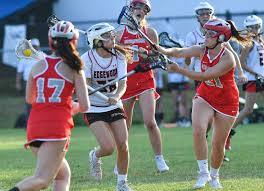
Association headgear mandate and concussion injury rates in girls high school lacrosse
Herman DC, Caswell SV, Kelshaw PM, Vincent HK, Lincoln AE. Br J Sports Med. 2022;56:970-974. doi:10.1136/bjsports-2021-105031
https://bjsm.bmj.com/content/56/17/970.long
Take home message
Headgear can reduce the risk of concussions in high school lacrosse field players.
Background
Current regulations classify women’s lacrosse as a non-contact sport, limiting the amount of protective equipment required for goggles and mouthguards. However, unintentional head impacts (such as head-to-stick) are common, often leading to a concussion. There is little evidence to assess whether headgear reduces the risk of concussion in this population.
Study aim
The authors wanted to determine whether high school girls’ lacrosse players had fewer concussions in a state with a headgear mandate than players in states without a headgear mandate.
Methods
The authors used an existing data recording system (the High School National Athletic Treatment, Injury, and Outcomes Network [NATION]) to analyze athlete exposures and concussions. Each athlete exposure represented a single athlete participating in a high school sanctioned practice or competition. A concussion had to occur during a high school lacrosse game or practice and be diagnosed by a healthcare professional. The authors compared data from Florida, which has a statewide headgear mandate, with athletes in 31 other states without a mandate. They focused on data from 2019-2021.
Results
In total, the authors analyzed 289 school seasons (96 with mandatory helmets), yielding 357,225 exposures to athletes (91,074 with mandatory helmets). During these exposures, 141 concussions occurred. Lacrosse players competing in states without a headgear mandate had a ~59% greater incidence of concussion than players in a state with a mandate.
Viewpoints
This study adds to the limited literature suggesting that headgear can reduce the risk of concussion in female high school lacrosse players. More states and lacrosse organizations should consider implementing a similar mandate to reduce the incidence of concussions in this athletic population. Unlike previous research, this study simultaneously tracked both mandatory and non-mandatory headgear concussions, which increases its potency. However, several limitations are also present. First of all, this study lacks randomization of participants. Therefore, athletes with helmet mandates (mainly Florida) may be unique compared to other players. This may include differences in refereeing style and player intensity. Second, some lacrosse players in states without a mandate may have worn helmets based on their preferences. It is unclear how many athletes in the states without a mandate voluntarily wore helmets and may have been protected. Therefore, these results could underestimate the benefit of helmets.
Clinical implications
Athletic trainers and other sports medicine professionals should advocate for headgear mandates and resources to ensure access to headgear in women’s lacrosse to potentially reduce the incidence of concussions.
Questions for discussion
What are your thoughts on the ability of helmets and headgear to reduce the risk of concussion in athletes? Does this study change your view on their ability to reduce the incidence of concussions?
related posts
- Aftermarket helmet add-ons don’t add up
- Women are not only at increased risk for concussions, but also for more severe concussions
- A Closer Look at Concussions 2016-2020: Increasing Prevalence and Gender Differences
Written by: Cade Watts
Review by: Jeffrey Driban

Source link