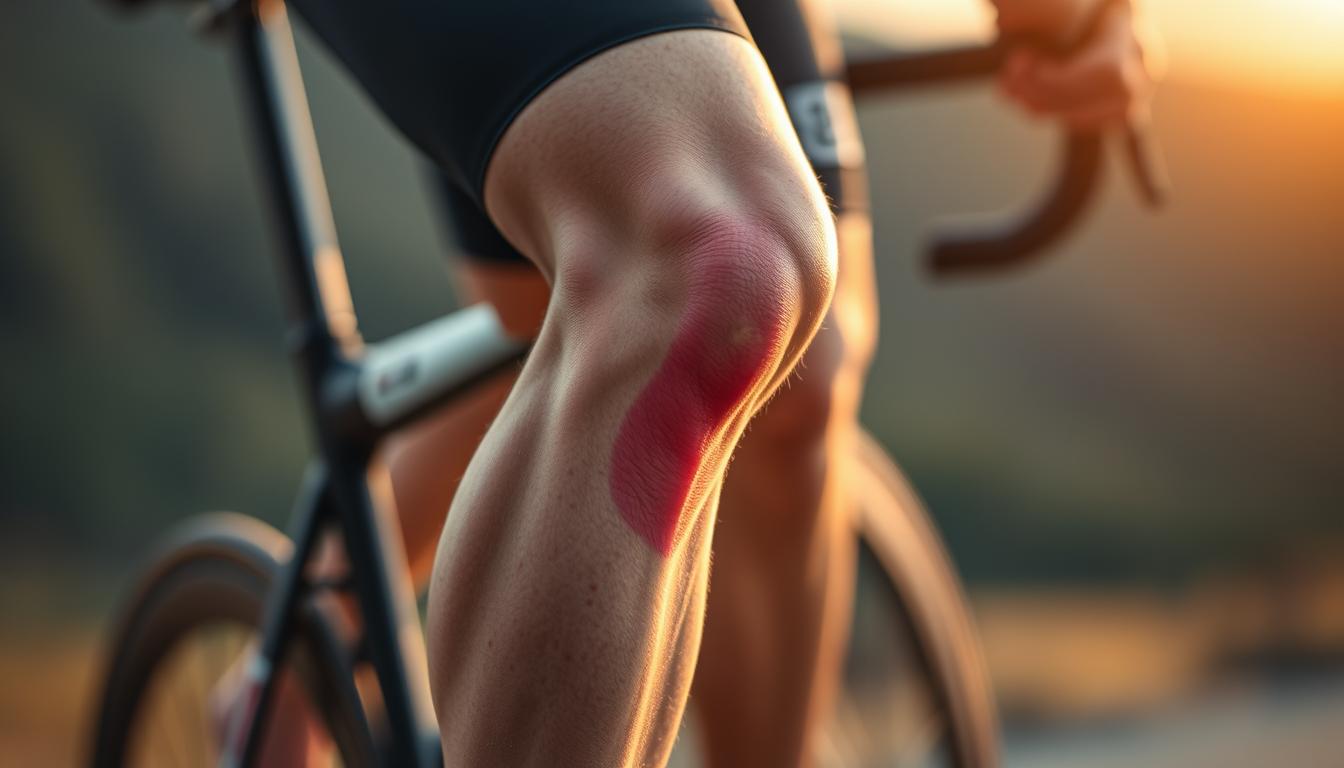
Are you tired of letting knee pain hold you back from enjoying your favorite cycling routes? You’re not alone. According to a 2018 study published in the Open Access Journal of Sports Medicine, up to 33 percent of riders have suffered from cycling-related knee pain.
The low-impact nature of cycling can be both beneficial and detrimental – you can cycle for a long time before tissues get irritated, meaning by the time you feel discomfort, the issue has probably been present for quite a while.
We’ll explore comprehensive strategies to address and prevent knee pain that commonly affects cyclists of all experience levels. Understanding the relationship between cycling form, equipment setup, and knee health is essential for maintaining long-term comfort on the bike.
Key Takeaways
- Common causes of cycling knee pain, including improper bike fit and muscle imbalances.
- Specific adjustments and exercises to alleviate existing knee pain.
- Techniques to prevent future occurrences of knee discomfort.
- Understanding when to seek professional medical advice for persistent issues.
- The importance of proper cycling form and equipment setup for knee health.
Understanding Cycling Knee Pain
For many cyclists, knee pain becomes a persistent issue that interferes with their enjoyment of the sport. We need to understand the underlying causes to address it effectively.
Why Cyclists Experience Knee Pain
Cycling knee pain often arises from the way power is generated and transferred through the knee joint. Power comes from the large muscles in our hips and thighs as we pedal. To transfer that power to the site of propulsion—our lower legs and feet—energy needs to be transferred through the knee. The knee doesn’t work in isolation; it’s always working in conjunction with the hip and ankle in a kinetic chain.
The Biomechanics of Cycling and Knee Stress
The biomechanics of cycling play a crucial role in understanding knee stress. As we pedal, the pedal stroke involves a complex interplay of forces and movements. We’ll analyze how forces are distributed through the knee during different phases of the pedal stroke and how improper mechanics can lead to pain.
- The relationship between hip, knee, and ankle alignment during cycling is critical for preventing unnecessary stress on the knee joint.
- Understanding how muscle activation patterns affect knee loading can help cyclists modify their technique to reduce pain.
- Different pedaling styles and cadences affect the biomechanical stresses placed on the knee, involving quads and hamstrings.
Common Causes of Cycling Knee Pain
Knee pain while cycling can be debilitating, but recognizing its root causes can help in developing targeted strategies for alleviation. We will explore the primary factors contributing to cycling knee pain, enabling cyclists to address the issue effectively.
Improper Bike Fit
An improper bike fit is a significant contributor to knee pain among cyclists. When the bike is not adjusted to the rider’s body, it can lead to strain on the knee joint. Ensuring a proper bike fit can help alleviate this strain and reduce the risk of pain.
Training Errors and Overuse
Training errors and overuse are common causes of knee pain in cyclists. Increasing mileage or intensity too quickly can put excessive stress on the knee, leading to pain and discomfort. Gradual progression and adequate rest are crucial in preventing overuse injuries.
Muscle Imbalances and Weakness
Muscle imbalances and weakness, particularly in the leg muscles, can significantly impact knee health. Tight or weak quadriceps or hamstrings can affect knee alignment and tracking, leading to pain. Strengthening the core and leg muscles is essential for maintaining proper knee function.
| Cause | Description | Impact on Knee |
|---|---|---|
| Improper Bike Fit | Bike not adjusted to rider’s body | Strain on knee joint |
| Training Errors and Overuse | Excessive stress from rapid increase in mileage or intensity | Pain and discomfort from overuse |
| Muscle Imbalances and Weakness | Weakness in leg muscles like quadriceps or hamstrings | Affects knee alignment and tracking |
Identifying Different Types of Knee Pain
Cycling knee pain can manifest in different forms, and recognizing these differences is vital for treatment. Knee pain can occur in various locations around the knee, each indicating a different underlying issue.
Front Knee Pain: Patellofemoral Pain Syndrome
Front knee pain is often associated with Patellofemoral Pain Syndrome, characterized by pain around or behind the patella. This condition is typically caused by improper tracking of the patella within the femoral groove, often due to muscle imbalances or poor bike fit.
Back Knee Pain: Hamstring Overextension
Back knee pain can be attributed to hamstring overextension, where the hamstring muscles are stretched beyond their normal range. This overextension can lead to strain and pain at the back of the knee.
Outside Knee Pain: IT Band Syndrome
IT Band Syndrome is a common cause of outside knee pain among cyclists. The iliotibial band rubs against the lateral condyle of the femur, causing friction and pain, often due to improper bike fit or repetitive knee flexion and extension.
Inside Knee Pain: Foot Misplacement Issues
Inside knee pain feels like sharp pain on the inner side of the knee, often related to improper cleat positioning or foot misplacement. When cleats are placed too far toward the inside of the foot or externally rotated, it can cause the knee to collapse inward, putting stress on the medial structures.
- Improper cleat positioning can force the knee into an unnatural alignment.
- Understanding foot pronation and arch support is essential for addressing medial knee pain.
- A too-wide stance on the bike may contribute to medial knee stress.
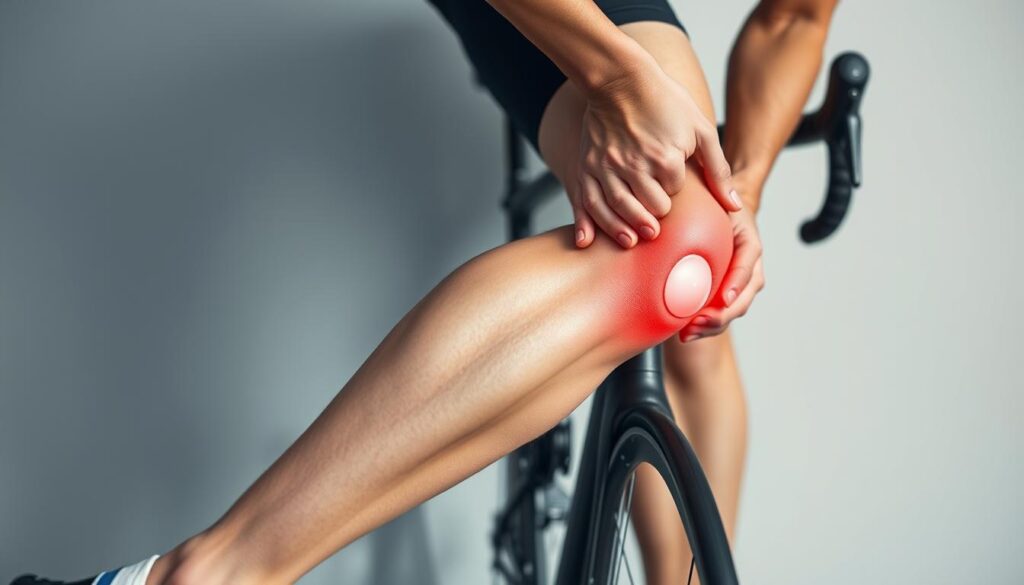
Bike Fit Adjustments for Knee Pain Relief
Optimizing your bike fit is essential for reducing knee stress and discomfort. A well-fitted bike ensures that your body is positioned in a way that minimizes strain on your knees.
Saddle Height and Position
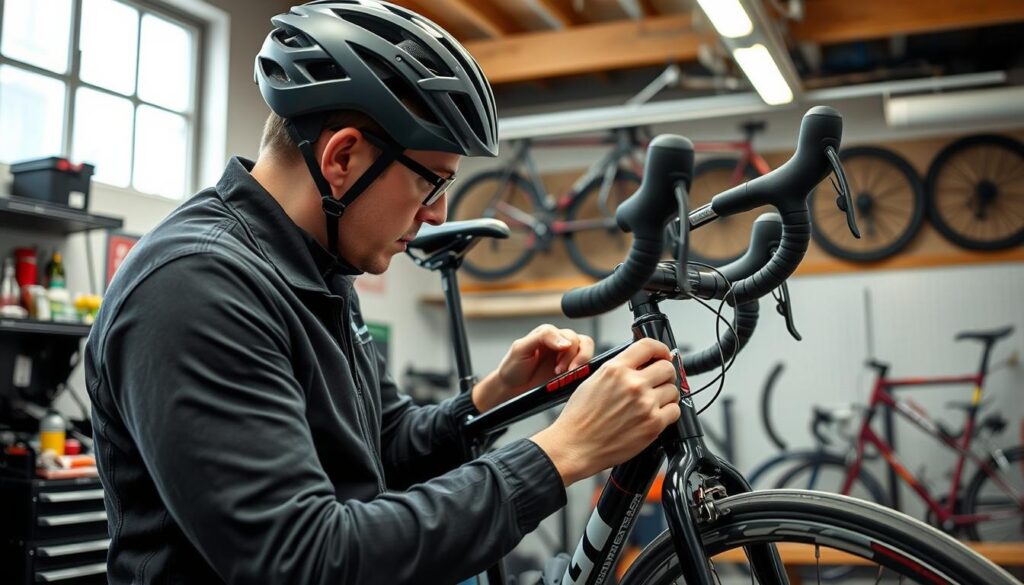
The saddle height and position play a critical role in determining knee angle and stress during pedaling. A saddle that is too high or too low can lead to knee pain.
To adjust the saddle height, ensure that your leg is almost fully extended at the bottom of the pedal stroke. The saddle position should also be adjusted so that your knee is in line with the pedal spindle when the crank is in the 3 o’clock position.
Cleat Positioning and Foot Alignment
Proper cleat positioning and foot alignment are vital for maintaining correct knee alignment during cycling. Incorrect cleat positioning can lead to knee pain and discomfort.
Ensure that the cleats are positioned so that the ball of your foot is directly over the pedal spindle. Adjusting the cleat position can help to reduce knee stress and alleviate pain.
Handlebar and Reach Adjustments
While handlebar position might seem unrelated to knee pain, your upper body position affects your overall biomechanics on the bike. If your reach is too long, you may be overextending and placing additional stress on your knees.
Conversely, if your handlebars are too close, you may be too upright, which can also alter knee angles during pedaling. Adjusting the handlebar height and reach can help to accommodate flexibility limitations and reduce knee stress.
Essential Stretches for Cyclists with Knee Pain
To alleviate knee pain, cyclists should incorporate a comprehensive stretching routine that targets key muscle groups.
Quadriceps Stretches
Tight quadriceps can contribute to knee pain. We recommend standing quadriceps stretches, where you stand with one hand against a wall for balance and lift one leg behind you, keeping your knee straight.
Hamstring Stretches
Hamstring flexibility is crucial for maintaining proper knee alignment during cycling. Try seated hamstring stretches, where you sit on the floor with your legs straight out and lean forward.
IT Band and Hip Flexor Stretches
The IT band and hip flexors play significant roles in knee stability. Use a foam roller to roll out the IT band, and perform hip flexor stretches by kneeling on one knee with the other foot in front.
Calf and Ankle Mobility Exercises
Calf tightness can affect ankle mobility, altering knee positioning. Basic calf stretches include the wall stretch and step stretch. Ankle mobility exercises include ankle circles and point-and-flex movements.
| Stretch | Target Area | Benefit |
|---|---|---|
| Quadriceps Stretch | Front of thigh | Reduces knee pain |
| Hamstring Stretch | Back of thigh | Improves knee alignment |
| IT Band Stretch | Outside of thigh | Enhances knee stability |
| Calf Stretch | Lower leg | Improves ankle mobility |
Knee Pain Relief for Cyclists: Strengthening Exercises
Effective knee pain relief for cyclists involves not just stretching but also strengthening the key muscle groups used in cycling. Strengthening exercises can help alleviate knee pain by improving the stability and strength of the muscles around the knee.
Core Strengthening Exercises
Core strength is essential for maintaining proper cycling posture and reducing strain on the knees. Exercises like planks and Russian twists can help improve core stability, which in turn can help reduce knee pain.
Glute Activation and Strengthening
The glutes play a significant role in the cycling motion. Strengthening them through exercises like squats and lunges can help improve cycling efficiency and reduce the risk of knee pain. For more information on stretches that can complement these strengthening exercises, visit our guide on knee pain relief.
Quad and Hamstring Balancing Exercises
Balancing the strength between the quadriceps and hamstrings is crucial for knee health. Exercises such as leg press and deadlifts can help achieve this balance, thereby reducing the risk of knee pain.
Single-Leg Stability Work
Single-leg exercises like step-ups and single-leg squats are particularly relevant for cyclists as they mimic the single-leg motion of cycling. These exercises help identify and correct strength imbalances between legs, improving overall stability and reducing pain.
| Exercise | Repetitions | Sets |
|---|---|---|
| Single-Leg Squats | 10-12 | 3 |
| Step-Ups | 12-15 | 3 |
| Leg Press | 10-12 | 3 |
Modifying Your Cycling Technique
Adjusting your cycling technique can be a game-changer for knee pain relief. By making a few simple changes, cyclists can significantly reduce the stress on their knees and enjoy a more comfortable ride.
Optimal Cadence for Knee Health
Maintaining an optimal cadence is crucial for minimizing cycling knee stress. A cadence of 80-100 revolutions per minute is generally recommended, as it allows for a smooth, efficient pedaling motion that reduces the risk of knee injury.
Proper Pedaling Technique
Using a proper pedaling technique is essential for reducing knee strain. Cyclists should focus on applying gentle, consistent pressure throughout the pedal stroke, avoiding heavy reliance on the downstroke.
Position Variations During Long Rides
Varying your position during long rides can help distribute the load more evenly and reduce the risk of pain. Standing up on the pedals, sliding back in the saddle, and shifting around every 10 minutes or so can help refresh the system and keep pain from setting in, especially as terrain changes. This habit is essential for maintaining comfort over time.
Immediate Relief Strategies for Cycling Knee Pain
Cyclists experiencing knee pain need effective and immediate relief strategies to continue their passion without interruption. We will explore various methods to alleviate knee pain, enabling cyclists to return to their routine with minimal downtime.
Ice and Heat Therapy Applications
Applying ice or heat to the affected area can provide immediate relief. Ice therapy helps reduce inflammation, while heat therapy relaxes the muscles and improves blood flow. Alternating between the two can be an effective approach to managing knee pain.
Rest and Active Recovery Approaches
Balancing rest with active recovery is crucial. Complete rest can lead to stiffness, while gentle exercises like straightening and bending the knee can promote healing. We recommend incorporating low-impact activities to maintain mobility without exacerbating the pain.
Over-the-Counter Pain Management Options
Non-steroidal anti-inflammatory drugs (NSAIDs) like ibuprofen can help manage pain and reduce inflammation. However, they should be used judiciously and according to package directions. Topical pain relievers are another option, offering localized relief with fewer systemic effects.
| Relief Strategy | Description | Benefits |
|---|---|---|
| Ice Therapy | Applying ice to reduce inflammation | Reduces swelling and pain |
| Heat Therapy | Applying heat to relax muscles | Relaxes muscles and improves blood flow |
| NSAIDs | Using medications like ibuprofen | Reduces pain and inflammation |
As noted by experts,
“The key to effective pain management is finding the right balance between relief and addressing the underlying cause of the pain.”
It’s essential to use these relief strategies as temporary measures while working on long-term solutions to prevent knee pain.
Preventative Measures for Long-Term Knee Health
To maintain long-term knee health, cyclists must adopt a multifaceted approach that includes various preventative measures. By incorporating these strategies into their routine, cyclists can significantly reduce the risk of knee pain and associated issues.
Cross-Training Benefits
Cross-training is an effective way to reduce the repetitive stress on the knees associated with cycling. By engaging in activities such as swimming or running, cyclists can strengthen their muscles and improve cardiovascular fitness without exacerbating knee problems. Cross-training not only enhances overall fitness but also helps prevent overuse injuries.
Gradual Training Progression
A gradual progression in training intensity and volume is crucial for allowing the knees to adapt to the demands of cycling. Sudden increases in ride distance or intensity can lead to knee pain and injury. Cyclists should aim to increase their training load by no more than 10% each week to allow for safe adaptation.
Proper Warm-Up and Cool-Down Routines
Warming up before cycling and cooling down afterwards are essential for maintaining knee health. A proper warm-up increases blood flow to the muscles, raises tissue temperature, and improves joint lubrication, while cooling down helps reduce muscle soreness and stiffness.
| Routine | Benefits |
|---|---|
| Warm-Up | Increases blood flow, raises tissue temperature, improves joint lubrication |
| Cool-Down | Reduces muscle soreness, stiffness, and promotes recovery |
By incorporating these preventative measures into their cycling routine, cyclists can enjoy long-term knee health and improved overall performance.
When to Seek Professional Help for Cycling Knee Pain
Cycling knee pain can be debilitating; recognizing the signs that indicate the need for professional evaluation is essential.
If your knee pain is greater than five out of ten and persists for more than 24 hours, it’s time to seek medical attention. A physical therapist can provide specific exercises to alleviate knee pain and review your bike setup to minimize future issues.
They can analyze your biking technique and suggest improvements, such as engaging your core muscles to enhance your pedal stroke efficiency. By seeking professional help, cyclists can address underlying issues before they become chronic problems.
FAQ
What are the most common causes of knee pain while cycling?
We find that improper bike fit, overuse, and muscle imbalances are among the top reasons cyclists experience knee pain. Ensuring our bike is properly fitted to our body and incorporating exercises to strengthen the muscles around the knee joint can help alleviate this issue.
How can I adjust my bike to reduce knee stress?
Adjusting the saddle height and position, cleat positioning, and foot alignment can significantly reduce stress on our knees. We recommend consulting a professional bike fitter to make these adjustments.
What exercises can help prevent knee pain while cycling?
Strengthening our core, glutes, and leg muscles through exercises like squats, lunges, and leg press can help stabilize the knee joint. Additionally, incorporating stretches for our quadriceps, hamstrings, and IT band can improve flexibility and reduce the risk of knee pain.
Can modifying my pedaling technique help alleviate knee pain?
Yes, adopting a proper pedaling technique, such as maintaining an optimal cadence and using the correct muscle groups, can help reduce stress on our knees. Focusing on a smooth, circular pedal stroke can also help.
When should I seek professional help for cycling knee pain?
If our knee pain persists or worsens despite trying various relief strategies, we should consult a healthcare professional or a physical therapist specializing in sports medicine. They can help diagnose the underlying cause and develop a personalized treatment plan.
Are there any quick relief strategies for cycling knee pain?
Applying ice or heat therapy, taking regular breaks to rest and stretch, and using over-the-counter pain management options can provide temporary relief. However, addressing the underlying cause is crucial for long-term relief.