Tag: Medicine and Rehabilitation

  • Regular football training improves lung diffusion capacity in boys aged 6 to 10 years |  BMC Sports sciences, medicine and rehabilitation

    Regular football training improves lung diffusion capacity in boys aged 6 to 10 years | BMC Sports sciences, medicine and rehabilitation


    Attendees

    The required sample size was calculated using G*Power (version 3.1, University of Düsseldorf, Germany) [21]. The a priori power analysis was calculated with an assumed power of 0.90, an alpha level of 0.01 and an effect size of Cohen’s f = 0.26 for pulmonary diffusion capacity (TL) [10]. The analysis showed that a total sample size of N=60 would be sufficient to detect a significant interaction effect by time. Accordingly, 80 participants were enrolled to account for possible dropouts due to injuries.

    Eighty healthy prepubertal boys, aged 6 to 10 years, with normal lung volumes and regular flow-volume curves and no history of cardiovascular disease or allergies, volunteered to participate in the study. A respiratory functional examination was performed by a physician, including a health questionnaire to screen the participants’ medical history. The boys were randomly divided into two groups:

    • The football group (SG, n = 40) participated in four weekly football sessions of 75 minutes each over a period of 28 weeks.
    • The control group (CG, n = 40) matched to the SG in terms of age, body weight and height, participated only in regular physical education classes without any other extracurricular sports activities.

    All participating boys went to the same school near the football training center. After providing written and verbal information about the risks and benefits of the study, written informed consent to participate in the study was obtained from all study participants and their parents or legal guardians before the start of the study. The ethics committee of Sousse Medical University (Tunisia) approved the study. The study was conducted in accordance with the latest version of the Declaration of Helsinki. The physical characteristics of the study participants at the time of inclusion are listed in Table 1.

    Table 1 Characteristics of the participants and maximum exercise performance of the participating boys before the start of the study (pre: T1) and after completion of the study (post: T2)

    Procedures

    Baseline (Trial 1) anthropometric data (body height to the nearest 0.1 cm and body weight to the nearest 100 g) were collected using standard stadiometers (Seca™, Hamburg, Germany) and scales (Tefal, France). Maximum oxygen consumption (VO2max) and maximum aerobic power (MAP) were determined using standard protocols, with the extensive testing performed on a bicycle ergometer (Monark cycle). The bicycle ergometer was chosen for safety reasons, because the participants are boys aged 6 to 10 years and the treadmill is also more stressful. Participants cycled unloaded at 60-65 revolutions/min (rpm) for the first minute, after which the work rate was increased every minute according to the Cooper and Weiler-Ravell procedure. [22] to VO2the maximum had been reached. The examiners who performed the exercise test were blinded to group assignment.

    Oxygen consumption (VO2) and carbon dioxide (VCO2) production were determined using a calibrated metabolic measurement system (MedGraphics CPX St Paul, MN, USA). The transfer of nitric oxide (NO) and carbon monoxide (CO) was measured simultaneously during a single breathing maneuver using an automated device (Medisoft, Dinant, Namur, Belgium), according to the latest ERS guidelines [23]. Each participant completed three validated transfer measurements [9, 10]: two at rest (before exercise) and one at the end of the maximum exercise test. After the test, the participants remained seated on the bicycle ergometer. An investigator attached the nose clip and mouthpiece to initiate the breathing maneuver under the experimenter’s guidance. Participants were informed about the importance of test standardization to achieve better test reproducibility. The validity of the test was visually checked by examining the trace showing the volume changes during the maneuver. In other words, the computer-generated trace should have no pause during the rapid inhalation, be flat during the breath-hold, and be continuous during the exhalation. The test was considered valid if these criteria were met. All participants were given three introductory trials to practice the maneuvers.

    DM and Vc were determined from TLNO and T.LCO values ​​as previously described by Dridi et al. [9]. Since the reactivity of NO and hemoglobin was considered very high and its inverse was negligible, TLNO was considered equivalent to DMNO. DMCO was determined using the coefficient of proportionality (a) and the DM values ​​of the two gases (aDMNO = aDMCO = 1.97) according to “Graham’s law.

    Same tests (maximum O2 consumption, maximum aerobic power and NO/CO transfer) were repeated 28 weeks later (Test 2). All tests and effort measurements were performed on the same equipment, calibrated using identical methods, and measured using identical laboratory techniques for the initial and follow-up tests.

    Football training program

    The training period was spread over 28 weeks (from October to April) (Table 2), with training taking place in four weekly sessions (between 5:00 PM and 6:15 PM on Tuesday, Wednesday, Friday and Sunday) (Table 3). During this time, only friendly matches were scheduled. Each training session included a 15-minute warm-up, followed by 20 minutes of physical work (jumping, wrapping, running) and 30 minutes of basic technical training (dribbling, juggling, passing, technical circuit), supplemented with active stretching exercises.

    Table 2 Characteristics of the research design and sessions
    Table 3 Illustrated microcycle of football training

    The SG was exposed to seven months (i.e. 28 consecutive weeks) of systematic football training with three sessions per week. The training sessions were carried out on a synthetic football field and were led by three professional coaches. During the first 6 weeks, the coaches emphasized training physical fitness components such as endurance, linear speed and speed of change of direction, coordination including balance to provide a foundation for subsequent football-specific training. From weeks 7 to 12, the exercise program mainly included football-specific technical exercises (passing, dribbling, ball control, etc.).

    From weeks 13 to 18, the coaches ensured the development of motor skills such as movement coordination, speed, joint flexibility, basic endurance through circuits, slaloms, races, jumps, etc. From weeks 19 to 28, the coaches focused on technical and tactical aspects of training including ball possession, recovering the ball, transition… and proposing simple situations of reduced squads by limiting the opposition (3 × 2; 4 × 3; 5 × 4…) in addition to fun games and small games (3 × 3 ; 4 × 4; 5 × 5 in small to medium-sized places 12 × 20 m; 16 × 24 m; 25 × 35 m). The last 10 weeks were reserved for technical development, maintenance of physical qualities and tactical placement (mainly in player position). The model applied by the coaches followed the model proposed by the Tunisian Football Federation.

    Exercise intensity was regulated and monitored using smartwatches (H.Tang, Model F6, China) that allowed monitoring heart rate during continuous running (i.e. 50–70% of maximum heart rate [HRmax]), high-intensity interval training (i.e. 90-100% of HRmax), specific football training with and without the ball, tactical training, technical training, small matches and aerobic training. In addition, a football match was scheduled every week on Sunday. The participating team played against other regional clubs, using a 7 × 7 format on a relatively small field (30 ≠ 40 m). The match lasted 15 minutes at halftime. SG played 20 matches during the experimental period.

    The participating boys were part of the same football training center in the city of Sousse (Tunisia). Nine of the forty children played football in a private training center before the start of the study (maximum two years). All other participants started playing football when they entered the study. During the same period, CG attended a one-hour weekly physical education course at their primary school, the content of which was fundamentally playful and based on educational games. Boys did not participate in any other physical training activities during the study. The children in both groups completed all aspects of the training programs. The participation rate in training for the experimental group (e.g. the football group) was 91%. No test- or training-related injuries occurred during the study.

    static analysis

    All results are presented as means and standard deviations (SDs) after the normality distribution of the data was assessed and confirmed using the Shapiro-Wilk test. The intraclass correlation coefficient (ICC) and the coefficients of variation (CV) were used to determine the consistency of the measurements and their variation (test-retest reliability). Based on the 95% CI of the ICC estimate, values ​​less than 0.5, between 0.5 and 0.75, between 0.75 and 0.9 and greater than 0.90 were indicative of poor, moderate, good, respectively. and excellent agreement. Differences within and between groups were calculated using a two-way analysis of variance (ANOVA) for repeated measures. Bonferroni adjusted post hoc tests were calculated to assess any significant interactions by time period. Partial eta squared (η2p) are taken from the ANOVA output and Cohen’s d effect sizes (d) are calculated to quantify meaningful differences in the data [24, 25] with demarcations of trivial (<0.2), small (0.2–0.59), moderate (0.60–1.19), large (1.2–1.99) and very large (≥ 2, 0).

    Pearson correlations were used to examine the relationship between variables. The magnitude of the correlations was determined using the modified scale proposed by Hopkins (2009). [26]. A stepwise multiple regression analysis was used to determine the best predictive independent variables. We attempted to use a stepwise regression between the VO2max, MAP) and the lung parameters (TLNOTLCOVA, Vc, DM).

    All statistical analyzes were calculated using SPSS for Windows, version 16.0 (SPSS Inc., Chicago, IL, USA).
    Source link

  • Research into the impact of substitutes in professional football on physical and technical performance |  BMC Sports sciences, medicine and rehabilitation

    Research into the impact of substitutes in professional football on physical and technical performance | BMC Sports sciences, medicine and rehabilitation


    The current study aimed to (1) quantify the physical and technical profile of substitutes, substitutes and players who completed the entire match, taking into account situational variables; (2) analyze the physical and technical performance difference between substitutes and players who substituted or completed the entire match at each playing position. Previous studies have mainly examined the physical performance of substitutes in football [5, 18,19,20,21]but only a few have examined the technical performance of replacements [5, 19]. In the current study, more comprehensive and detailed technical indicators were analyzed to investigate the impact of substitutes on technical performance. The results of the current study showed that substitutes performed better in terms of physical performance (Table 3), especially at high-intensity running and sprint distances, than players who were substituted or completed the entire match. The findings have shown the similarity with previous studies as the better physical performance of substitute players [5, 19]. Substitutions are generally used to reduce the impact of fatigue and maintain a high level of running performance for the entire team [34]. High-intensity running distances seem to be a particularly essential and useful indicator of physical performance in football [35], and the findings of the current study showed the significant difference in high-intensity running distance between substitutes and players who are substituted or complete the entire match. However, replacement players perform worse on the total distance than replaced players. Accordingly, playing time on the field is the most important factor that influences match intensity [36]. Replaced players mainly play on the field in the first half and would be replaced in the second half [5]. During the playing time of substituted players, the match intensity may therefore be higher than that of substitutes playing on the field, resulting in substitutes showing a lower total distance. Depending on playing positions, substitutes from all positions exhibit higher high-intensity distance and sprint distance than substitute players or players who complete the entire match. The finding is similar to the results regardless of positions. However, substitutes in the wide midfield show lower total distance than replaced players and players have completed the entire match. Coaches would introduce more defensive players to strengthen the defense if the team wins [4]. Modric, verse [37] It was found that wide midfielders’ total running distance decreased and sprint distance increased in the defensive phases, which is in line with the findings of this study.

    By focusing on technical performance, technical indicators in a broader range were analyzed and performance related to scoring, passing and defending was quantified (Table 1). Despite the importance of technical performance, little literature focuses on the technical activities of substitute players [1, 5, 19]. Bradley, Peñas [5] first analyzed the technical activities of substitutes, but found no significant difference in passing activities between substituted players and players who completed the entire match. The results of the current study show that substitutes mainly perform better in shooting activities and defensive activities, while they exhibit poorer passing activities, including passing, passing accuracy and long passes, than players who substituted or completed the entire match (Fig. 1). Existing literature mentions passing activities such as short passes; successful passes decrease from the first to second half of football matches, which can be affected by fatigue [38]. According to the theory, it is a good strategy for the coach to make substitutions on the field to counteract the decline in the team’s technical performance. Additionally, match status also impacts player performance as replacement players may attempt riskier passes and crosses due to the match status when they were introduced onto the pitch. [39]. Furthermore, research into substitution introduction patterns shows that coaches would introduce more players into attacking positions in the second half of the match [5]. Thus, substitutes would engage in riskier and more attacking activities when coaches aim to change the score line, causing the substitutes to employ lower passing accuracy but perform more attacking activities, including shots, shots on goal, key passes and breakthroughs.

    One of the most compelling findings in time-motion analysis research is the significant differences between all playing positions in physical performance [6,7,8, 40,41,42] and technical performance [5, 24, 43, 44] of top footballers. Therefore, it is crucial to discuss the performance differences between players who are substituted, replaced and completed the entire match for each playing position. According to this research, substitute centre-backs have shown lower passing and organizational activities, while performing more defensive actions. To win the game, coaches usually send the defenders onto the field when their team is ahead [16, 17]. Thus, the tactical objective of substitute central defenders and full-backs is to defend the opponent’s attackers and protect the attacking third zone. Under the tactical objective, substitute defenders (center defenders and full-backs) would perform lower passing actions and higher defensive actions compared to players who substituted or completed the entire match. Furthermore, to strengthen the defensive level, attacking players may also have been introduced on the pitch in a defensive role, to hold the scoreline or waste time during the final stages of the match. [1]. These may be the reasons why attacking substitutes, such as forwards and wide midfielders, have shown more tackles, clearances and pass blocks than players who have been substituted or played out for the entire match.

    On the other hand, the current research has shown that substitute strikers and wide midfielders demonstrate better passing and organization actions, such as passing, ball controls, crosses, short passes and long passes, than players who were substituted or completed the entire match. Players with attacking playing positions are usually introduced onto the field when their team is losing [1, 16, 17]. In general, replaced players are more likely to be considered underperforming if the team loses [17]and coaches introduce attacking substitutes to create more scoring opportunities and improve the performance of the entire team [5, 39]. The higher passing and organizational performance of attacking substitutes than those who have been substituted or completed the match are considered crucial factors for the success of the match. [5, 24, 39, 45]. Furthermore, substitute central midfielders in this study showed more scoring actions. Research into elite French football has shown that the increased number of goals scored by substitutes was a factor in distinguishing successful teams [46]. Therefore, substitute central midfielders can be introduced onto the pitch as another attacker to score a goal when their team is losing. These may be reasons why replacement central midfielders have a lower passing performance than replaced players and complete the entire match. Furthermore, a very interesting result from the current research is that substitute full-backs perform more shots, which is more likely the attacking playing style. Although coaches introduce some players with defensive positions, such as fullbacks, the introduced players may play in the attacking playing position in an attempt to create scoring opportunities. [19].

    Overall, substitutes can indeed improve the physical and technical performance of the team. The current study has confirmed previous findings as substitutes are introduced to change the scoring line or reduce the influence of fatigue [1, 4, 5, 16, 17, 19, 39, 47]. By taking into account the situational variables, the current study analyzed a wider range of technical variables and quantified the technical performance of substitutes in different playing positions. Furthermore, the match location influences most technical performance indicators, which show higher scoring and passing performance, while defensive performance is lower. The findings verified home field advantage and confirmed previous research [26, 31].

    However, some limitations need to be further studied in subsequent research. Sports psychology literature shows that substitutes may perform worse when introduced into the match as starters due to the psychological strain [48]. It is important to investigate the performance difference of substitutes between the substitution situations and the starter situation. Furthermore, the timing of substitutes introduced onto the field also influences performance, as the match status determines the tactical purpose of substitutions. [5, 16, 17]. In the current study, the match data was analyzed for only one year and the substitution option was changed in 2020. To better investigate the influence of substitutes on match performance, it is important for future research to analyze match data over a larger number of seasons.

    Source link

  • Effects of trunk training using motor imagery on the control ability and balance function of the trunk in stroke patients |  BMC Sports sciences, medicine and rehabilitation

    Effects of trunk training using motor imagery on the control ability and balance function of the trunk in stroke patients | BMC Sports sciences, medicine and rehabilitation

    General information

    Post-stroke patients with motor dysfunction who were hospitalized in the Department of Rehabilitation Medicine of our hospital from January 1, 2020 to January 1, 2022, aged 50 to 70 years old, were selected.

    Inclusion criteria: [12] The patient met the diagnostic criteria for stroke established at the Fourth National Academic Conference on Cerebrovascular Diseases in 1995, [13, 14] and stroke was diagnosed as the primary disease on CT or MRI. The time between disease onset and enrollment ranged from two weeks to three months. The patient’s vital signs were stable and the patient was conscious, able to understand the instructions and cooperate with the rehabilitation training. The patient’s score on the Kinesthetic and Visual Imagery Questionnaire (KVIQ) was ≥ 25 points. The patient signed the required informed consent form. Age between 50 and 70 years.

    Exclusion criteria: [14] The patient suffered from severe cardiac, hepatic or renal insufficiency, a malignant tumor, etc. The patient suffered from impaired consciousness, aphasia, mental disorder or severe cognitive impairment. The patient has had other craniocerebral diseases or traumatic sequelae in the past. The patient has previous severe osteoarticular disorders causing abnormal trunk function.

    Finally, a total of 100 patients with stroke and motor dysfunction were included, and they were divided into a control group and a trial group according to the random number table, with 50 cases in each group. There was no significant difference (P > 0.05) in general data such as gender, age, disease course and KVIQ between the two groups, and they were comparable. See Table 1 for details. This study was approved by the local ethics committee (approval number: 2018-ethical review-189) and conducted in accordance with the Declaration of Helsinki. All participants provided written informed consent.

    Table 1 Comparison of general data of patients such as gender, age, disease course and lesion site between the two groups

    Treatment methods

    The patients in the control group underwent routine rehabilitation therapy and remained in the supine position in the same environment for the same amount of time as the combined trunk motor imagery therapy. Meanwhile, the trial group received both routine rehabilitation therapy and combined trunk motor imagery therapy.

    Routine rehabilitation therapy

    The training included proper limb positioning, neuromuscular promotion techniques, such as the proprioceptive neuromuscular facilitation technique (PNF), Rood’s approach, motor relearning, occupational therapy, daily living training and traditional therapy. The participants received routine rehabilitation therapy for five hours a day, five times a week, for a period of four weeks.

    Motor image therapy

    The motor imagery therapy training consisted of six steps: [4, 14] Illustration of the task: The therapist first demonstrated and explained the content of the imagery training, asking the patients to carefully observe and identify which part of the limb was ‘active’, what kind of movement was to be performed, and the normal movement to master. feeling. Preview: Patients were asked to re-imagine the relevant movements. Motor imagery: Patients listened to the motor imagery instruction tape and practiced the imagery. Rehabilitation training: the patients repeatedly practiced the movements of imagery training. Problem solving: The patients learned relevant skills through repeated practice. Practical application: the patients convert relevant skills into practical skills. Before the motor images, a video of a normal person’s trunk movements was shown, including stable trunk movements with a Bobath ball, and balance movements while sitting, standing, and reaching to move a water cup. The 10-minute video and audio were shown to patients via a computer in a quiet treatment room. During each training session, patients were instructed to close their eyes and sit on a comfortable chair with their bodies relaxed. The patients then imagined the movement of their body based on the specific motor imagery instructions in the video. During the treatment, the therapist occasionally interrupted the patients to ask questions, to see if they could concentrate on the images of the physical movement. At the end of the session, the patients were asked to refocus their attention on their surroundings, after which they were sent back to their room and asked to feel their physical being. The patients were then asked to pay attention to the environmental sounds. Finally, the narrator counted down from 10 to 1, and the patients were asked to open their eyes when the countdown reached 1. A motor imagery video was shown only during the first treatment, after which the patients underwent motor imagery training according to the motor imagery. guidelines for imagery. The motor imagery therapy sessions were conducted for 30 minutes each, with a frequency of five times per week, for a total of four weeks.

    Observation indicators and evaluation methods

    The evaluation of the patient’s trunk control was performed before treatment and four weeks after treatment using Sheikh trunk control evaluation. The simple Fugl-Meyer assessment (FMA), the Berg rating scale (BBS), and the balance feedback trainer were used to evaluate the motor and balance functions of the patients. In addition, before and after treatment, the sEMG signals of the bilateral erector spinae and rectus abdominis in the maximum flexion and extension range at a uniform speed under the sitting position were measured by sEMG signals. All evaluations were performed in a blinded manner by the same evaluator.

    Sheik Hull Check Evaluation

    Sheikh is a scale for evaluating the ability to control the trunk. It involves four movements: turning from the supine position to the hemiplegic side, turning to the healthy side, sitting upright from the supine position and maintaining balance in a sitting position on the bed. The scoring method is: 0 points for non-completion, 12 points for completion but needing some assistance (grasping or leaning on an object), and 25 points for normal completion. A higher total score indicates better trunk control.

    BBS rating

    The balance function is divided into 14 items, from easy to difficult, and each item is scored based on a five-point scale: 0, 1, 2, 3, and 4. The highest score is 4 points and the lowest score is 0 points. . The highest integral score is 56 points, the lowest is 0 points. The higher the score, the better the balance function.

    Evaluation of motor functions

    FMA is used to evaluate motor function in patients. The highest score is 100. The higher the score, the better the patients’ motor functioning will be.

    Evaluation of balance feedback training equipment

    The ProKin 254P (PK-254P) balance feedback training device, manufactured by TecnoBody Ltd., Italy, was used to test the postural stability of the patients. Stability tests were performed in standing position with eyes open using the static mode of the PK-254P balancer. The standard standing posture includes: Bilaterally symmetrical standing with A1A5 as central axis. The patients raise their heads and look straight ahead. Both upper limbs are naturally placed on either side of the body. The medial edges of both feet are 10 cm apart and the highest point of the bilateral arches is on axis A3A5. Observation parameters are as follows: movement length, movement area, mean front-back movement speed, and mean left-right movement speed.

    sEMG signal acquisition

    While the patients are seated on a square stool, their trunk is subjected to anterior flexion and posterior extension in the maximum range at uniform velocity. The Shanghai NCC 8-channel sEMG signal acquisition system was used to acquire the bilateral erector spinae and rectus abdominis myoelectric signals. The electrodes were taped to the 3 cm lateral opening on the left and right sides of the L3 spinous process (erector spinae) and the 3 cm lateral opening on the left and right sides 3 cm above the navel (rectus abdominis). The conductive diameter of the electrodes was 1 cm and the distance between the electrodes was 2 cm. Dandruff and oil were removed with a fine gauze and alcohol before testing. The root mean square (RMS) of myoelectric signals was then analyzed. The test was repeated three times with an interval of 30 seconds to obtain the average value. The RMS of the bilateral rectus abdominis and erector spinae of the two groups was evaluated before treatment and four weeks after treatment.

    static analysis

    SPSS software version 16.0 was used to analyze the data. The measurement data is expressed as (\(\bar x \pm s\)). Parametric statistics were applied when the data collected met the assumptions of homogeneity of variance and normal distribution. When these assumptions were not met, non-parametric statistics were used. The paired sample T-test was used for pre- and post-treatment comparison within the same group, while the independent sample T-test was used for between-group comparison, and P< 0.05 indicated that the difference was statistically significant.

    Source link

  • Influence of cuff stiffness on hemodynamics and perceived cuff pressure in the upper limbs in men and women: implications for practical training to limit blood flow restriction  BMC Sports sciences, medicine and rehabilitation

    Influence of cuff stiffness on hemodynamics and perceived cuff pressure in the upper limbs in men and women: implications for practical training to limit blood flow restriction BMC Sports sciences, medicine and rehabilitation


    All participants (demographic and anthropometric data are shown in Table 1) successfully completed the experimental sessions without side effects, except for some cases of mild tingling in the fingers at the end of the measurements. Regarding RTD, three men had to be excluded from the data analyzes because the occlusion of arterial blood flow was not possible with the MS and/or LS cuff due to the painful pinching of the skin fold and the stretching of the cuff up to the yield point. In addition, one female was excluded from data analyzes for vsysRPP, SMO2and tHb because arterial blood flow was already occluded at 20% overlap using the HS cuff.

    Table 1 Participant characteristics expressed as means ± standard deviations

    Overlap to occlusion

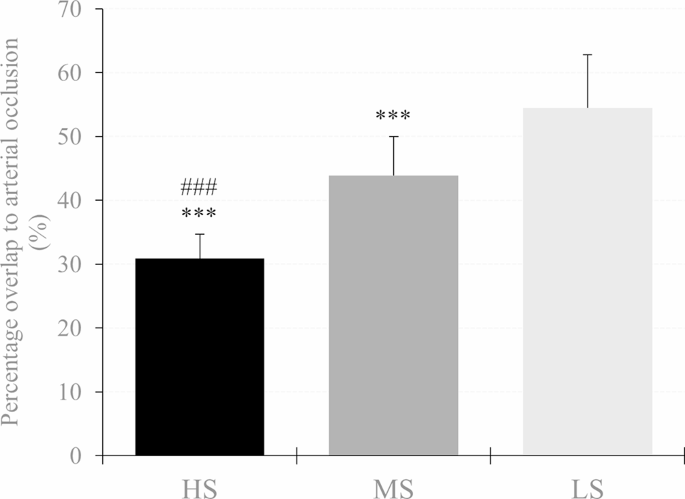
    There was a main effect of cuff (F2.62 = 175.679, P< 0.001, theP2= 0.850) and post hoc analysis indicated that RTD was lower in the HS compared to the MS (MD = -13.06% (-16.18 to -9.93%), P< 0.001, D= 2.06) and LS cuff (MD = -23.78% (-26.90 to -20.65%), P< 0.001, D= 3.75). In addition, RTD was also lower using the MS compared to the LS cuff (MD = -10.72% (-13.85 to -7.60%), P< 0.001, D= 1.69). Descriptive data are shown in Table 2; Fig. 3.

    Table 2 Hemodynamic, physiological and perceptual responses to progressive practical blood flow restrictions (10%, 20% and 30% overlap relative to the individual’s upper arm circumference) using a high stiffness (HS), medium stiffness cuff ( MS) and low stiffness (LS). Data are expressed as means ± standard deviations
    Fig. 3
    figure 3

    Percent overlap needed for arterial occlusion in the high stiffness (HS), medium stiffness (MS), and low stiffness (LS) cuff. A significant difference between LS and MS is shown as *p<0.05, **p < 0.01, ***p < 0.001 and #p<0.05, ##p < 0.01, ### p < 0.001 respectively

    Peak systolic velocity of blood flow

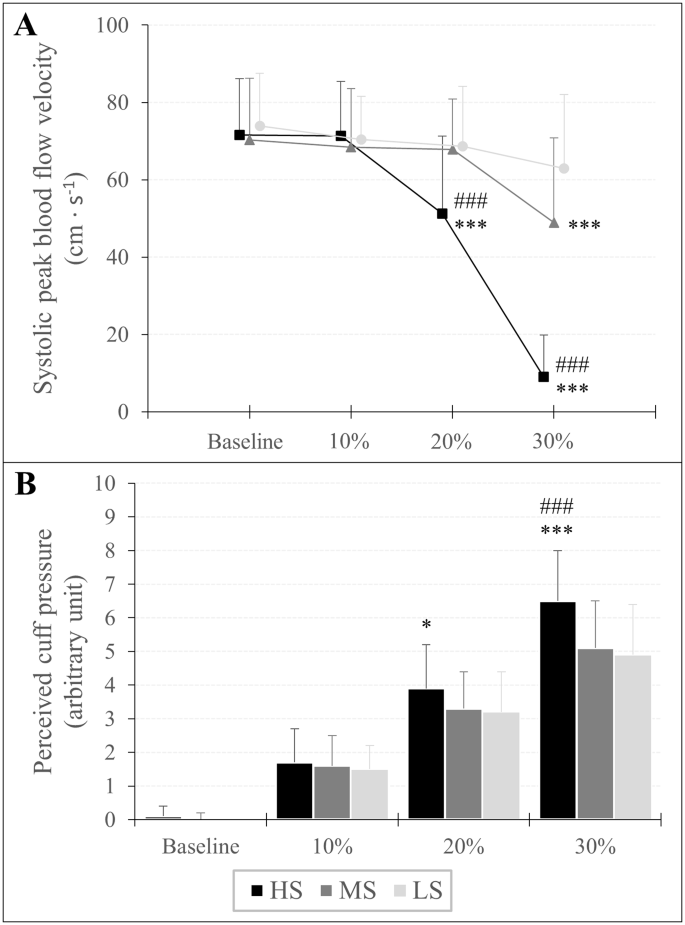
    There was an overlap × cuff interaction (F3,642,120,192 = 71.952, P< 0.001, theP2= 0.686) and a main effect of overlap (F1,770,58,422 = 161.427, P< 0.001, theP2= 0.830) and cuff (F2.66 = 50.380, P< 0.001, theP2= 0.604) for vsys. Post hoc analysis showed that vsys was lower at 30% overlap in each cuff compared to baseline (HS: MD = -62.67 cm s− 1(-70.97 to -54.37 cm s− 1 ), P< 0.001, D= 3.95; MS: MD = -21.53 cm s− 1(-29.83 to -13.24 cm s− 1 ), P< 0.001, D= 1.36; LS: MD = -11.02 cm s− 1(-19.31 to -2.72 cm s− 1 ), P< 0.001, D= 0.69). Furthermore, when the HS cuff was applied, vsys was also lower at 20% overlap compared to baseline (MD = -20.51 cm s− 1(-28.80 to -12.21 cm s− 1 ), P< 0.001, D= 1.29). As for cuff differences, vsys was lower at 20% and 30% overlap using the HS cuff compared to the MS (MD = -16.89 cm s− 1(-26.08 to -7.70 cm s− 1 ), P< 0.001, D= 1.07 and MD = -39.91 cm s− 1(-49.11 to -30.71 cm s− 1 ), P< 0.001, D= 2.52, respectively) and the LS cuff (MD = -17.60 cm s− 1(-26.80 to -8.41 cm s− 1 ), P< 0.001, D= 1.11 and MD = -53.99 cm s− 1(-63.18 to -44.79 cm s− 1 ), P< 0.001, D= 3.40 respectively). Furthermore vsys was also lower at 30% overlap using the MS compared to the LS cuff (MD = -14.08 cm s− 1(-23.27 to -4.88 cm s− 1), P< 0.001, D= 0.89). Descriptive data are shown in Table 2; Fig. 4.

    Fig. 4
    figure 4

    Peak systolic velocity of blood flow (A) and assessment of perceived cuff pressure (B) in response to progressive practical pressure on blood flow restriction, expressed as percent overlap in relation to the individual’s arm circumference. A significant difference between LS and MS is shown as *p<0.05, **p < 0.01, ***p < 0.001 and #p<0.05, ##p < 0.01, ###p < 0.001 respectively

    Assessment of perceived cuff pressure

    An overlap × cuff interaction (F3,946,130,209 = 13.994, P< 0.001, theP2= 0.298) and a main effect of overlap (F1,668,55,046 = 674.771, P< 0.001, theP2= 0.953) and cuff (F2.66 = 11.067, P< 0.001, theP2= 0.251) was found for RPP. A post hoc analysis showed that RPP increased at each %overlap stage compared to baseline for all three cuffs (HS10%: MD = 1.57 au (0.98 to 2.17 au), P< 0.001, D= 1.51; HS20%: MD = 3.80 au (3.21 to 4.40 au), P< 0.001, D= 3.66; HS30%: MD = 6.41 au (5.82 to 7.00 au), P< 0.001, D= 6.16; MS10%: MD = 1.54 au (0.94 to 2.13 au), P< 0.001, D= 1.48; MS20%: MD = 3.32 au (2.72 to 3.91 au), P< 0.001, D= 3.19; MS30%: MD = 5.03 au (4.44 to 5.63 au), P< 0.001, D= 4.84; LS10%: MD = 1.46 au (0.87 to 2.05 au), P< 0.001, D= 1.40; LS20%: MD = 3.18 au (2.59 to 3.77 au), P< 0.001, D= 3.05; LS30%: MD = 4.95 au (4.36 to 5.55 au), P< 0.001, D= 4.76). Regarding differences between cuffs, RPP was higher using the HS cuff with 20% overlap compared to the LS cuff (MD = 0.71 au (0.06 to 1.37 au), P= 0.016, D= 0.69) and with an overlap of 30% compared to Member States (MD = 1.43 (0.78 to 2.09 au), P< 0.001, D= 1.38) and LS cuff (MD = 1.54 au (0.89 to 2.19 au), P< 0.001, D= 1.48). Descriptive data are shown in Table 2; Fig. 4.

    Oxygenation of the muscles

    SMO2: There was an overlap × cuff interaction (F2,374,78,326 = 3.232, P= 0.037, theP2= 0.089) and a main effect of overlap (F1,297,42,808 = 404,914.= P< 0.001, theP2= 0.925) and gender (F1.33 = 5.096, P= 0.031, theP2= 0.134) for SMO2. Post hoc analysis showed that SMO2 was lower at 20% overlap (HS: MD = -9.94% (-12.43 to -7.45%), P< 0.001, D= 1.15; MS = -8.28% (-10.77 to -5.78%), P< 0.001, D= 0.96; LS: MD = -7.42% (-9.98 to -5.00%), P< 0.001, D= 0.87) and 30% overlap (HS: MD = -17.46% (-19.95 to -14.97%), P< 0.001, D= 2.02; MS: MD = -14.91% (-17.42 to -12.42%), P< 0.001, D= 1.72; LS: MD = -13.79% (-16.28 to -11.30%), P< 0.001, D= 1.59) compared to baseline. Furthermore, the main effect of sex indicated that regardless of overlap and cuff used, SMO2 was lower in men than in women (MD = -5.16% (-9.80 to -0.51%), P= 0.031, D= 0.60).

    tHb: An overlap × cuff (F3,072,101,386 = 6,440, P< 0.001, theP2= 0.163) and overlap × sex interaction (F1,187,39,158 = 14.814, P< 0.001, theP2= 0.310) and a main effect of overlap (F1,187,39,158 = 117,125.= P< 0.001, theP2= 0.780) and gender (F1.33 = 27.981, P< 0.001, theP2= 0.459) was found for tHb. Post hoc tests showed that tHb was higher at 20% overlap (HS: MD = 0.13 au (0.09 to 0.18 au), P< 0.001, D= 0.45; MS: MD = 0.10 au (0.05 to 0.14 au), P< 0.001, D= 0.32; LS: MD = 0.06 au (0.02 to 0.11 au), P< 0.001, D= 0.20) and 30% overlap (HS: MD = 0.22 au (0.18 to 0.27 au), P< 0.001, D= 0.75; MS: MD = 0.17 au (0.12 to 0.21 au), P< 0.001, D= 0.55; LS: MD = 0.15 au (0.10 to 0.19 au), P< 0.001, D= 0.45) compared to baseline. Moreover, tHb was already higher at a 10% overlap using the HS (MD = 0.05 au (0.00 to 0.09 au), P= 0.018, D= 0.16) compared to baseline. Regarding sex differences, post hoc analysis showed that regardless of cuff, tHb was higher by 10% (MD = 0.06 au (0.01 to 0.10 au), P= 0.003, D= 0.20), 20% (MD = 0.15 au (0.11 to 0.20 au), P< 0.001, D= 0.52) and 30% overlap (MD = 0.24 au (0.19 to 0.29 au), P< 0.001, D= 0.80) in men, while in women tHb was only higher during a 30% overlap compared to baseline (MD = 0.12 au (0.07 to 0.16 au), P< 0.001, D= 0.39). In addition, tHb was higher in men compared to women at baseline (MD = 0.51 au (0.31 to 0.70 au), P< 0.001, D= 1.69). Descriptive data are shown in Table 2.

    Source link