
What is a patient-reported outcome measure or PROM and the KOOS?
Image by FatCamera from Canva Pro
Are you recovering from a knee injury or knee surgery and are you asked to complete a questionnaire, the so-called Knee Injury and Osteoarthritis Outcome Score (KOOS)? This blog highlights the purpose of these questionnaires and explains what the KOOS is and how it is relevant to you and your recovery process. The first part discusses the purpose of these questionnaires in general and why you should care about them. The second part looks specifically at the KOOS and explains who it is designed for, what it measures, how it is scored, what it tells you about your knee and how it is relevant to you.
Why should I give feedback and are there any benefits for me?
Do you ever wonder why smartphones keep getting bigger or why your favorite website keeps changing its homepage? Well, it all comes from asking people what they want and then incorporating some or all of this feedback into the design of products and services.
For example, if you use our Curovate app for your knee replacement, ACL injury, or surgery recovery or hip replacement recovery, you’ve probably seen this one!
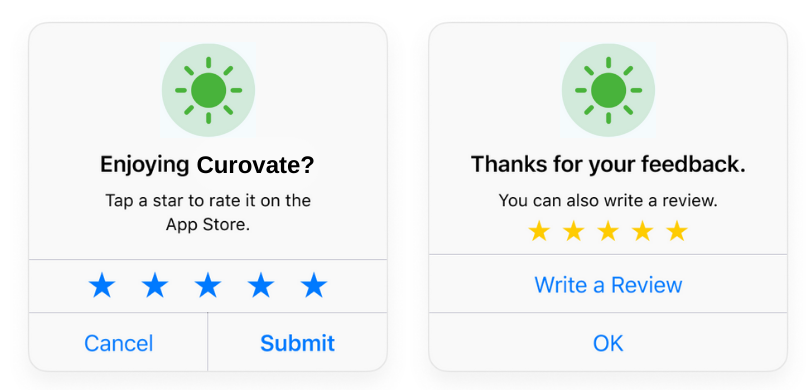
The purpose of this is to understand how you experience the app so we can make changes to improve your recovery at home after surgery and injury. You may think, “If the product works, I’ll be happy with the results,” or “giving feedback only helps the makers and doesn’t help me,” but that’s not the case. For example, a water bottle may be advertised as the perfect insulated bottle that can keep liquids cold for 42 hours. Even if you love the insulated feature of the bottle, you may not buy it because you simply hate the look or because the design of the bottle makes it impractical to carry around. By giving your feedback you not only help the creator of the product, but you also help create something for yourself.
What is a patient reported outcome measure or PROM and why should I worry about it?
The same concept of feedback is important in healthcare. For example, if you are a weightlifter recovering from ACL reconstruction surgery, there are a few important factors to consider as it relates to your recovery. First, you want to be sure that the surgery was successful in repairing your ACL. Secondly, as a weightlifter you also want to be sure that you can continue to lift heavy weights and do what you love.
To measure both aspects and determine the effectiveness of the treatment, two different outcome measures are used. Objective physician-based outcome measures (CBOMs) typically include clinical data such as range of motion, knee laxity, or knee strength, which are objectively collected by your healthcare provider.[1] CBOMs can be useful in determining whether your ACL reconstruction surgery is successful from a clinical perspective.
Patient-reported outcome measures (PROMs), on the other hand, allow you to report your symptoms, your level of disability, and your health-related quality of life, all from your perspective.[2] So PROMs can be used to let your doctor know about any limitations you may be experiencing that may be hindering your ability to lift weights. PROMs can also help you better understand whether you are making progress while recovering from injury or surgery.
Although CBOMs are defined by a standardized outcome from a physician’s perspective,[3] PROMs are intended to help you achieve the outcome you want by allowing you to report symptoms that are most relevant to you and your lifestyle.[4]
What exactly is the KOOS, who is it intended for and what does it require?
Since different conditions require different treatments, there are therefore also specific outcome measures to assess a specific treatment. A reliable and valid PROM, specialized for people with various knee conditions, including ACL injuries, ACL surgery, meniscal injuries, focal cartilage lesions, knee osteoarthritis, knee replacement and various other knee conditions, is the Knee Injury and Osteoarthritis Outcome Score (KOOS). .[5][6] The KOOS is used by people in their twenties to people in their eighties.[6] The KOOS is a self-reported questionnaire that takes approximately 10 minutes to complete. You will be asked to complete the questionnaire once before the treatment or surgery begins, and again after the treatment or surgery has taken place.[5]
In terms of questions, the KOOS assesses five of the following dimensions: pain (nine items); symptoms (seven items); activities of daily living (17 items); sports and recreational function (five items); and knee-related quality of life (four items).[5] For reference, here is an example of the entire KOOS questionnaire.[5]
How is the KOOS scored?
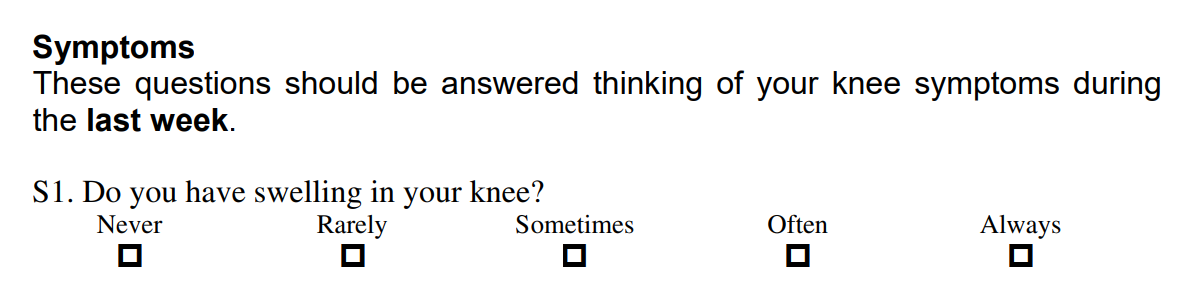
Each item on the KOOS is scored on a 5-point Likert scale, with 0 representing the least severe and 4 the most severe.[4] A 5-point Likert scale allows you to show how strongly you feel about a particular question and gives you five options from which to select the one that best represents how you feel.[7] An example question from the symptom dimension of the KOOS and the 5-point Likert scale can be found in the image below:
Each answer is associated with a score and each item score is then summed to give a total for that specific dimension. For example, the scores of all nine items from the pain dimension are summed to give a total score for pain. The total scores for each of the five dimensions are then converted to a scale of 0-100, with zero representing extreme knee problems and 100 no knee problems.[5]
What does the KOOS tell me about my knee and why is this important for me and my recovery process?
A KOOS is usually performed after an injury, after treatment, before surgery and after surgery. The KOOS can provide insight into the course of your knee injury or knee surgery and also allows healthcare providers to monitor the effect of the treatment over time.[8] It is important and necessary to have tests that can measure both short- and long-term outcomes, as traumatic knee injuries often result in damage to multiple structures such as ligaments, menisci, or cartilage.[8] and can ultimately lead to knee osteoarthritis, a degenerative joint disease characterized by pain, stiffness, swelling and limitations in joint function.[9] Given its ability to monitor both short- and long-term effects, the KOOS is therefore an effective tool to measure improvements or identify deterioration over time for people recovering from traumatic knee injuries.
As a person who has had a knee injury or surgery, it is valuable to compare your own KOOS scores with other people who have had a similar injury or surgery. Doing this can help you determine your level of functioning, progress, and limitations at any given time compared to others who have undergone the same injury or surgery.[10] In part 2 of the KOOS blog we discuss normative values for the KOOS and how to interpret these scores so you can compare your progress and understand what normal progress is.
Conclusion
A PROM is a patient-reported outcome measure. Typically, people complete these questionnaires after the injury, before surgery, after treatment, after surgery, and when they have completed treatment or rehabilitation. These questionnaires provide some insight into how the person is doing and can show progress or lack of progress. PROMs are important for you and your healthcare provider to better understand your current capabilities and limitations. One such PROM is called the Knee Injury and Osteoarthritis Outcome Score or KOOS. The KOOS asks various questions about pain (nine items); symptoms (seven items); activities of daily living (17 items); sports and recreational function (five items); and knee-related quality of life (four items). The KOOS only take 10 minutes and can provide a lot of insight into how your knee is doing. Read the blog above for more information about PROMs and the KOOS. Stay tuned for our second part of the KOOS blog, which will provide normal values for various knee injuries and surgeries.
If you have had a knee injury or surgery, try our Curovate app for your daily recovery. Curovate offers video-guided daily exercises, progress tracking, the ability to measure the range of motion of your knee and hip, and the ability to complete the KOOS outcome measurement, all within the app.
If you need more tailored help during your surgery or recovery from your injury, check out our Virtual Physiotherapy page to book your 1-on-1 video session with a physiotherapist.


Other recommended blogs





3 Comments