Author: Mokhtar

  • Orthofix announces the full commercial launch of the WaveForm L Interbody System for lateral lumbar fusion procedures

    Orthofix announces the full commercial launch of the WaveForm L Interbody System for lateral lumbar fusion procedures

    LEWISVILLE, Texas, November 6, 2023–(BUSINESS WIRE)–Orthofix Medical Inc. (NASDAQ:OFIX), a leading global spine and orthopedics company, today announced the full commercial launch in the U.S. of the WaveForm® L Lateral lumbar interbody system. Designed for lateral lumbar interbody fusion (LLIF) procedures, the 3D printed WaveForm L features a porous structure that prioritizes strength and stability to provide a robust fusion environment.

    “Designed to safely and reproducibly treat the spine via indirect decompression and sagittal alignment restoration, the WaveForm L features a large core opening for the placement of bone graft material to optimize bone fusion throughout the body,” said Dr. Donald Blaskiewicz, director of Spinal Malformation at St. Luke’s Boise Medical Center in Boise, Idaho, and faculty at UCSD in San Diego, CA. “The WaveForm L also has enhanced imaging properties to assist with radiographic visualization during intra- and postoperative imaging. These combined features make it one of the best 3D printed interbodies available.”

    WaveForm interbodies are uniquely created with a primary focus on structure, surface and stability. Constructed from a repeating wave-like structure, WaveForm L is designed to efficiently distribute compressive loads and provide high porosity for optimized stiffness without compromising strength.1,2 With an 80 percent body porosity, WaveForm L provides improved imaging properties and greater graft packability, while the optimized 65 percent endplate porosity of the wave-like structure provides bone ingrowth and early mechanical stability.3,4,5

    “We are committed to delivering a comprehensive portfolio of innovative, procedurally focused products that are strategically designed to work together to drive fusion,” said Kevin Kenny, president of Orthofix Global Spine. “WaveForm L represents the latest developments in patented spinal implant technology, which is designed to address the many nuances of spinal pathology to meet the individual needs of patients, providing both clinical and economic value to patients, surgeons and hospital systems.”

    Lateral lumbar interbody fusion (LLIF) procedures represent approximately 20 percent of the interbody device market. The number of these procedures is expected to continue to increase based on the rapid growth of titanium-coated PEEK devices and 3D printed metal devices. According to 2022 data, the LLIF market in the US is estimated at over $350 million.6

    1. Data available, TM-0043-22
    2. Kelly, Cambre N., et al. “Design and structure-function characterization of 3D printed synthetic porous biomaterials for tissue engineering.” Advanced Healthcare Materials 7.7 (2018): 1701095.
    3. Data available, TM-0071-23
    4. Data available, D0006845
    5. Kelly, C.N., Wang, T., Crowley, J., Wills, D., Pelletier, M.H., Westrick, E.R., Adams, S.B., Gall, K., & Walsh, W.R. (2021). High-strength, porous, additively manufactured implants with optimized mechanical osseointegration. Biomaterials, 279, 121206. https://doi.org/10.1016/j.biomaterials.2021.121206
    6. Data on file. Market estimates based on iData 2022 US Market Report Suite for Spinal Impants and MIS.

    About Orthofix

    Orthofix and SeaSpine merged in January 2023 to form a leading global spine and orthopedics company with an extensive portfolio of biologics, innovative spine hardware, bone growth therapies, specialty orthopedic solutions and a leading surgical navigation system. The products are distributed in approximately 68 countries around the world.

    The company is headquartered in Lewisville, Texas, where it conducts general business, product development, medical education and manufacturing, and corporate offices in Carlsbad, CA, with a focus on spine and biologics product innovation and surgeon education, and Verona, Italy. with an emphasis on product innovation, production and medical education for orthopedics. The combined company’s global R&D, commercial and manufacturing footprint also includes facilities and offices in Irvine, CA, Toronto, Canada, Sunnyvale, CA, Wayne, PA, Olive Branch, MS, Maidenhead, UK, Munich, Germany, Paris, France and São Paulo, Brazil. For more information, visit Orthofix.com.

    Forward-Looking Statements

    This press release may contain forward-looking statements within the meaning of Section 21E of the Securities Exchange Act of 1934, as amended, and Section 27A of the Securities Act of 1933, as amended. In some cases, you can identify forward-looking statements by terminology such as “may,” “will,” “should,” “expects,” “plans,” “anticipates,” “believes,” “estimates,” “projects” , ‘intends’, ‘predicts’, ‘potential’, ‘continue’ or other similar terminology. Orthofix cautions you that statements in this press release that are not descriptions of historical facts are forward-looking statements based on the company’s current expectations and assumptions. Any forward-looking statement contained in this press release is subject to risks and uncertainties that could cause actual results to differ materially from those expressed or implied by such statement. Applicable risks and uncertainties include, but are not limited to: the ability of newly launched products to perform as designed and intended and to meet the needs of surgeons and patients, including due to the lack of robust clinical validation; and the risks identified under the heading “Risk Factors” in Orthofix Medical Inc.’s annual report. on Form 10-K for the fiscal year ended December 31, 2022, which was filed with the Securities and Exchange Commission (SEC) on March 6. , 2023. The Company’s public filings with the Securities and Exchange Commission are available at www.sec.gov. You are cautioned not to place undue reliance on forward-looking statements, which speak only as of the date on which they are made. Orthofix does not intend to revise or update any forward-looking statement contained in this press release to reflect events or circumstances occurring after the date of this press release, except as may be required by law.

    Contacts

    Media relations
    Denise Landry
    DeniseLandry@orthofix.com
    214.937.2529

    Investor Relations
    Louisa Smith, Gilmartin Group
    IR@orthofix.com

    Source link

  • Salivary gland abnormalities in primary Sjögren’s become more serious over time, research shows

    Salivary gland abnormalities in primary Sjögren’s become more serious over time, research shows

    shutterstock 312351317 82a9e0224160430890b6b34a2b64af19

    New research at ACR Convergence 2023, the annual meeting of the American College of Rheumatology (ACR), shows that ultrasound-detected salivary gland abnormalities in primary Sjögren’s become more severe over time and that the slowly progressive disease likely begins long before it reaches the is first. detected (summary #1371).

    Sjögren’s disease, also called primary Sjögren’s syndrome, is a systemic autoimmune disease. It is characterized by inflammation of the tear and salivary glands, leading to chronic dry eyes and mouth. Fatigue is common and about a third of patients have complications affecting the lungs, skin, kidneys and joints. Up to 60% of patients may develop systemic symptoms.

    Salivary gland ultrasound (SGUS) is a safe and non-invasive method for diagnosing and monitoring Sjögren’s disease. Still, it’s unclear whether the abnormalities it detects become more notable over time. Valérie Devauchelle-Pensec, M.D., Ph.D., professor of rheumatology in the Department of Clinical Immunology and Rheumatology at the University of Brest Occidentale and Cavale Blanche Hospital in Brest, France, designed a cross-sectional international study to find out.

    I have been caring for patients with Sjögren’s disease for years and I am always surprised that when I see them at the beginning of their disease, their first ultrasound scan of the salivary gland shows severe lesions. I also have many patients with rheumatoid arthritis. In rheumatoid arthritis, the joints are destroyed, but not at the onset of the disease. Sjögren’s seems different. I wondered, ‘When does the disease really start and do the lesions evolve over time or not?’ Many of my colleagues, who are experts in Sjögren’s and ultrasound, agreed to participate [in the study].”


    Valérie Devauchelle-Pensec, MD, Ph.D., professor of rheumatology, department of clinical immunology and rheumatology at the University of Brest Occidentale

    Between May 2019 and February 2022, 247 patients from 11 international centers consecutively participated in the study. Most were women, with an average age of 58 years. Nearly 100% of patients reported dry mouth; 75% had abnormal saliva production and 85% were positive for anti-SSA autoantibodies, a hallmark of Sjögren’s. The median EULAR Sjögren’s disease activity score (ESSDAI) was 3, indicating low disease activity.

    Ultrasound-detected functional abnormalities of the parotid and submandibular gland were classified according to the most recent Outcome Measures in Rheumatology (OMERACT) score, a four-grade semiquantitative scoring system. The patients were then grouped according to the duration of illness from the onset of dry mouth symptoms.

    • Group A: less than five years (47 patients)
    • Group B: five to nine years (69 patients)
    • Group C: 10 to 20 years (78 patients)
    • Group D: More than 20 years (53 patients)

    When the researchers looked at the most serious node for each patient, they found a significant association between disease duration and the OMERACT score. The odds ratio for progression over a five-year interval was 1.23.

    There was no statistical difference between the groups with regard to the various ultrasound parameters, with the exception of the proportion of hyperechoic bands, which are associated with damage in established Sjögren’s patients.

    “We hypothesized that hyperechoic bands represent the slow fibroadipose evolution of the disease,” says Devauchelle-Pensec. “To me, this means that Sjögren’s disease starts long before we find it, so it is important to treat patients early.”

    She adds that the study highlights the importance of adding ultrasound findings to the classification criteria for Sjögren’s syndrome and the need for a better understanding of when the disease begins.

    Source:

    American College of Rheumatology

    Source link

  • Dr.  Gail Naughton, world-renowned authority on the multi-billion dollar regenerative medicine market, joins HippoFi as Head of Regenerative Therapeutics and Commercialization

    Dr. Gail Naughton, world-renowned authority on the multi-billion dollar regenerative medicine market, joins HippoFi as Head of Regenerative Therapeutics and Commercialization

    Scientist, inventor, business expert and holder of more than 140 patents will advance PUR Biologics’ regenerative therapeutic patent portfolio to address unmet needs in the $200 billion osteoarthritis, pain and cartilage and spine regeneration markets.

    IRVINE CA., November 7, 2023 – OrthoSpineNews HippoFi, Inc. (OTCPK: ORHB) is proud to announce the appointment of the world’s foremost authority and pioneer in regenerative medicine, Gail Naughton, MBA, Ph.D, as the “Head of Regenerative Therapeutics and Commercialization.”

    Recognized worldwide, Dr. Naughton was awarded the 27th annual National Inventor of the Year by the Intellectual Property Owners Association in honor of her groundbreaking work in tissue engineering and regenerative medicine. Dr. Naughton has been a driving force in regenerative medicine for more than 35 years and, as founder of Advanced Tissue Sciences and Histogen, has a proven track record in monetizing important cell-based therapies and bioengineered tissue technologies. Although it is known for taking four products from concept, through FDA approval, to market launch; and taken two companies to a NASDAQ stock exchange listing, she has had broad success in commercializing major brands that are still widely sold today by establishing partnerships and strategic business alliances with several industry giants, including: NYSE Company Allergan (recently purchased by AbbVie for $63B), NYSE company Smith & Nephew, NYSE company Medtronic, and Inamed Corporation (also owned by AbbVie).

    “I am thrilled and honored to join the visionary HippoFi team and work together to transform healthcare by developing and commercializing life-changing regenerative medicine solutions for unmet medical needs,” said Gail Naughton, MBA, Ph.D – Head of Regenerative Therapeutics and Commercialization.

    Dr. Naughton has served on the board of directors of several public and private companies since 1988. She currently serves as chair of the board of directors of the La Jolla Institute, executive chair of BioHIP, a member of the boards of NASDAQ, Therapeutics MD, and NYSE company CelSci, and serves on the boards of International Business and Fowler College of Business at SDSU. In addition to serving for eleven years on the board of the Toronto-based, publicly funded Center for the Commercialization of Regenerative Medicine (CCRM), she also served for several years on the bioengineering advisory board of John Hopkins, UCSD, MIT and Georgia Tech. Dr. Naughton served as dean of the College of Business Administration at SDSU from 2002 to 2011 and received her Ph.D. and MS from NYU Medical Center and an MBA from UCLA.

    “Dr. Naughton is a globally recognized, accomplished entrepreneur with many proven track records, visionary talent and unparalleled experience that will be extremely valuable to HippoFi’s continued growth and success,” said CJ Wiggins, MBA – Founder, Executive Chairman and CEO of HippoFi. “As a pioneer in our industry, adding her expertise to our experienced team not only helps us quickly commercialize and monetize our patented technologies, but also validates the tremendous market value of our patent portfolio and strengthens HippoFi as a leader in the market for regenerative therapies. ”

    About PUR Biologics
    PUR Biologics, a wholly owned subsidiary of HippoFi, Inc. (OTCPK: ORHB), is a leading biologics company committed to supporting surgeons and hospitals in providing the best care to their patients. PUR Biologics’ full line of biological products currently includes: advanced allografts and demineralized extracellular matrices (dECM), innovative synthetic solutions, cellular-derived tissues and a future of next-generation regenerative stem cell and growth factor-driven therapies for the treatment of osteoarthritis and cartilage regeneration.

    About HippoFi, Inc.
    HippoFi, Inc. delivers its breakthrough healthcare innovations through an extensive sales channel network while deploying first-to-market solutions in the multi-billion dollar biotech, fintech and artificial intelligence (AI) markets. HippoFi consists of three segments: Regenerative Therapeutics, Digital Payments and AI, which use the same customer channels to commercialize solutions, increase revenue and improve patient outcomes.

    HippoFi, Inc. is publicly traded under the symbol: ORHB and is headquartered in Irvine, California. For more information, please visit: www.HippoFi.com and www.PURbiologics.com.

    Contact
    HippoFi, Inc.
    949-323-2330
    info@hippofi.com

    Source link

  • New training program expands access to rheumatology care for Native American communities

    New training program expands access to rheumatology care for Native American communities

    Rheumatology

    New research at ACR Convergence 2023, the annual meeting of the American College of Rheumatology (ACR), describes the expansion of a new program to train primary care physicians (PCPs) in the diagnosis and treatment of rheumatoid arthritis (RA) in Native American communities that little or no access to rheumatology care (Abstract #2455).

    Despite the high prevalence of RA and other rheumatologic diseases among Native Americans, many Native American communities lack adequate access to subspecialty care. As a result, the responsibility for treatment has shifted to primary care providers, who often lack confidence in prescribing RA medications or managing the disease. To help offset the critical shortage of rheumatologists, the Rheumatology Access Expansion (RAE) Initiative launched RA ECHO (Extension for Community Healthcare Outcomes) in 2021, a 12-week training program to teach Navajo Nation PCPs how to diagnose and treat RA. The goal was to improve outcomes and reduce entrenched disparities in healthcare. This year, the project expanded to tribes in 15 states.

    We successfully offered the RA ECHO curriculum three times on the Navajo Nation from 2021-2022. For our fourth cohort – Spring 2023 – we have dramatically expanded our target audience and invited healthcare professionals serving Native American communities across the country to participate.”


    Jennifer Mandal, MD, assistant professor at the University of California, San Francisco (UCSF) and director of the RAE Initiative

    Mandal says she and her team worked with an organization called Indian Country ECHO to recruit participants for cohort four.

    “We knew that Indian Country ECHO’s established lines of communication with tribes across the country would allow us to reach a much broader audience for our RA ECHO program. And indeed, when Indian Country ECHO put out a call for interested health care providers the response was overwhelming in attending our program. Over 100 providers responded that they would like to participate, and after the final dates and times were selected, 50 providers registered,” says Mandal.

    Most participants were PCPs, but pharmacists, community health care representatives, and providers from non-primary care settings such as emergency medicine, ophthalmology, and orthopedics also enrolled.

    The Spring 2023 program followed the same format as the first three: 12 weekly interactive classes held virtually, with approximately 30 minutes of high-level didactics on key aspects of RA diagnosis and management, followed by case-based discussion. Participants were encouraged to bring their own anonymized patient cases to class. In addition to the weekly sessions, there were also biweekly virtual ‘office hours’, where participants could interact with a panel of rheumatologists.

    To measure how successful the training actually was, the RAE Initiative team collected data on PCP responses to tests and surveys. Before and after each of the four programs (cohort five is currently underway), participants completed a medical knowledge test about RA and surveys about their confidence in the diagnosis and treatment of RA on a five-point Likert scale. Starting in cohort three, participants were also asked to rate changes in their own clinical behavior, such as how often they performed joint screening exams or blood tests before starting immunosuppressants.

    Pre- and post-intervention scores were available for more than one-third of participants. When data across cohorts were pooled, test scores increased by 26% and PCP confidence increased by more than one point on the Likert scale. Nearly 80% of participants reported that they performed important clinical behaviors related to the diagnosis and treatment of RA “more often” or “much more often” after taking the course.

    While the results are encouraging, Mandal says one limitation is that they did not look directly at patient outcomes.

    “While the RAE Initiative team hopes to eventually measure patient health data, it is critical to recognize that, due to centuries of exploitation, there is widespread mistrust of requests for access to private medical records in the Navajo community. Before seeking out personal health information, we strive to prioritize respectful and considerate handling of sensitive information, while still striving to achieve our educational and empowerment goals.”

    In the meantime, she lists other next steps, including:

    • Creating educational materials for RA patients that are culturally and linguistically tailored to the Navajo community
    • Organizing in-person training for community health representatives in Navajo Nation to increase awareness about joint health and different types of arthritis
    • Creating online training resources for PCPs who want to learn more about common rheumatologic diseases
    • Creating a new ECHO training program for spondyloarthritis

    Mandal hopes that the RA ECHO program can serve as a model for creating similar rheumatology training programs for other communities with limited access to rheumatologists, saying, “We are eager to collaborate with others who are interested in joining this important mission to expand access to rheumatology care.”

    This work was funded by a grant from the Bristol Myers Squibb Foundation.

    Source:

    American College of Rheumatology

    Source link

  • Comment on Fresh air can help improve performance.  by Jordan Reed

    Comment on Fresh air can help improve performance. by Jordan Reed

    Jordan Reed- I am not currently monitoring air pollution/quality in my area. I’ve been more aware of it lately because of the fires that have been happening in Canada. Seeing the enormous effect it has had not only on the land, but also in the air. It has spread all the way to my home state of Virginia. I think if you live somewhere where air quality is a concern, you should be aware of it and monitor it daily, especially if you have athletes participating in outdoor sports. Long-term effects can occur due to poor air quality and it is not ideal for people to regularly breathe outside. If the air quality is poor, as a future Athletic Trainer there must be other places where the team/individual can participate and/or practice. It is preferable to ensure that these areas are available and ready for use, as air quality can change quickly.

    Source link

  • A deep learning system accurately identifies joint space narrowing and erosions on hand X-rays

    A deep learning system accurately identifies joint space narrowing and erosions on hand X-rays

    shutterstock 390538711 6b3c40fdd32742caa54307db3553cab1

    New research at ACR Convergence 2023, the annual meeting of the American College of Rheumatology (ACR), shows that a deep learning system can accurately identify and predict joint space narrowing and erosions in hand x-rays of patients with rheumatoid arthritis (RA) (Abstract #0745) .

    X-rays are the most commonly used imaging technique for detecting and monitoring RA in the hand. Radiologists often use the well-validated Sharp/van der Heidje (SvH) method to evaluate joint space narrowing and erosions by assessing specific locations in each hand and wrist. However, scoring SvH is time-consuming and requires expertise that is not always available. This has led to increased use of deep learning (also called machine learning) to analyze hand X-ray data in RA.

    According to Carol Hitchon, MD, FRCPC, MSc, associate professor at the University of Manitoba and clinical scientist in rheumatology and lead co-author of the study: “Machine learning offers a powerful and complementary approach to traditional RA detection and diagnosis methods. It improves the accuracy, efficiency and objectivity of RA radiograph assessment, while providing the opportunity for early detection of damage and valuable insights into the disease.”

    For the current study, Hitchon and colleagues aimed to develop and validate a deep learning system for the automated detection of joints and prediction of SvH scores on hand radiographs of patients with RA.

    They used a convolutional neural network (CNN)-based algorithm called You Only Look Once (YOLO). CNN is a deep learning neural network commonly used in computer vision and recognition tasks and has been successfully used in medical image classification. YOLO is a type of CNN model specifically designed for real-time object detection in images and videos and known for its speed and efficiency in image processing. Hitchon and colleagues used a recent version of YOLOv516, which they showed to be more than 90% accurate in detecting hand joints.

    The YOLO model was trained to detect joints in 240 training and evaluation pediatric hand radiographs from the Radiologic Society of North America database.

    The researchers boxed and labeled the different joints of interest: proximal interphalangeal, metacarpophalangeal, wrist, distal radius, and distal ulna. The joint detection model was validated with 54 clinician-labeled radiographs from four adult RA patients followed for more than ten years.

    Researchers then applied a vision transformer model (VTM) to predict the erosion and joint space narrowing score of each joint. Hitchon explains that a VTM is a deep learning architecture designed to efficiently process and understand sets of data.

    It works by splitting an image into small chunks, transforming or flattening the chunks into a sequence, creating low-dimensional linear embeddings from the flattened spots, adding the positional embedding, and then running the encoded sequence into a standard transformer encoder for the remaining prediction task. “


    Carol Hitchon, MD, FRCPC, MSc, Associate Professor, University of Manitoba

    The VTM was validated using more than 2,200 hand radiographs from 381 RA patients to whom the physician assigned SvH scores. Patients were from the Canadian Early Arthritis Cohort, a multicenter Canadian study. These scored radiographs were used as the gold standard for this study.

    The joint detection model was trained to detect the entire wrist, but the researchers had SvH scores for individual wrist joints, so they trained a separate model to detect joint space narrowing and erosion in each joint.

    When they evaluated the accuracy of their models, they found:

    • The joint detection model accurately identified target joints. The F1 score for children was 0.991 and the F1 score for adults was 0.812. (In machine learning, the F1 score is a metric that measures the accuracy of a model).
    • VTM predictions for joint space narrowing and erosion were very accurate. The principal square error, which evaluates the accuracy of predictions, was 0.91 and 0.93, respectively.
    • The multitask models predicted SvH erosion and joint space narrowing scores of individual wrist joints with moderate accuracy (0.6 to 0.91).

    Hitchon says they weren’t surprised by the performance of their model.

    “The AI ​​technologies we applied in this study have been successfully and widely used in other domains, some of which have been commercialized. Compared to the model’s performance in other domains, our performance is relatively low in predicting X-ray scores for some joint types, such as the wrist. [This] may be due to the relatively small sample size in our study or to the complexity of the anatomy of the wrist joint,” she notes.

    Hitchon also says the model’s performance does not match that of human radiologists for joints such as the wrist.

    “The AI ​​models cannot replace human radiologists at this stage, but they will be excellent complementary tools that can improve the overall quality and efficiency of radiograph scoring analysis when used in conjunction with the radiologist’s judgment. [these models] may be applicable to the interpretation of large volumes of radiographs in clinical trials.”

    The study has two major limitations: X-rays were obtained from cohorts composed almost entirely of white women, and the findings may not apply to races and ethnicities traditionally underrepresented in research studies. Hitchon acknowledges that the findings need to be replicated in other groups. The model also lacks the ability to learn and become more accurate with subsequent images, although Hitchon says they are developing a new deep learning framework so that the model continuously learns as new data is available.

    This study received local funding from the Health Science Center Foundation, a hospital charity in Winnipeg, Manitoba, Canada. One of the co-authors, Pingzhao Hu, is supported by the Canada Research Chair Program. The Canadian Early Arthritis Cohort, which provided one set of radiographs, is funded by multiple sources.

    Source:

    American College of Rheumatology

    Source link

  • Paragon 28 Announces New $150 Million Credit Facility to Replace Existing $90 Million Credit Facility

    Paragon 28 Announces New $150 Million Credit Facility to Replace Existing $90 Million Credit Facility

    ENGLEWOOD, CO, November 7, 2023–(BUSINESS WIRE)–Paragon 28, Inc. (NYSE: FNA) (“Paragon 28” or “Company”), a leading medical device company focused exclusively on the foot and ankle orthopedic market, today announced that it has received a new $150 million credit facility from Ares Capital Corporation (“the Facility”) to replace the existing $90 million senior credit facility. The facility consists of up to $100 million in term loans, with $75 million drawn at closing, and a $50 million revolving credit facility, with $25 million drawn at closing. The facility has no dilutive effect without warrants or other equity-based instruments. The Company’s pro forma liquidity as of September 30, 2023 is $147.0 million, including $97.0 million of pro forma cash and $50 million of available borrowings under the facility.

    “We expect continued improvements in our earnings and cash flow in 2024 and beyond, and the non-dilutive liquidity provided by Ares strengthens P28’s path to breakeven cash flow,” said Steve Deitsch, Chief Financial Officer.

    “We are excited to partner with Paragon 28, a truly innovative and fast-growing company,” said Doug Dieter, partner at Ares’ Credit Group. “P28’s growth and leadership in the global foot and ankle market has been impressive, and we are pleased to support its continued mission to improve patient outcomes.”

    Further details regarding the credit agreement are included in the Company’s Form 8-K filed with the U.S. Securities and Exchange Commission on November 7, 2023.

    About Paragon 28, Inc.

    Based in Englewood, Colo., Paragon 28 is a leading medical device company focused exclusively on the foot and ankle orthopedic market and committed to improving the lives of patients. Since its inception, Paragon 28® has provided innovative orthopedic solutions, procedural approaches and devices covering a wide range of foot and ankle conditions, including fracture fixation, forefoot, ankle, progressive collapsing foot deformity (PCFD) or flat foot, Charcot foot and orthobiological agents . The company designs products with both the patient and surgeon in mind, with the goals of improving outcomes, reducing recurrences of disease and complications, and making procedures simpler, more consistent and reproducible.

    About Ares Management Corporation

    Ares Management Corporation (NYSE: ARES) is a leading global alternative investment manager offering clients complementary primary and secondary investment solutions across the credit, private equity, real estate and infrastructure asset classes. We strive to provide flexible capital to support businesses and create value for our stakeholders and within our communities. By working with all our investment groups, we aim to generate consistent and attractive investment returns throughout market cycles. As of September 30, 2023, Ares Management Corporation’s global platform had approximately $395 billion in assets under management, with approximately 2,800 employees operating in North America, Europe, Asia Pacific and the Middle East. For more information, please visit www.aresmgmt.com.

    Forward-Looking Statements

    Except for the historical information contained herein, the matters set forth in this press release are forward-looking statements within the meaning of the “safe harbor” provisions of the Private Securities Litigation Reform Act of 1995, including, but not limited to to: Paragon 28’s potential to shape a better future for foot and ankle patients and estimated net revenues for the full year 2023. You are cautioned not to place undue reliance on these forward-looking statements. Forward-looking statements are only predictions based on our current expectations, estimates and assumptions, which speak only as of the date on which they are made, and are subject to risks and uncertainties, some of which we are not currently aware of. Forward-looking statements should not be read as a guarantee of future performance or results and may not necessarily be an accurate indication of the times at or at which such performance or results will be achieved. These forward-looking statements are based on Paragon 28’s current expectations and inherently involve significant risks and uncertainties. As a result of these risks and uncertainties, actual results and the timing of events may differ materially from those anticipated in such forward-looking statements. These risks and uncertainties are more fully described in the section entitled “Risk Factors” in Paragon 28’s filings with the Securities and Exchange Commission (the “SEC”), including Paragon 28’s Annual Report on Form 10-K filed on filed with the SEC on March 2. , 2023. Paragon 28 undertakes no obligation to update any forward-looking statements and expressly disclaims any obligation or undertaking to publicly release any updates or revisions to any forward-looking statements contained herein. These forward-looking statements should not be relied upon as representing the views of Paragon 28 as of any date subsequent to the date of this press release. Paragon 28’s results for the quarter ended September 30, 2023 are not necessarily indicative of our results of operations for future periods.

    Contacts

    Contact person for investors:
    Matt Brinckman
    Senior Vice President, Strategy and Investor Relations
    mbrinckman@paragon28.com

    Source link

  • Influence of the 2000-meter ergometer test on indirect markers of intestinal injury in competitive elite rowers in different training phases  BMC Sports sciences, medicine and rehabilitation

    Influence of the 2000-meter ergometer test on indirect markers of intestinal injury in competitive elite rowers in different training phases BMC Sports sciences, medicine and rehabilitation

    Attendees

    Eighteen male members of the National Polish Rowing Team (heavyweight rowers) were recruited, but only 10 met the inclusion criteria and participated in the study; all participants completed the two ergometer tests of 2000 meters. Before each test, anthropometric parameters were assessed using an electronic scale to the nearest 0.05 kg (Tanita BC-980 MA, Tanita Corporation, Tokyo, Japan). The results are shown in Table 1. The study was conducted by following the Declaration of Helsinki. The study protocol was approved by the local ethics committee of Poznań University of Medical Sciences (decision No. 314/22 in 2022). All participants were informed of the study procedures and gave their written consent.

    Table 1 The anthropometric characteristics of the participants (in the morning after an overnight fast before tests I and II).

    Inclusion criteria

    The inclusion criteria were a minimum of 5 years of training, a minimum total training time of 240 minutes per week, membership of the Polish rowing team and completion of the 2000 meter ergometer test.

    Exclusion criteria

    The exclusion criteria were antibiotic therapy, probiotics, prebiotics, metformin, dietary regimen, and health problems in the past three months.

    Training program

    The exercise profile, including intensity, volume (in minutes), and type (specific, i.e., rowing: endurance, speed, technical; and nonspecific: strength, jogging), was recorded daily. In addition, the intensity of the training was classified based on the LA threshold (4 mmol/l): an extensive (below the LA threshold) or an intensive (above the LA threshold) workload (Table 2).

    Table 2 Pre-test training program

    Food intake

    Total food intake was analyzed by a dietitian before each test using the 24-hour dietary recall method. The dietitian carefully checked each questionnaire and was available to participants during all meals. Energy, carbohydrates, proteins and fats were then measured via the commercially available DietetykPro program (DietetykPro, Wrocław, Poland).

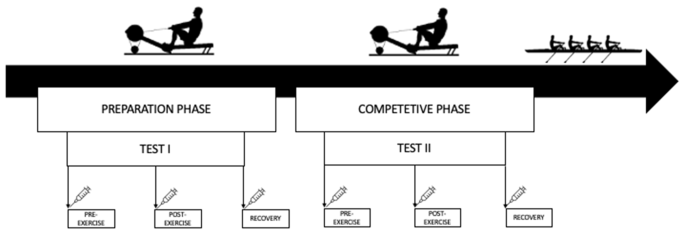
    figure 1
    Figure 1

    The research design and timeline

    Exercise test

    For tests I and II, the athletes performed a controlled test at a distance of 2000 m (Fig. 1). The break between tests was almost 10 weeks (68 days). Test I was conducted at the beginning of the preparatory phase, while Test II was conducted at the beginning of the competitive phase. The participants rowed a distance of 2000 m as quickly as possible on the ergometer (Concept II, USA), as the test results were taken into account when selecting for the champion team. The athletes were therefore highly motivated to perform both tests with maximum effort. The exercise test was performed every day at 10:00 am. Before the test, participants ate a small, light meal and were hydrated (Table 1). Before testing, each participant completed an individual 5-minute warm-up.

    Collect and research material

    Samples were collected at the same three time points: before (before training), after an overnight fast; Post (immediately after training) and recovery (after 1 hour of recovery) for tests I II.

    Blood samples were collected from the antecubital vein into 9 ml polyethylene tubes (to obtain serum) and centrifuged at 3000 rpm for 10 minutes. The serum was frozen and stored at −80°C until analysis. In addition, capillary blood samples were collected from the earlobe before and immediately after the exercise test to assess LA levels.

    Dimensions

    Serum zonulin, intestinal fatty acid binding protein (I-FABP), LPS, LBP, and interleukin 6 (IL-6) were measured using commercially available enzyme-linked immunosorbent assays (ELISAs; SunRed Biotechnology Company, Shanghai, China). The test range was 0.25–70 ng/ml for zonulin, 0.3–80 ng/ml for I-FABP, 12–4000 endotoxin units (EU)/l for LPS, 0.2–60 µg/ml for LBP and 1–300 ng/l for IL-6. In addition, LA in capillary blood was measured immediately after sampling using a commercially available kit (Diaglobal, Berlin, Germany). The LA concentrations are presented as mmol/l.

    static analysis

    Statistical analysis was performed using GraphPad Prism 9 (GraphPad Software, USA). Descriptive statistics such as mean and standard deviation were used to identify patterns and trends. To investigate whether the variables had a normal distribution, the Shapiro-Wilk test was performed. To measure the equality of variances, the Brown-Forsythe test was used. One-way repeated measures analysis of variance (ANOVA), with Tukey’s post hoc analysis, was used to assess differences in measured variables from the three assessment points (Pre, Post, and Recovery) for Tests I and II. A t test was used to compare food intake, anthropometric characteristics and 2000-m test results (power, time and LA) between tests I and II. Cohen’s d was calculated to determine effect size. It was interpreted as small (0.2), moderate (0.5), or large (0.8) (Cohen, 1988). For correlation analysis, Pearson linear correlation coefficients were calculated. Significance of all statistical analyzes was set at p ≤ 0.05. Based on a power analysis, all tests that produced significant results had a power above 0.9, as calculated by G Power 3.1(G Power, (13).

    Source link

  • Appointment of deputy general manager

    Appointment of deputy general manager

    Appointment of Sandrine Carle
    as deputy general manager

    Ecully, November 7, 2023-The Spineway Group, specialists in innovative implants for the treatment of serious spinal disorders, announces the appointment of Sandrine Carle as Deputy Chief Executive Officer. Ms. Carle joined Spineway in July 2022, at the time of the acquisition of Spine Innovations, where she was CEO. She was instrumental in the successful integration of Spine Innovations into the Spineway Group.

    After obtaining a degree in biomedical engineering (UT Compiègne) and an Executive MBA at HEC in Paris, Sandrine Carle worked for more than 20 years in the orthopedic surgery sector, and more specifically in the spine surgery sector at Medtronic (Europe), Kyphon (USA) and Vexim (France). She held marketing and management positions in France and the US before being appointed CEO of Spine Innovations in 2020.

    Ms. Carle led the creation of this entity following a spin-off in 20201 and the development of this activity between 2020 and 2022. She led the recruitment and management of about fifteen employees, set up the functional and operational organization of the team and also obtained the company’s certification from the notified body G-MED (France ).

    Together with Stéphane Le Roux, CEO of Spineway, Sandrine Carle is responsible for executing the Group’s overall roadmap, in particular the business development plan aimed at returning to operational break-even,2 as well as all R&D projects (short, medium and long term).

    Stéphane Le Roux said: “I am pleased that Sandrine is joining me as Deputy Chief Executive Officer of Spineway. I am confident that her leadership, strategic insight and deep market knowledge will help shape our future. She will strengthen our highly experienced management team. Sandrine will also lead the Group’s development plan as we remain committed to our core values ​​of quality and innovation. She will work closely with me, our management team and all our employees to achieve our goal: to become an innovative player in France and internationally, a leader in less invasive spine treatments.”

    Next event:
    November 10, 2023: Extraordinary General Meeting

    SPINEWAY ELIGIBLE FOR PEA-SME (Small and Medium Business Equity Savings Plans)
    Find out all about Spineway at www.spineway.com

    This press release has been drawn up in both English and French. In case of contradictions, the French version shall prevail.

    Spineway designs, produces and sells innovative implants and surgical instruments for the treatment of serious spinal conditions.
    Spineway has an international network of more than 50 independent distributors and 90% of its turnover comes from exports.
    Spineway, which is eligible for investment through FCPIs (French unit trusts specialized in innovation), has received the OSEO Excellence Award since 2011 and the Deloitte Fast 50 Award (2011). Rhône Alpes INPI Patent Innovation Award (2013) – INPI Talent Award (2015).
    ISIN: FR001400BVK2 – ALSPW

    Contacts:

    SPINEWAY

    Shareholder services line

    Available from Tuesday to Thursday

    +33 (0)806 706 060

    Suitable PEA/PME

    ALSPW

    Euonext growth

    HEAVEN

    Office & Communications

    Relations with investors

    Solène Kennis

    Spineway@aelium.fr


    1 Spine Innovations was a spin-off born in 2020 from the sale of Groupe FH Orthopedics (France) to the Spineway Group.
    2 Positive operating result

    SPINEWAY

    Source link

  • Zimmer Biomet reports third quarter 2023 financial results

    Zimmer Biomet reports third quarter 2023 financial results

    • Third quarter net sales of $1.754 billion increased 5.0% and 4.7% at constant exchange rates1 base
    • Third quarter diluted earnings per share were $0.77; adjusted1 diluted earnings per share were $1.65
    • The company updates reported 2023 revenue expectations due to currency expectations and reaffirms consistent 2023 foreign exchange revenue growth and adjusted1 financial guidelines for earnings per share

    WARSAW, Ind., Nov. 7, 2023 /PRNewswire/ — Zimmer Biomet Holdings, Inc. (NYSE and SIX: ZBH) today reported financial results for the quarter ended September 30, 2023. The company reported third quarter net sales of $1.754 billion, up 5.0% from the same period last year, and an increase of 4.7% at constant exchange rates1 base. Net income for the third quarter was $162.7 million, or $346.5 million adjusted1 base.

    Diluted earnings per share were $0.77 for the third quarter and were adjusted1 diluted earnings per share were $1.65.

    1. Reconciliations of these measures to the corresponding US generally accepted accounting principles are included in this press release.

    “We are very pleased to report another Zimmer Biomet quarter of strong revenue growth and earnings per share. Our team continues to successfully drive execution and growth with a focus on innovation to create value for the stakeholders we serve,” said Ivan Tornos, President and Chief Executive Officer of Zimmer Biomet. “As the new CEO of ZB, I am more confident than ever in our team, our full-year expectations for 2023 and that our solid growth – both top and bottom line – will continue in 2024.”

    Recent Highlights

    In line with the ongoing transformation of Zimmer Biomet’s business, key recent highlights include:

    • Appointment of Ivan Tornos as President and Chief Executive Officer and expansion of Chief Financial Officer Suketu (Suky) Upadhyay’s role to CFO and EVP, Finance, Operations & Supply Chain as part of Zimmer Biomet’s increased focus on innovation and commercial execution
    • Major updates to the Zimmer Biomet Executive Leadership Team, including the promotion of Wilfred van Zuilen to Group President, EMEA and Mark Bezjak to President of the Americas, as well as the appointment of Chief Science, Technology and Innovation Officer Nitin Goyal, MD to the Executive Leadership team
    • Registration of 100,000 patients since the launch of mymobility® care management platform, which provides a guided orthopedic patient experience, with automation, data and insights for physicians
    • Continued recognition for our Environmental, Social and Governance (ESG) programs with inclusion on the Newsweek Americas Greenest Companies 2024 and Sustainability Magazine Top 10: Sustainable Healthcare Device Companies lists

    Geographic and product category sales

    The following sales tables provide results by geography and product category for the three- and nine-month periods ended September 30, 2023, as well as the percentage change compared to the applicable prior year period, both on a reported and constant currency basis.

    SEE FINANCES HERE

    Source link