13102

Influence of the 2000-meter ergometer test on indirect markers of intestinal injury in competitive elite rowers in different training phases BMC Sports sciences, medicine and rehabilitation


Attendees

Eighteen male members of the National Polish Rowing Team (heavyweight rowers) were recruited, but only 10 met the inclusion criteria and participated in the study; all participants completed the two ergometer tests of 2000 meters. Before each test, anthropometric parameters were assessed using an electronic scale to the nearest 0.05 kg (Tanita BC-980 MA, Tanita Corporation, Tokyo, Japan). The results are shown in Table 1. The study was conducted by following the Declaration of Helsinki. The study protocol was approved by the local ethics committee of Poznań University of Medical Sciences (decision No. 314/22 in 2022). All participants were informed of the study procedures and gave their written consent.

Table 1 The anthropometric characteristics of the participants (in the morning after an overnight fast before tests I and II).

Inclusion criteria

The inclusion criteria were a minimum of 5 years of training, a minimum total training time of 240 minutes per week, membership of the Polish rowing team and completion of the 2000 meter ergometer test.

Exclusion criteria

The exclusion criteria were antibiotic therapy, probiotics, prebiotics, metformin, dietary regimen, and health problems in the past three months.

Training program

The exercise profile, including intensity, volume (in minutes), and type (specific, i.e., rowing: endurance, speed, technical; and nonspecific: strength, jogging), was recorded daily. In addition, the intensity of the training was classified based on the LA threshold (4 mmol/l): an extensive (below the LA threshold) or an intensive (above the LA threshold) workload (Table 2).

Table 2 Pre-test training program

Food intake

Total food intake was analyzed by a dietitian before each test using the 24-hour dietary recall method. The dietitian carefully checked each questionnaire and was available to participants during all meals. Energy, carbohydrates, proteins and fats were then measured via the commercially available DietetykPro program (DietetykPro, Wrocław, Poland).
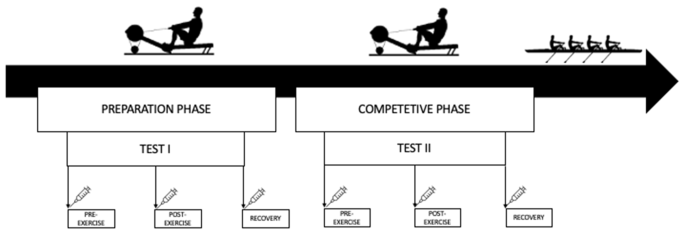
figure 1
Figure 1

The research design and timeline

Exercise test

For tests I and II, the athletes performed a controlled test at a distance of 2000 m (Fig. 1). The break between tests was almost 10 weeks (68 days). Test I was conducted at the beginning of the preparatory phase, while Test II was conducted at the beginning of the competitive phase. The participants rowed a distance of 2000 m as quickly as possible on the ergometer (Concept II, USA), as the test results were taken into account when selecting for the champion team. The athletes were therefore highly motivated to perform both tests with maximum effort. The exercise test was performed every day at 10:00 am. Before the test, participants ate a small, light meal and were hydrated (Table 1). Before testing, each participant completed an individual 5-minute warm-up.

Collect and research material

Samples were collected at the same three time points: before (before training), after an overnight fast; Post (immediately after training) and recovery (after 1 hour of recovery) for tests I II.

Blood samples were collected from the antecubital vein into 9 ml polyethylene tubes (to obtain serum) and centrifuged at 3000 rpm for 10 minutes. The serum was frozen and stored at −80°C until analysis. In addition, capillary blood samples were collected from the earlobe before and immediately after the exercise test to assess LA levels.

Dimensions

Serum zonulin, intestinal fatty acid binding protein (I-FABP), LPS, LBP, and interleukin 6 (IL-6) were measured using commercially available enzyme-linked immunosorbent assays (ELISAs; SunRed Biotechnology Company, Shanghai, China). The test range was 0.25–70 ng/ml for zonulin, 0.3–80 ng/ml for I-FABP, 12–4000 endotoxin units (EU)/l for LPS, 0.2–60 µg/ml for LBP and 1–300 ng/l for IL-6. In addition, LA in capillary blood was measured immediately after sampling using a commercially available kit (Diaglobal, Berlin, Germany). The LA concentrations are presented as mmol/l.

static analysis

Statistical analysis was performed using GraphPad Prism 9 (GraphPad Software, USA). Descriptive statistics such as mean and standard deviation were used to identify patterns and trends. To investigate whether the variables had a normal distribution, the Shapiro-Wilk test was performed. To measure the equality of variances, the Brown-Forsythe test was used. One-way repeated measures analysis of variance (ANOVA), with Tukey’s post hoc analysis, was used to assess differences in measured variables from the three assessment points (Pre, Post, and Recovery) for Tests I and II. A t test was used to compare food intake, anthropometric characteristics and 2000-m test results (power, time and LA) between tests I and II. Cohen’s d was calculated to determine effect size. It was interpreted as small (0.2), moderate (0.5), or large (0.8) (Cohen, 1988). For correlation analysis, Pearson linear correlation coefficients were calculated. Significance of all statistical analyzes was set at p ≤ 0.05. Based on a power analysis, all tests that produced significant results had a power above 0.9, as calculated by G Power 3.1(G Power, (13).

Source link

Similar Posts

  • |

    Flying after knee replacement

    What if the freedom to travel by air after major joint surgery isn’t as far off as you think? We understand this is a common concern. Many people who have undergone this significant orthopedic procedure worry about their next trip. flying after knee replacement Research shows that managing mobility after an operation is crucial. For instance, data indicates 3-4% of total hip arthroplasty patients develop symptomatic blood clots within three months. Our guide provides essential information for navigating air travel following a successful procedure. We aim to help you feel confident and prepared for your journey. You may wonder when it is safe to resume your plans. We explore how to manage your healing while looking ahead. By following expert-backed advice, you can minimize potential issues. Our focus is on helping you enjoy your restored mobility with peace of mind. Key Takeaways Air travel is a major concern for individuals recovering from joint surgery. Proper planning is essential for a safe and comfortable journey post-operation. Understanding the risks, like blood clots (VTE), is a critical part of preparation. Timing your trip correctly is a key milestone in the overall recovery process. Expert guidance can help reduce complications and build confidence. The goal is to regain freedom of movement and enjoy travel without worry. Understanding the Risks and Benefits of Flying after Knee Replacement The decision to fly after a major joint procedure requires a careful look at safety data and personal mobility gains. We break down the key factors to consider. Assessing Venous Thromboembolism (VTE) Risk A primary concern is venous thromboembolism, which includes deep vein thrombosis (DVT). Research shows the risk of symptomatic VTE after long flights is 1.9 to 5.2 per million person-days. For individuals who have had joint surgery, this risk is heightened. Studies indicate 3-4% of patients develop symptomatic clots within three months of a procedure like total hip arthroplasty. Balancing Recovery and Mobility Benefits The significant improvement in movement is a major positive outcome. However, balancing this benefit with the inherent dangers of blood clots requires medical guidance. Understanding these risks empowers people to make informed choices about travel timing. For comprehensive safety tips, see our detailed guide on flying after knee replacement. Pre-Flight Preparation for Knee Replacement Patients A successful journey begins long before you reach the airport, especially following a significant orthopedic operation. Proper groundwork is essential for safety and comfort. This phase involves close collaboration with your medical team. It also requires a tailored strategy for your specific needs. Consulting with Your Surgeon and Healthcare Team Your first step is to get clear guidance from your orthopedic surgeon. They understand your unique situation best. Dr. Nathan Cafferky of The Steadman Clinic recommends a two-week recovery period near the surgical site before returning home. This allows for immediate post-operative care and monitoring. consulting surgeon for knee surgery travel plan We advise creating a personalized plan with your doctor. This consultation is vital for setting a safe timeline. Creating a Personalized Recovery and Travel Plan Dr. Cafferky also suggests avoiding nonessential trips for six weeks post-surgery. This waiting time helps ensure full healing. Your plan should coordinate support from your entire care team. Focus on rehabilitation during the initial weeks. This approach minimizes risks and builds a solid foundation for future mobility. A thoughtful strategy makes the transition back to daily life much smoother. Planning Your Travel Itinerary and Navigating Airline Requirements Understanding specific carrier policies can make or break your travel plans post-surgery. We guide you through this essential step. Your itinerary must account for unique airline rules. These rules directly impact individuals recovering from an operation. Reviewing Airline Policies and Certification Requirements Research reveals varied carrier stances. A UK study found five airlines restrict flying following arthroplasty. Seven carriers mandate a medical certificate from your doctor. One even requires a 14-day waiting period post-procedure. Always verify your airline’s specific policy before booking. This is a critical precaution for all patients. Policy Type Medical Certificate Required Typical Waiting Period Restricted (No travel allowed) N/A…

  • Attending live sports improves well-being: study

      New scientific research has found that attending live sporting events improves levels of wellbeing and reduces feelings of loneliness. Published in the magazine Frontiers in public healthThe study is the first large-scale study to examine the benefits of attending any type of live sporting event. The research, conducted by academics from Anglia Ruskin University’s…

  • The story of chronic traumatic encephalopathy is not as simple as it seems

    Neuropathological and clinical findings in young contact athletes exposed to repetitive head impacts McKee AC, Mez J, Abdulmohammad B, et al. JAMA Neurology. Published online 2023. doi:10.1001/jamaneurol.2023.2907 Full article available for free Take home message Less than half of young adults exposed to repetitive head impacts through sports and who suffered from mental health and…

  • Spontaneous baby movements have a purpose

      Spontaneous, voluntary baby movements promote the development of their sensorimotor systems, according to new research led by the University of Tokyo. Detailed movement recording of newborns and infants was combined with a computer model of the musculoskeletal system, allowing researchers to analyze the communication between muscles and sensations across the body. Researchers found that…

  • 2024-2025 – Rush Research Fellowship – Orthopedic Oncology

      Prerequisites for the position include: – Ability to start on campus within the recommended time frame – Successful completion of the third year before start date – Strong motivation for a career in orthopedic surgery – Clear interest in research and a strong academic record – MUST be extremely organized and detailed – MUST…

2 Comments

Leave a Reply

Your email address will not be published. Required fields are marked *