
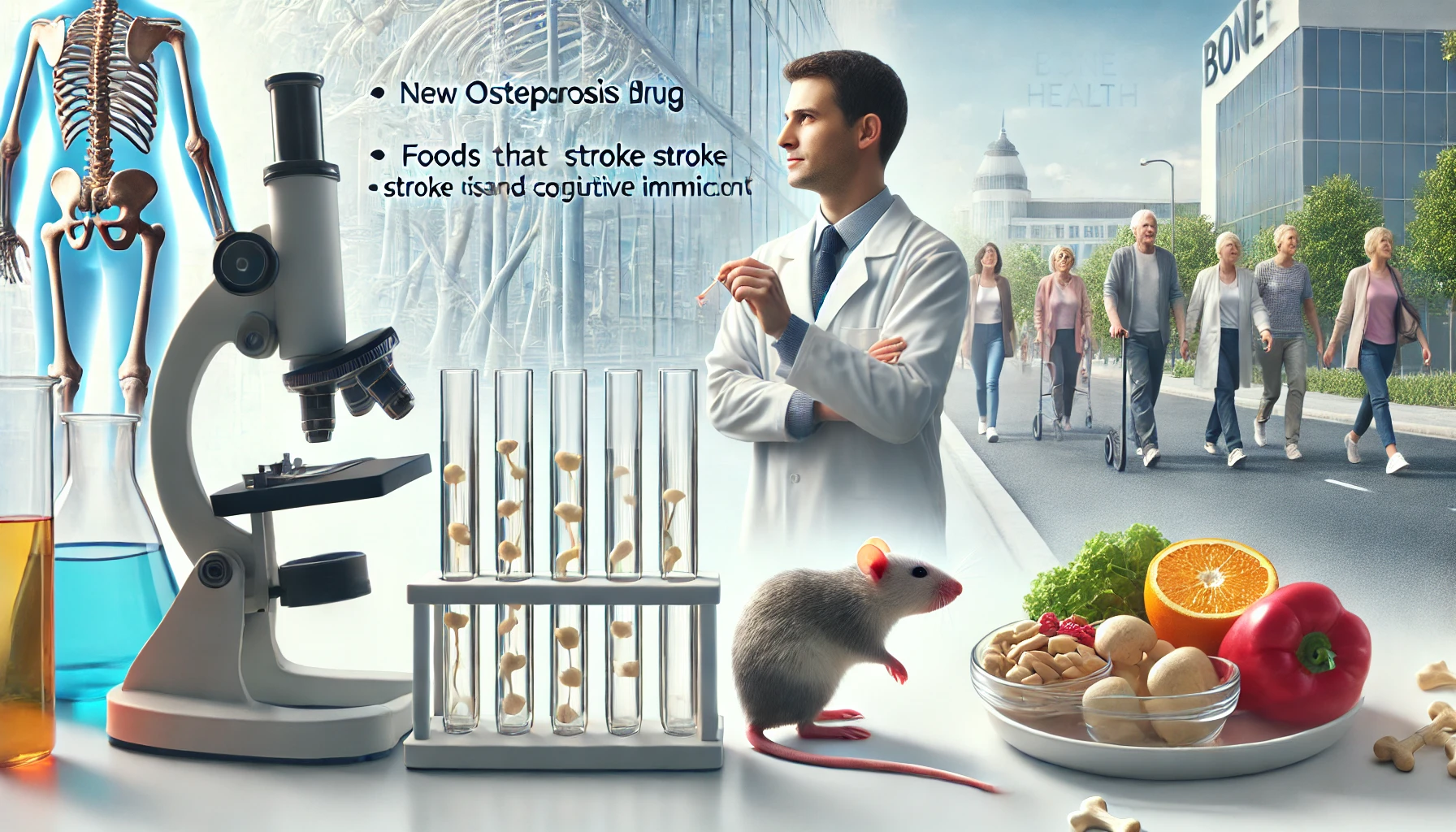
Save Our Bones Bulletin: New Osteoporosis Drug Tested in Mice; Diet Reduces Stroke Risk, Cognitive Impairment; Walking Outdoors Benefits Bone Health
This month’s bulletin begins with a study that could lead to a new drug for osteoporosis. We’ll explore what researchers have discovered and how it could impact the future of bone health.
Next, you’ll learn about a study on the health effects of ultra-processed foods. Cognitive decline may be more related to eating TV dinners than watching TV.
Finally, we discuss a study published in the journal Osteoporosis International that measured the benefits of outdoor walking on bone health. Get your sneakers ready, because these results will inspire you to get out of the house and hit the trails!
Natural protein investigated as potential drug against osteoporosis
Researchers at the University of Birmingham in the UK have discovered that a short protein called PEPITEM (Peptide Inhibitor of Trans-Endothelial Migration) can be turned into a new drug against osteoporosis.
In the study, PEPITEM was administered to laboratory mice to study the protein’s impact on their bones. The researchers found that PEPITEM therapy significantly increased bone volume and thickness in both the tibia and vertebrae of adult mice. They also observed the effects of PEPITEM on osteoblast cells in the laboratory and found that the protein increased the activity of the bone-forming cells.
Relevant fragment
“…the key test for a potential new therapy is its ability to target the natural repair process that is impaired by age or inflammatory disease. Here, the researchers showed that giving extra PEPITEM limits bone loss and improves bone density in animal models of menopause, which is a common trigger for osteoporotic bone loss in humans. Their studies also showed similar findings in models of inflammatory bone disease (arthritis), where PEPITEM significantly reduced bone damage and erosion.”1
This discovery provides useful information about how our bodies regulate the bone remodeling process, but also carries unknown risks as a potential new drug. PEPITEM is likely to enter human trials, which will begin to reveal what unintended side effects are caused by pharmaceutical applications of the protein.
Short content
Scientists in the UK have identified a protein called PEPITEM and found that the compound increases the volume and thickness of bone in studies with mice. The researchers suggest that PEPITEM could be turned into an osteoporosis drug that increases osteoblast activity to improve bone density.
Ultra-processed foods linked to stroke and cognitive decline
A new study published in the May 22, 2024, online edition of Neurology links ultra-processed foods to an increased risk of stroke and cognitive decline. Ultra-processed foods are high in added sugar, fat, and salt, and low in protein and fiber.
The study followed 30,239 people aged 45 or older for an average of 11 years. Participants completed a food questionnaire that was used to calculate the percentage of their daily diet that consisted of ultra-processed foods.
Relevant fragment
“After adjusting for age, sex, high blood pressure and other factors that may influence dementia risk, researchers found that a 10% increase in the amount of ultra-processed foods eaten was associated with a 16% higher risk of cognitive impairment.
They also found that eating more unprocessed or minimally processed foods was linked to a 12% lower risk of cognitive impairment.”2
Similar to the results for cognitive impairment, a higher intake of ultra-processed foods was associated with an 8% higher risk of stroke. Participants with a higher intake of unprocessed or minimally processed foods had a 9% lower risk of stroke.
These findings underscore the value of the Osteoporosis Reversal Program’s 80/20 pH-balanced diet. Processed foods are acidifying, so they are naturally limited by a diet that consists of only 20 percent acidifying foods. Additionally, the Save Institute recommends avoiding processed foods as much as possible.
Short content
A study in the online journal Neurology found that participants who ate higher amounts of ultra-processed foods had a higher risk of stroke and cognitive impairment. All processed foods are acidifying, so they are naturally limited by an 80/20 pH-balanced diet, but they should also be avoided as much as possible.
Walk to stronger bones
A study published in Osteoporosis International analyzed the outdoor walking habits of 24,700 older adults and their risk of osteoporosis. They also looked at participants’ genetic predisposition to osteoporosis.
Researchers divided the participants into four groups:
- those who did not go outside
- those who walked 30 minutes or less
- those who walked 30-60 minutes
- those who walked 60 minutes or more
The study included 37 months of follow-up, during which time researchers found a significant negative correlation between daily outdoor walking and the risk of osteoporosis incidence. The reduction in osteoporosis risk was directly correlated with the length of the walks, ranging from 14 percent to as much as 40 percent for those who walked the most.
Relevant fragment
“Researchers also found a “decreasing trend” in osteoporosis risk among participants with both low and high genetic predispositions – meaning that regardless of whether osteoporosis runs in your family, a daily walk may help strengthen bones. Note: If you have a family history of osteoporosis, it may be especially helpful to walk for an hour every day: the researchers found that participants with a high genetic risk who walked outdoors for more than 60 minutes experienced the greatest reduction in their risk.”3
Walking is a weight-bearing exercise that promotes bone formation. It is notable that this study specifically examined outdoor walking. Exposure to greenery and the outdoors has a positive impact on both well-being and bone health.
Regardless of how much or how little you currently walk, you can increase the benefit by adding extra distance, frequency, or intensity to your walks. Additionally, choosing a greener walking path can amplify the positive effects of your walk.
Short content
A study of older adults found that those who spent the most time outdoors (more than 60 minutes per day) had the lowest risk of osteoporosis. This risk reduction was also effective for people who were genetically predisposed to osteoporosis.
What this means for you
Our bodies are complex biological systems that are sensitive to many inputs. That sensitivity is one reason why drugs are such a risky proposition: they cause changes and effects that are not intended or desired. But it is also why natural strategies to improve our health have such far-reaching positive effects. A balanced diet of whole foods and regular exercise can keep your bones strong and your life active.
The Osteoporosis Reversal Program provides a comprehensive approach to strengthening your bones and reducing your risk of fractures, without the risks of medications.
You have an incredible amount of resources at your disposal. Use what you have learned to create the future you deserve.
References
1 https://www.birmingham.ac.uk/news/2024/new-therapeutic-avenues-in-bone-repair
2 https://www.news-medical.net/news/20240522/Higher-intake-of-ultra-processed-foods-linked-to-increased-risk-of-stroke-and-cognitive-decline.aspx
3 https://www.thehealthy.com/exercise/walking/news-walking-outside-osteoporosis-risk-may-2024-study/




4 Comments