download 3

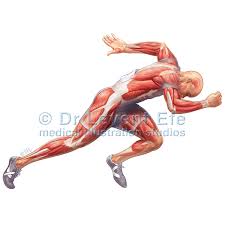
Sprinters’ legs: very muscular, still maneuverable


A comprehensive knowledge of human biomechanics is useful to train athletes more effectively. From a biomechanical perspective, sprinting is challenging compared to running and endurance running, making it an intriguing area of ​​research. Furthermore, a detailed biomechanical understanding of sprinters’ limbs may be insightful for more effective training of sprinters and for advancing our understanding of human motor performance in general.

Previous studies have shown that sprinters have inhomogeneous muscle development, with well-developed hip flexors, extensors and muscles in the proximal femur. Muscle strength in sprinters corresponds well with the demands of the musculoskeletal system when sprinting, which can be a positive aspect in terms of strength-related factors. At the same time, however, the morphological differences would imply differences in mass distribution and thus maneuverability. More muscular legs would lead to greater mass and, in turn, to general speculation about the trade-off between greater torque-exertion capacity and greater difficulty in moving the lower limb.

This raises an interesting question: how do sprinters balance muscle strength and brisk movements? Contextually, not much is known about the maneuverability of sprinter legs from an inertial perspective. This knowledge gap caught the attention of a research team led by Professor Yasuo Kawakami of Waseda University’s Faculty of Sports Sciences, who, together with his colleagues Hoshizora Ichinose of Nihon University and Dr. Natsuki Sado of the University of Tsukuba examined the leg morphology of athletes. from an inertial perspective.

“As former athletes, we have been interested in the relevance of the human body in sport. Athletes train hard, but in many cases they do not know how their body specifically responds to training. We wanted to address this and help develop effective training strategies ,” says Kawakami, explaining the motivation behind their research.

In their study, the researchers analyzed fat- and water-separated MRI scans from 11 male sprinters, all trained athletes with careers lasting more than 7 years, and 12 male non-sprinters, individuals who had not undergone resistance training or practiced sports within the past two years at the time of the survey. By comparing the MRI features, they found that the sprinters had higher relative lower limb mass than the non-sprinters. This increase in muscle strength in turn promoted energy production while running. These findings have been published in Medicine & Science in Sports & Exercise. To understand the interplay between joint torque and segment maneuverability, the researchers further calculated the moment of inertia of the lower limbs around the hip. This comparison showed that moment of inertia did not differ between sprinters and non-sprinters, suggesting that increased muscle mass does not compromise lower limb maneuverability in sprinters.

When comparing different parts of the lower limbs between sprinters and non-sprinters, the researchers found that while the relative mass of the thighs differed between sprinters and non-sprinters, the relative mass of the shank and foot did not vary. Thus, the researchers conclude that these top-heavy, underlight features of sprinters’ limbs help them perform athletic movements with ease, judging from an inertia perspective.

This new study sheds light on the unique characteristics of sprinters’ lower limbs. The findings will be useful for the development of new training strategies. Based on their findings, what do the researchers suggest athletes and trainers do to train more effectively? Kawakami notes: “Sprinters can focus on training the muscles of their lower extremities without having to worry about the increased mass associated with sprint-induced lower extremity muscle strength and the resulting difficulty in moving due to a larger moment of inertia. This strategy will help balance running power and limb movements.”

Source link

Similar Posts

  • Patients with autoimmune rheumatic diseases benefit significantly from the fourth dose of COVID-19 vaccine

    Patients with autoimmune rheumatic diseases, including rheumatoid arthritis and other chronic conditions that cause inflammation, are at increased risk for SARS-CoV-2 infection and death from severe COVID-19. Many patients receive disease-modifying antirheumatic drugs (DMARDs) to treat these conditions, but this treatment has been associated with a blunted response to COVID-19 vaccines. The U.S. Centers for…

  • |

    Aclarion Expands Immediate Nociscan Access to New York City with Addition of Tenth Key Opinion Leader, Consultant Surgeon Roger Hartl, MD

      Dr. Hartl is the Hansen-MacDonald Professor of Neurological Surgery and director of Spinal Surgery at the Weill Cornell Brain and Spine Center in New York, and co-director of New York-Presbyterian Och Spine. Dr. Hartl becomes Aclarion’s 2NL KOL to gain access to an MRI center authorized to perform Nociscans, adding NYC to Denver as…

  • August 2023 — Bone Talk

    As team captain of Be Bone Strong™, Barbara Hannah Grufferman, a nationally recognized positive living advocate, award-winning author and avid marathoner, will provide guidance and support to the team. To date, Barbara has run fourteen marathons and countless half marathons and other smaller races, all since she turned 50. She is passionate about motivating people…

  • |

    Best knee pillow for side sleepers

    What if one simple addition to your bedtime routine could dramatically improve how you feel every morning? Many people who rest on their side wake up with aches in their hips, back, or legs. This common discomfort often stems from poor spinal alignment during the night. Finding the right support can make all the difference. knee pillow for side sleepers We consulted with experts to understand this issue. Grace Wu, a textiles product review analyst at the Good Housekeeping Institute, has tested over 200 pillows in recent years. Dr. Jonathan S. Kirschner, a physiatrist at the Hospital for Special Surgery, often recommends specific support for hip issues. Choosing the Best knee pillow for side sleepers can significantly enhance your comfort and support while you rest. Our team evaluated numerous products designed for this purpose. We looked for items that promote a neutral position and offer lasting comfort. This guide is the result of our thorough analysis. We aim to help you navigate the options and make an informed choice for your bedroom. The right product can transform your nightly rest and support your joints properly. Key Takeaways Proper support is crucial for maintaining spinal alignment while sleeping on your side. Expert input from textile analysts and medical professionals informs our recommendations. Our selection is based on extensive evaluation of comfort, durability, and support. The correct product can alleviate common discomfort in the hips, back, and legs. This guide simplifies your search by highlighting top-performing options. Investing in quality support is an investment in better sleep and daily well-being. Introduction to Best Knee Pillow for Side Sleepers Have you ever considered how the position of your legs at night could influence your entire day? Proper support is not just about your head and neck. What Is a Knee Pillow? A knee pillow is a specialized cushion. It is designed to be placed between your legs while you are resting. Its primary job is to improve your sleeping posture and support your joints. Why Side Sleepers Benefit When you rest on your side, your top leg often drops forward. This can pull your spine out of its natural line. The result is unwanted pressure on your hips and lower back. Beth Terranova, a physical therapist, notes that knee position directly affects the hip, pelvis, and spine. Using a cushion here bridges the natural gap. It helps keep your hips properly stacked. This simple act prevents the spine from rotating during the night. You are less likely to wake up with morning aches. Understanding this mechanic is the first step toward a more restful night. How Knee Pillows Enhance Sleep Alignment Could a simple cushion between your legs be the key to unlocking deeper, more restorative sleep? It all comes down to alignment. Proper spinal and hip positioning is crucial for anyone resting on their side. Spine and Hip Alignment When your hips are not stacked correctly, your spine twists. This places stress on joints and muscles. Dr. Jonathan S. Kirschner recommends placing a pillow between the legs for hip bursitis patients. sleep…

  • You Are Not Alone – Depression, Stress and Anxiety in the Locker Room

    Trends in student-athlete mental health in the National College Health Assessment, 2011-2019. Edwards B, Froehle AW and Fagan SE. J Athl training. 2023,58(4):361-373. doi: 10.4085/1062-6050-0586.21. Full text available for free Take home message College athletes and non-athletes are under a great deal of stress. Reported mental health symptoms and diagnoses are increasing, with 1 in…

One Comment

Leave a Reply

Your email address will not be published. Required fields are marked *