download 3

Sprinters’ legs: very muscular, still maneuverable


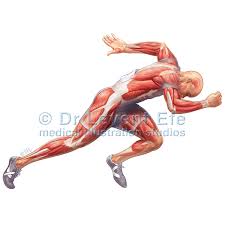
A comprehensive knowledge of human biomechanics is useful to train athletes more effectively. From a biomechanical perspective, sprinting is challenging compared to running and endurance running, making it an intriguing area of ​​research. Furthermore, a detailed biomechanical understanding of sprinters’ limbs may be insightful for more effective training of sprinters and for advancing our understanding of human motor performance in general.

Previous studies have shown that sprinters have inhomogeneous muscle development, with well-developed hip flexors, extensors and muscles in the proximal femur. Muscle strength in sprinters corresponds well with the demands of the musculoskeletal system when sprinting, which can be a positive aspect in terms of strength-related factors. At the same time, however, the morphological differences would imply differences in mass distribution and thus maneuverability. More muscular legs would lead to greater mass and, in turn, to general speculation about the trade-off between greater torque-exertion capacity and greater difficulty in moving the lower limb.

This raises an interesting question: how do sprinters balance muscle strength and brisk movements? Contextually, not much is known about the maneuverability of sprinter legs from an inertial perspective. This knowledge gap caught the attention of a research team led by Professor Yasuo Kawakami of Waseda University’s Faculty of Sports Sciences, who, together with his colleagues Hoshizora Ichinose of Nihon University and Dr. Natsuki Sado of the University of Tsukuba examined the leg morphology of athletes. from an inertial perspective.

“As former athletes, we have been interested in the relevance of the human body in sport. Athletes train hard, but in many cases they do not know how their body specifically responds to training. We wanted to address this and help develop effective training strategies ,” says Kawakami, explaining the motivation behind their research.

In their study, the researchers analyzed fat- and water-separated MRI scans from 11 male sprinters, all trained athletes with careers lasting more than 7 years, and 12 male non-sprinters, individuals who had not undergone resistance training or practiced sports within the past two years at the time of the survey. By comparing the MRI features, they found that the sprinters had higher relative lower limb mass than the non-sprinters. This increase in muscle strength in turn promoted energy production while running. These findings have been published in Medicine & Science in Sports & Exercise. To understand the interplay between joint torque and segment maneuverability, the researchers further calculated the moment of inertia of the lower limbs around the hip. This comparison showed that moment of inertia did not differ between sprinters and non-sprinters, suggesting that increased muscle mass does not compromise lower limb maneuverability in sprinters.

When comparing different parts of the lower limbs between sprinters and non-sprinters, the researchers found that while the relative mass of the thighs differed between sprinters and non-sprinters, the relative mass of the shank and foot did not vary. Thus, the researchers conclude that these top-heavy, underlight features of sprinters’ limbs help them perform athletic movements with ease, judging from an inertia perspective.

This new study sheds light on the unique characteristics of sprinters’ lower limbs. The findings will be useful for the development of new training strategies. Based on their findings, what do the researchers suggest athletes and trainers do to train more effectively? Kawakami notes: “Sprinters can focus on training the muscles of their lower extremities without having to worry about the increased mass associated with sprint-induced lower extremity muscle strength and the resulting difficulty in moving due to a larger moment of inertia. This strategy will help balance running power and limb movements.”

Source link

Similar Posts

  • |

    Inflammatory diseases do not increase the risk of clotting after COVID, research shows

      This is evident from a recent study published in the journal JAMA network openedResearchers in Canada investigated whether coronavirus disease 2019 (COVID-19) patients with immune-mediated inflammatory diseases (IMIDs) were at higher risk of experiencing venous thromboembolism after recovery from severe acute respiratory syndrome coronavirus 2 (SARS-CoV- 2) infections compared to COVID-19 patients without IMIDs….

  • |

    Plums for your bones – Food for healthy bones

    Eating plums for your bones can help prevent or slow bone loss by reducing inflammation and oxidative stress. There are two delicious recipes on my plum blog. Skelly and I spend a lot of time promoting strong bones and how to nourish them. But many women we meet don’t think about it – until it’s…

  • Bone Turnover Markers with Dr. McCormick

      Hello friends of bones: I am pleased to present my Bone Turnover Marker PDF from my interview with Dr. McCormick. We discussed: What are bone markers? Why are they necessary? What’s the best way to get an effective test? My gift to my community is the easy-to-navigate, clickable transcript. Bone turnover markers: “Therapeutic targets…

  • Sex after knee replacement

    Is it true that most people regain an active intimate life after major joint surgery? This question is on the minds of many, yet it’s rarely discussed in the doctor’s office. We believe honest information is the first step toward healing. Recent data shows a hopeful picture: 84% of people in the United States who have had this procedure are sexually active. sex after knee replacement recovery Chronic joint pain from conditions like arthritis can severely limit physical closeness. It often dampens desire and comfort. A successful knee replacement aims to remove that barrier. Our guide provides clear insights. We focus on how to safely resume activity while protecting your new joint. Understanding your recovery journey empowers you to move forward with confidence. You are not alone in your concerns. By addressing them early, you can better prepare for a return to comfort and connection with your partner. Key Takeaways Most patients successfully return to an active intimate life following their procedure. Open communication with your healthcare provider and partner is crucial for a smooth transition. Using careful positioning and taking things slowly helps protect your new joint. Relief from chronic pain can significantly improve overall comfort and libido. Planning and gradually resuming activities lead to safer and more satisfying outcomes. Addressing your questions and anxieties early in the process reduces stress. Improved physical well-being directly boosts your confidence and quality of life. Understanding the Impact of Knee Replacement on Sexual Health The connection between physical mobility and intimate well-being is profound, yet frequently overlooked in medical consultations. Chronic discomfort from conditions like arthritis doesn’t just hinder walking. It can make finding comfortable positions for closeness a real challenge. How Knee Replacement Affects Mobility and Pain Debilitating joint pain severely limits movement. A study in the Journal of Arthroplasty found knee pain and the inability to kneel are primary factors limiting physical intimacy. Research indicates 70% of individuals with osteoarticular knee problems report a loss of libido due to these issues. knee replacement mobility pain The main goal of a knee replacement is to eliminate this source of constant pain. Successful surgery aims to restore your range of motion. The Importance of Discussing Intimacy with Your Surgeon Having an open dialogue with your medical team is vital. Your surgeon can offer personalized advice on resuming intimacy based on your specific case. Some people worry their new joint might be damaged. Modern implant design makes dislocation during normal movements highly unlikely. Factor Before Procedure After Recovery Pain Level High, chronic Significantly reduced Mobility Limited, stiff Improved range of motion Comfort in Positions Difficult, painful More adaptable Libido Often decreased Typically improves Addressing these limitations helps you transition from a life dominated by pain. You can move toward enjoying physical connection without fear. Safe Strategies and Positions for Resuming Intimacy A careful approach to intimacy can protect your new joint while fostering closeness with your partner. We focus on gentle techniques and supportive setups. safe positions after knee surgery…

  • Study uses motion capture to determine the best free throw shooters

    Every basketball coach has told his players that free throws win games. A new study from the University of Kansas used innovative, markerless motion capture technology to determine the mechanics of skilled free throw shooters and better understand one of the biggest keys to success in the game. According to the study, skilled free throw…

  • First implantation of the MOVE®-C cervical artificial disc prosthesis from NGMedical GmbH in Taiwan

      MOVE®-C cervical artificial disc replacement NONNWEILER, SAARLAND, GERMANY, November 14, 2023 /OrthoSpineNews/ — NGMedical GmbH, a medical device manufacturer focused exclusively on creating innovative technologies for spinal applications, announces the first implantation of its MOVE®-C cervical artificial disc replacement in Taiwan. MOVEMENT®-C combines the features of a second-generation viscoelastic disc prosthesis with the simple…

One Comment

Leave a Reply

Your email address will not be published. Required fields are marked *