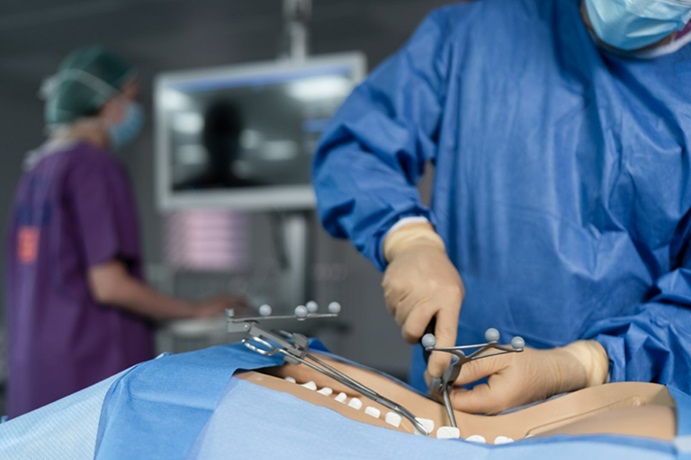
PathKeeper2

PathKeeper Surgical is celebrating the first spine surgery performed with the PathKeeper 3D optical navigation system in Massachusetts


The PathKeeper 3D optical navigation system is used to improve the clinical experience, increase surgical accuracy and eliminate radiation exposure during spine surgery.

KFAR SABA, Israel, Nov. 16, 2023 /PRNewswire/ — PathKeeper Surgical, a privately held, Israel-based medical technology company, is committed to improving the health of people around the world suffering from all spinal problems requiring surgery. As PathKeeper Surgical celebrates the first use of the PathKeeper 3D optical navigation system during spinal fusion surgery at Southcoast Health’s St. Luke’s Hospital in New Bedford, Massachusetts, PathKeeper Surgical is committed to making navigation-guided surgery available to every patient in all operating rooms.

The PathKeeper system was used to create a comprehensive surgical plan and accurately navigate the single-level lumbar degenerative spinal fusion surgery at Southcoast Health’s St. Luke’s Hospital.

“The PathKeeper system addresses many of the complexities of spine surgery and adapts to the patient’s individual needs with a high degree of accuracy and without radiation during a critical part of the surgical procedure,” said Matthew Philips, MD, chief of Brain & Spine Services, Southcoast Health Neurosurgery, Dartmouth, MA. “We have already experienced the clinical benefits of integrating the PathKeeper system into our spinal fusion surgeries at St. Luke’s Hospital.”

The PathKeeper system is designed to replace traditional navigation technology with a 3D optical navigation system that provides comprehensive surgical planning; active, independent submillimeter registration and tracking of patient anatomy and surgical instruments; establish precise accuracy of device implantation; more efficient surgical workflow; elimination of radiation exposure during the surgical procedure; and a more affordable price point so that both hospital operating rooms and ambulatory surgical center operating rooms can integrate this new technology.

“We are very pleased with the adoption of the PathKeeper system at Southcoast Health, which continues our expansion of the PathKeeper system to hospitals and surgery centers across the United States,” said Ryan LeBlanc, Chief Commercial Officer of PathKeeper Surgical. “The PathKeeper system is a game changer in driving improved clinical outcomes and economic value for patients and healthcare providers.”

PathKeeper Surgical received FDA 510k clearance for the PathKeeper System earlier this year. The name PathKeeper effectively describes the essence of the system: a 3D optical navigation system that ‘keeps’ the surgical ‘path’ on course throughout the operation.

About PathKeeper Surgical
PathKeeper Surgical is an Israel-based medical technology company that has developed a solution to combat the high failure rates in spine surgery. PathKeeper was founded in 2018 by Erez Lampert, a top expert in medical 3D imaging with more than 20 years of experience in the healthcare and aerospace industries, and a proven track record in 3D imaging. Erez previously served as R&D leader for the Itero Element Intraoral Scanner for Align Technology (Invisalign), the world’s leading 3D dental scanner. Josh Schroeder, MD, director of Spinal Deformities at Hadassah Medical Center and an HSS fellow, has been on board as a clinical advisor since the company’s founding. Erez and Josh’s combined knowledge enabled the company to develop an innovative navigation system that outperforms existing solutions. More information can be found at path-keeper.com.

About Southcoast Health
For more than 25 years, Southcoast Health has served communities in southeastern Massachusetts and Rhode Island as the region’s largest provider of primary and specialty care. The nonprofit charity system includes three acute care hospitals – Charlton Memorial in Fall River, St. Luke’s in New Bedford (a Level II Trauma Center) and Tobey in Wareham – as well as a network of more than 700 physicians, hospitalists and mid-level practitioners.

Southcoast Health has established six urgent care centers, two cancer centers, a Visiting Nurse Association and numerous outpatient facilities that ensure convenient access to services for 725,000 residents in 33 communities covering 900 square miles. Additionally, the system has partnered with Acadia Healthcare to provide expanded resources at Southcoast Behavioral Health in Dartmouth.

Southcoast Health has been consecutively recognized as a Newsweeks World’s Best Hospital of 2019-2023, in addition to being ranked as a High Performing Hospital for Maternity Care during the calendar years 2021-2022 and 2022-2023 by American news and world report.

With more than 7,500 employees, Southcoast Health is the largest employer in southeastern Massachusetts and one of the largest employers in the Commonwealth, according to the Boston Business Journal. More information is available online at www.southcoast.org.

US Media Contact:
Ryan LeBlanc
head of marketing
ryan.leblanc@path-keeper.com

Photo – https://mma.prnewswire.com/media/2279117/PathKeeper.jpg

SOURCE PathKeeper

Source link

Similar Posts

  • |

    Best knee scooter post-surgery

    Is hopping around on one leg or battling clumsy crutches the only way to get through recovery after a foot or ankle procedure? For many, traditional crutches are a source of frustration and fatigue. They demand considerable arm strength and often lead to instability. This can make you feel trapped and dependent on others. best knee scooter post-surgery There is a more comfortable and popular solution. Studies show that 90 percent of patients prefer using a knee scooter over crutches during their healing period. Occupational therapists highlight a key benefit: these aids keep your injured foot correctly elevated and non-weight bearing. This proper positioning is vital for a smooth recovery. We’ve done the research for you. Our analysis of the current market identifies devices that provide superior mobility and comfort compared to old-fashioned methods. Selecting the right walker helps you maintain your independence. It allows for safer movement around your home and community. A sturdy, well-designed walker is a much more stable alternative to risky hopping. Our expert-driven guide reviews the leading models available. The goal is to help you find reliable equipment that protects your leg while letting you continue with daily life. Key Takeaways The vast majority of patients prefer knee scooters to traditional crutches for recovery. These devices properly elevate the leg, which is essential for non-weight bearing healing. They promote greater independence and reduce reliance on others during your recovery. Choosing a high-quality model significantly improves safety and overall comfort. Our guide provides an expert analysis of the top mobility aids on the market today. A stable walker minimizes the risk of falls and accidental weight-bearing. Informed selection helps you navigate your environment with confidence and ease. Understanding Knee Scooters in Post-Surgery Recovery Patients seeking a stable alternative to crutches frequently turn to rolling walkers with a knee platform. This device, often called a knee scooter or knee walker, has two to five wheels and a padded rest for your leg. It is designed to keep your injured foot correctly elevated. This positioning is completely non-weight bearing, which is vital for healing. Unlike traditional crutches, a knee walker does not demand much arm strength. You simply rest your leg on the cushioned platform and propel yourself forward. This reduces physical exertion dramatically during daily movement. Occupational therapists note an overwhelming patient preference for this mobility aid. We have found that nearly 90 percent of users prefer it over other options. The design helps prevent reinjury caused by balance struggles. Feature Knee Scooter/Walker Traditional Crutches Weight-Bearing Non-weight bearing, leg elevated Partial weight on arms and shoulders Upper Body Strain Minimal; uses leg for support High; requires arm strength Hands-Free Operation Yes; handlebars for steering No; hands occupied Stability on Flat Surfaces Very stable with multiple wheels Less stable; two points of contact Risk of Reinjury Low; proper leg positioning Higher; balance challenges These devices are essential for maintaining independence. They allow you to perform household tasks while your injury heals. By keeping your hands free, a knee scooter lets you carry items and engage in daily life more effectively. Benefits of Using Knee Scooters Over Crutches The journey to regain mobility after surgery doesn’t have to be a struggle against discomfort and instability. While traditional crutches are less expensive, they frequently cause pain and balance issues for active individuals. A knee walker provides a stable base for movement. It allows you to navigate both indoors and outdoors without the constant fatigue linked to crutches. benefits of knee scooter over crutches Occupational therapists emphasize that a knee scooter is a superior choice if you lack upper body strength. Using this device greatly lowers your chance of a fall compared to balancing on underarm crutches. These aids offer a level of freedom that lets you spend time outside. This activity is proven to speed up the healing process. Choosing the right knee walker ensures you can maintain your daily routine. You avoid the physical limits imposed by standard crutches. A quality knee scooter supports your injured leg correctly, promoting safer recovery….

  • |

    Plowing on with gratitude on all fronts – Bone Talk

    It’s fair to say that I’ve been a rule follower for most of my life. After all, I am an eldest child. I have always valued and protected my health, making sure I eat healthy foods and do many of my favorite exercises such as walking, yoga, swimming and cycling. I have been grateful for…

  • Presentation on fall risk factors and prevention, followed by a short Tai Chi session – Bone Talk

    Thursday, September 21 at 4:00 PM ET Helen Hayes Hospital Auditorium, Route 9W, West Haverstraw, NY Falls Prevention Awareness Week takes place September 18-22, 2023. Join the NYSOPEP Osteoporosis Support & Education Group on September 21, 2023 at 4:00 PM ET as they review the latest information on falls risk factors and prevention, followed by…

  • |

    Deconstruction of the synovium of rheumatoid arthritis defines inflammatory subtypes

      Division of Rheumatology, Inflammation and Immunity, Department of Medicine, Brigham and Women’s Hospital and Harvard Medical School, Boston, MA, USA Fan Zhang, Anna Helena Jonsson, Aparna Nathan, Nghia Millard, Michelle Curtis, Qian Xiao, Maria Gutierrez-Arcelus, Gerald FM Watts, Dana Weisenfeld, Kathryne E. Marks, Joyce B. Kang, Laurie Rumker, Joseph Mears, Kathryn Weinand, Ellen M….

  • Put down the drink; Alcohol use after a concussion can prolong symptoms in collegiate athletes

    Alcohol use after injury is associated with prolonged recovery from concussion in NCAA athletes Chang RC, Singleton M, Chrisman SPD, et al. Alcohol use after injury is associated with prolonged recovery from concussion in NCAA athletes. Clin J Sport Med. Published online 2023:1-8. doi:10.1097/JSM.0000000000001165 https://journals.lww.com/cjsportsmed/Abstract/9900/Postinjury_Alcohol_Use_Is_Associated_With.142.aspx Take home message Collegiate athletes can experience long-lasting concussion symptoms…

  • Rising star footballers among young athletes benefit from new screening tool

      Young elite athletes will benefit from a new screening tool with the potential to change clinical practice by ruling out serious heart disease that is often misdiagnosed. The research is thanks to a jointly led study between the Universities of Exeter and Bristol, working with emerging athletes from around the world. Cardiomyopathy, a form…

One Comment

Leave a Reply

Your email address will not be published. Required fields are marked *