MCL vs ACL Recovery Time: A Complete Comparison Guide for 2026
When it comes to MCL vs ACL recovery time, the difference is significant enough to change your entire rehabilitation plan, and understanding that gap matters more than most people realize. Remarkably, only 10% of athletes with a combined ACL and MCL injury return to their pre-injury level of sport compared to those with an isolated ACL reconstruction, making it critical to understand exactly what type of knee injury you are dealing with from the very start.
Key Takeaways
- MCL recovery time typically ranges from 4 to 12 weeks for Grade 1 and Grade 2 sprains, while severe Grade 3 tears can take up to 6 months.
- ACL recovery time after surgical reconstruction averages 9 to 12 months, and sometimes longer for a full return to high-impact sport.
- MCL injuries most often heal without surgery, while ACL tears in active individuals almost always require surgical reconstruction.
- Both injuries cause significant knee pain, swelling, and instability, but ACL tears are generally associated with a more severe and sudden onset of symptoms.
- Combined MCL and ACL injuries carry a 7.4% reoperation rate, more than double the rate for isolated ACL injuries alone.
- Early physical therapy and appropriate bracing are critical for both injuries to reduce long-term knee complications.
- Psychological readiness is now a formal benchmark in 2026 rehab protocols before returning to sport after an ACL injury.
For a broader overview of the types of injuries that cause knee pain, our comprehensive guide to understanding and overcoming knee pain is a strong starting point alongside this comparison.
Understanding MCL vs ACL Recovery Time: What Makes Each Injury Unique
The medial collateral ligament (MCL) and the anterior cruciate ligament (ACL) serve very different structural roles inside the knee. The MCL runs along the inside of the knee and resists inward stress forces, while the ACL sits deep inside the joint and controls rotational stability.
Because of these differences in location and blood supply, the two ligaments heal in fundamentally different ways. The MCL has a relatively rich blood supply, which is why it can often repair itself without surgery. The ACL, sitting inside the joint capsule with limited blood flow, rarely heals on its own.
Understanding this biological difference is the single most important factor in explaining why MCL vs ACL recovery time varies so dramatically. For a deeper look at how ligament injuries are classified and treated, our page on ligament knee injuries covers the full spectrum of damage types.
MCL Recovery Time: What to Expect at Each Stage
MCL injuries are graded on a scale from 1 to 3, and the grade directly determines how long recovery takes. Grade 1 sprains involve minor fiber stretching, and most people recover within 2 to 4 weeks with rest, ice, compression, and light rehabilitation exercises.
Grade 2 MCL tears involve a partial rupture of the ligament and typically require 4 to 8 weeks of structured rehabilitation. A hinged knee brace is often used during this period to protect the healing ligament from additional valgus stress.
Grade 3 MCL tears are complete ruptures. While surgery is still infrequent, the MCL recovery time for Grade 3 injuries extends to 3 to 6 months in most cases, particularly when combined with other structural damage inside the knee.
If your knee hurt began after a direct blow to the outer side of the leg during sport, an MCL sprain should be one of the first considerations your clinician evaluates. Our page on traumatic knee injuries explains how these impact events translate into specific ligament damage patterns.
ACL Recovery Time: Why It Takes Significantly Longer
ACL recovery time is one of the most discussed topics in sports medicine because the timeline is long and the stakes are high. For athletes who undergo ACL reconstruction surgery, the standard 2026 protocol places full return to competitive sport at 9 to 12 months post-operation, and many surgeons now extend this to 12 to 24 months for high-demand athletes.
The extended ACL recovery time exists for several reasons. First, the graft used to reconstruct the ACL must undergo a biological process called “ligamentization,” where the transplanted tissue slowly transforms into functional ligament material over 12 to 18 months.
Second, the surrounding musculature, particularly the quadriceps and hamstrings, must be completely rebuilt to protect the new graft. Returning too early is one of the leading causes of ACL re-injury.
For guidance on appropriate bracing during ACL recovery, our detailed resource on ACL injury knee braces explains how different brace types support each stage of the rehabilitation process.
MCL vs ACL Recovery Time: A Phase-by-Phase Comparison
Laying out MCL vs ACL recovery time side by side makes the difference immediately visible. The table below reflects current 2026 clinical rehabilitation standards for isolated injuries in otherwise healthy adults.
| Phase | MCL (Grade 2-3) | ACL (Post-Surgery) |
|---|---|---|
| Acute / Protection Phase | Week 1 to 2 | Week 1 to 2 |
| Early Mobility Phase | Week 2 to 4 | Week 2 to 6 |
| Strength Building Phase | Week 4 to 8 | Month 2 to 5 |
| Functional Training Phase | Week 6 to 10 | Month 5 to 9 |
| Return to Sport | Week 8 to 16 | Month 9 to 12+ |
These timelines represent typical cases. Individual recovery depends heavily on injury grade, age, baseline fitness, and adherence to rehabilitation protocols.
Key Factors That Influence MCL vs ACL Recovery Time
Not every MCL or ACL injury follows the same timeline. Several variables can either shorten or extend recovery significantly. Understanding these factors helps set realistic expectations from the very beginning of rehabilitation.
Injury severity and grade is the most obvious factor, but concurrent damage matters just as much. If the knee sustains both an MCL and ACL tear simultaneously, as happens in contact sports collisions, recovery becomes substantially more complex and slow.
- Patient age: Younger patients with strong bone density and muscle mass tend to recover faster, though graft maturation timelines remain consistent regardless of age.
- Pre-injury fitness level: Athletes who maintained strong quadriceps and hamstrings before injury consistently achieve better rehab outcomes.
- Graft type (ACL only): Patellar tendon grafts tend to integrate faster than hamstring grafts in some protocols, affecting when functional milestones can be reached.
- Compliance with rehab: Skipping physical therapy sessions or returning to activity too soon are the most common reasons recovery timelines extend beyond normal expectations.
- Presence of additional injuries: Meniscus tears occurring alongside ligament damage can significantly delay the overall timeline.
If your recovery involves a concurrent meniscus injury, our resource on torn meniscus injuries provides important context on how that additional damage affects the overall healing process.
Recognizing When Your Knee Hurt Is a Sign of Something Serious
One of the most common questions we receive at KneeHurt.com is how to tell whether knee hurt after a twisting injury represents an MCL sprain or an ACL tear. The two injuries can feel similar in the immediate aftermath of trauma, but there are key distinguishing signs.
An ACL tear is often accompanied by a loud “pop” at the moment of injury, followed by rapid swelling within the first few hours. The knee typically feels unstable or “giving way” during weight-bearing activities, which is a hallmark of ACL-related instability.
An MCL sprain typically produces pain and tenderness specifically along the inner (medial) edge of the knee, with swelling that is more localized to that side. Pure MCL injuries rarely produce the sensation of the knee “giving out,” though this can occur in severe Grade 3 cases.
If you experience sudden onset knee pain with significant swelling and instability after a sports injury, seek professional evaluation promptly. Delayed diagnosis of an ACL tear can allow secondary damage to develop inside the joint. Our guide on knee pain covers the full range of causes and when to seek urgent care.
It is also worth noting that not all knee hurt after a ligament injury is straightforward. Some patients develop cartilage-related complications during or after rehabilitation, which is something our proprietary 2026 Knee Pathology and Surgical Glossary can help clarify in plain language.
Managing Knee Pain During MCL and ACL Rehabilitation
Controlling knee pain effectively during rehabilitation is not just about comfort. It also directly affects your ability to participate in physical therapy and progress through the recovery phases on schedule.
For MCL rehabilitation, pain management during the first two weeks centers on the R.I.C.E. protocol (Rest, Ice, Compression, Elevation), combined with appropriate anti-inflammatory strategies as directed by your physician. After the acute phase, progressive loading exercises replace rest as the primary therapeutic tool.
ACL rehabilitation presents a more complex pain management challenge because surgery itself creates a significant inflammatory response on top of the original injury. Post-surgical protocols in 2026 emphasize early controlled movement (cryotherapy combined with gentle range-of-motion work within the first 24 to 72 hours) to reduce stiffness and swelling without stressing the new graft.
For ongoing knee pain management resources including structured exercise programs, our knee pain relief and strengthening exercises guide provides a progression-based framework suitable for both MCL and ACL recovery phases.
Patients who also develop kneecap-related discomfort during rehabilitation should review our resource on chondromalacia patella, as this cartilage condition frequently co-occurs with ligament injuries and requires its own targeted management strategy.
MCL vs ACL Recovery Time for Athletes vs. Non-Athletes
The MCL vs ACL recovery time comparison looks somewhat different depending on the activity goals of the patient. Non-athletes aiming to return to daily functional activities such as walking, climbing stairs, and light recreational movement typically reach those goals significantly faster than competitive athletes.
A non-athlete recovering from a Grade 2 MCL tear may return to comfortable daily function within 6 to 8 weeks. An athlete recovering from the same injury with a goal of returning to cutting and pivoting movements in competitive sport may require 10 to 16 weeks of structured rehabilitation with sport-specific training in the final stages.
For ACL injuries, the gap between non-athlete and athlete timelines is even more pronounced. Return to daily activities after ACL reconstruction often occurs at the 4 to 6 month mark. However, return to competitive sport consistently requires the full 9 to 12 month protocol due to the graft maturation requirements outlined above.
Psychological readiness is now formally integrated into 2026 return-to-sport protocols. A score of 90% or higher on the ACL-RSI (Return to Sport After Injury) psychological readiness scale is considered a prerequisite for clearance in many leading sports medicine clinics, recognizing that mental confidence is as critical as physical strength in preventing re-injury.
Athletes competing in contact or pivoting sports should also be aware that the risk of tearing the ACL in the opposite knee is 11.2% within six years of the initial injury, making bilateral strengthening throughout the rehabilitation process an essential long-term priority.
Related Knee Conditions That Can Complicate Recovery
MCL and ACL injuries rarely occur in complete isolation. The forces that damage these ligaments frequently stress other structures inside and around the knee at the same time.
The posterior cruciate ligament (PCL) is one structure that can sustain concurrent damage in high-energy trauma. Our dedicated resource on PCL knee injuries explains how combined ligament damage changes the surgical planning and rehabilitation approach.
Patellar tendon stress is also common during ACL rehabilitation, as altered movement mechanics place increased load on the extensor mechanism of the knee. If your knee hurt transitions from the joint line toward the front of the kneecap during rehab, a patellar tendon complication may need to be addressed. More information on this is available in our guide on patellar tendon injuries.
If the original mechanism of injury involved a fall, collision, or high-energy accident, reviewing our page on traumatic knee injuries is worthwhile to understand all the structures that may be affected beyond the primary ligament diagnosis.
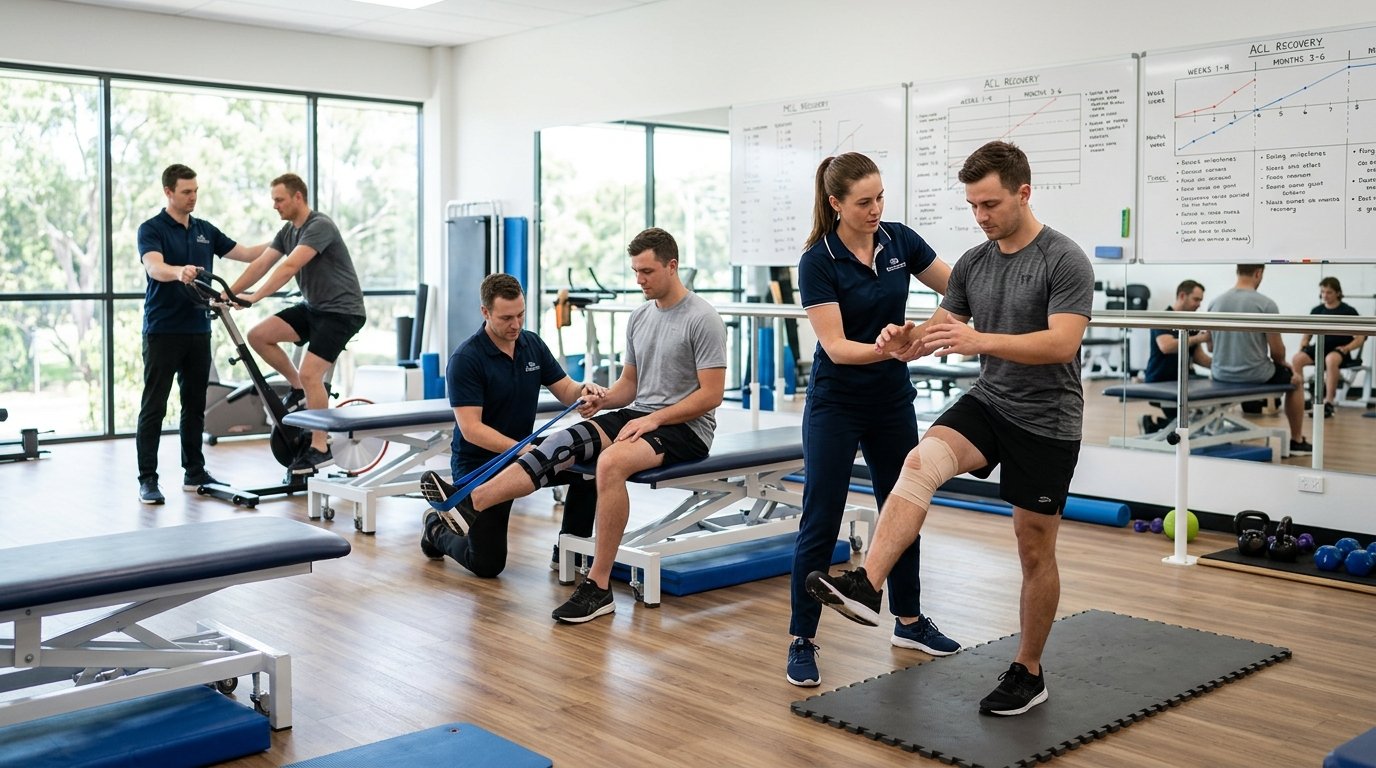
A side-by-side look at recovery timelines for MCL vs ACL injuries, highlighting the key differences.
Tools and Resources to Support Your Recovery Journey
At KneeHurt.com, we provide several proprietary tools designed to help you track and understand your recovery in more precise terms. The 2026 Knee Joint Pressure Relief and Load Calculator helps patients and clinicians estimate how much mechanical load is being placed through the recovering joint during specific exercises, which is particularly useful for progressing ACL rehab safely.
Our Knee Range of Motion (ROM) Master Benchmarks Chart allows you to compare your current range of motion against clinical standards at each phase of MCL or ACL rehabilitation, giving you a data-driven measure of progress rather than relying on subjective assessments alone.
For patients who are unsure whether their symptoms warrant urgent evaluation, our Knee Health Advisor tool provides multilingual symptom guidance and can help you identify whether your situation requires immediate clinical attention or can be managed with conservative care at home.
If you are navigating a complex multi-ligament injury or experiencing knee pain that does not fit a simple pattern, our Clinical Knee Function Score integrates standardized metrics including WOMAC and KOOS to help you self-assess your functional level and track improvement over time.
Conclusion
When comparing MCL vs ACL recovery time, the core message is clear: MCL injuries typically resolve within weeks to a few months, while ACL injuries demand a commitment measured in the better part of a year. Both injuries deserve structured, professional rehabilitation, and both carry long-term consequences for knee health if managed inadequately.
The single most important step you can take after any significant knee injury is to obtain an accurate diagnosis as early as possible. Knowing precisely which structure is damaged, and to what grade, allows you to begin the correct rehabilitation protocol without delay and avoid the extended timelines that come with mismanaged injuries.
If your knee hurt following an injury and you are uncertain where to begin, our resources on knee ligament injuries and our comprehensive knee pain guide are the best starting points for building an informed, realistic recovery plan. Remember, your health and well-being are the top priority, and you should always follow these resources alongside, not instead of, professional medical advice from a qualified clinician.
Frequently Asked Questions
How long does MCL recovery take compared to ACL recovery?
MCL recovery time typically ranges from 4 to 12 weeks for Grade 1 and 2 injuries, while Grade 3 MCL tears can take up to 6 months. ACL recovery time after surgical reconstruction averages 9 to 12 months before a full return to sport, making ACL injuries significantly longer to recover from than most MCL injuries.
Can an MCL injury heal without surgery?
Yes, the vast majority of MCL injuries heal without surgical intervention because the MCL has a strong blood supply that supports natural tissue repair. Even most Grade 3 complete MCL tears respond well to conservative rehabilitation including bracing, physical therapy, and progressive loading, particularly when no other structures are damaged.
Is ACL recovery time the same with and without surgery?
No, the approach significantly changes the timeline and outcome expectations. Without surgery, an ACL-deficient knee may become functional for low-demand daily activities within a few months, but it will typically remain unstable for cutting, pivoting, and high-impact sport. Surgical reconstruction followed by 9 to 12 months of rehabilitation is generally required for athletes who want a full functional return.
What happens if you return to sport too early after ACL or MCL rehab?
Returning to sport before full healing is one of the leading causes of re-injury for both ligament types. For ACL injuries specifically, the graft is most vulnerable between 6 and 9 months post-surgery during the final stages of ligamentization, making early return particularly risky and potentially leading to complete graft failure.
Does having both an ACL and MCL injury at the same time make recovery worse?
Yes, combined ACL and MCL injuries are considerably more complex to manage than either injury in isolation. Research shows that patients with combined ACL and MCL lesions face a 7.4% reoperation rate, more than double that of isolated ACL injuries, and only 10% of athletes with this combination return to their pre-injury competitive level.
How do I know if my knee pain is from my MCL or my ACL?
MCL injuries typically produce tenderness along the inner edge of the knee with pain on inward stress testing, while ACL tears are more often associated with a felt or heard “pop,” rapid widespread swelling, and a clear feeling of instability or the knee giving way. An MRI scan remains the definitive diagnostic tool to distinguish between the two and assess injury severity accurately.
What exercises should I avoid during MCL vs ACL recovery?
During MCL recovery, avoid any valgus (inward knee) stress activities such as lateral lunges or pivoting movements until cleared by your physiotherapist. During ACL recovery, deep squatting, high-impact jumping, and rapid direction-change activities are restricted in the early phases to protect the graft while ligamentization is occurring, with a gradual return based on strength benchmarks and clinical assessment.