
Emotions and Bone Strength: Do the ‘winds of worry’ weaken your bones?
Have you ever wondered what we can learn about bone health from our ancestors? I have. And I do so now as I reflect on my recent interview with Ayurvedic master and bestselling author Acharya Shunya. In this interview, I ask Acharya to discuss the ancient Vedic perspective on the connection between emotional stress, worry, anxiety and osteoporosis. What I learn can help every part of all of us: our body, our mind, and our soul!
Ayurveda is the 5,000-year-old health science from India and the subject of Acharya’s award-winning book: Ayurvedic lifestyle wisdom. As a master of Ayurveda, Acharya confirmed my decades-long clinical observation that stress, worry and anxiety weaken the bones. And to take it a step further, Acharya weaves deep yet practical, age-old solutions into our discussion to calm anxiety and restore balance. She graciously offers several time-honored self-awareness exercises for the mind and body to calm our worried, anxious minds and promote physical, emotional, and mental balance throughout the body. My interview with Acharya will soothe, uplift and inspire anyone who harbors concerns or outright fear about osteoporosis.
This inspiring interview with Acharya Shunya will air on October 5, 2023. I offer it to you with the confidence that you will find many useful bone-strengthening pearls of wisdom from the ancient science of Ayurveda. Let’s set the stage with a few cross-cultural observations so you can get the most out of this interview.
Fear, Worry and Bones: A Glimpse of Ancestral Wisdom
Thousands of years before modern-day neuroscientists like Dr. Candice Pert discovered the ’emotion molecules’, the ancient health sciences of both India and China codified the impact of emotions on health.
Through keen observation of nature and a deep spiritual awareness, ancestral wisdom-based medical systems such as Ayurveda and Traditional Chinese Medicine (TCM) stated that mental stress and negative emotions, especially fear, and the associated concerns for children, created a system-wide imbalance. Negative emotions, they explained, weakened the entire body system and especially eroded the strongest of all tissues: the bones.
Traditional Chinese Medicine (TCM)
As the famous Qi Gong Grandmaster, Dr. Nan Lu, once told me as we squeezed into a crowded elevator in his office in New York City: “Susan, you will never solve the problem of osteoporosis because osteoporosis is directly related to fear and fear abounds in this culture.”
It turns out that ancient traditional Chinese medicine, like Ayurveda, developed a medical system based on five basic building blocks of life. In TCM these are fire, water, metal, earth and wood. Each element has its own set of qualities and responsibilities, each interacting with all the others, and each governing a particular meridian energy path.
This life-encompassing and life-explanatory TCM theory was known as the ‘Five Element Theory’. What’s interesting to me about this complex medical model is that these ancients felt that fear was the emotion most damaging to the bones. This negative impact was due to the pernicious effect that anxiety had on the kidney-adrenal meridian system – the energetic system that controls the bones. Even today, most traditional Chinese medicines for the bones are herbal formulas that treat kidney dysfunction.
The ancient health science of Ayurveda
And then there is Ayurveda, the ancient medical system that fascinates me most. Ayurveda, like traditional Chinese medicine, views the body-mind-spirit complex as one integrated unit. Like Traditional Chinese Medicine, Ayurveda is based on the principle of balance and harmony within body, mind and spirit. Changes to a specific part of the system have consequences for the whole. As you’ll hear in my interview with Acharya Shunya, Ayurveda also links osteoporosis to anxiety and worry.
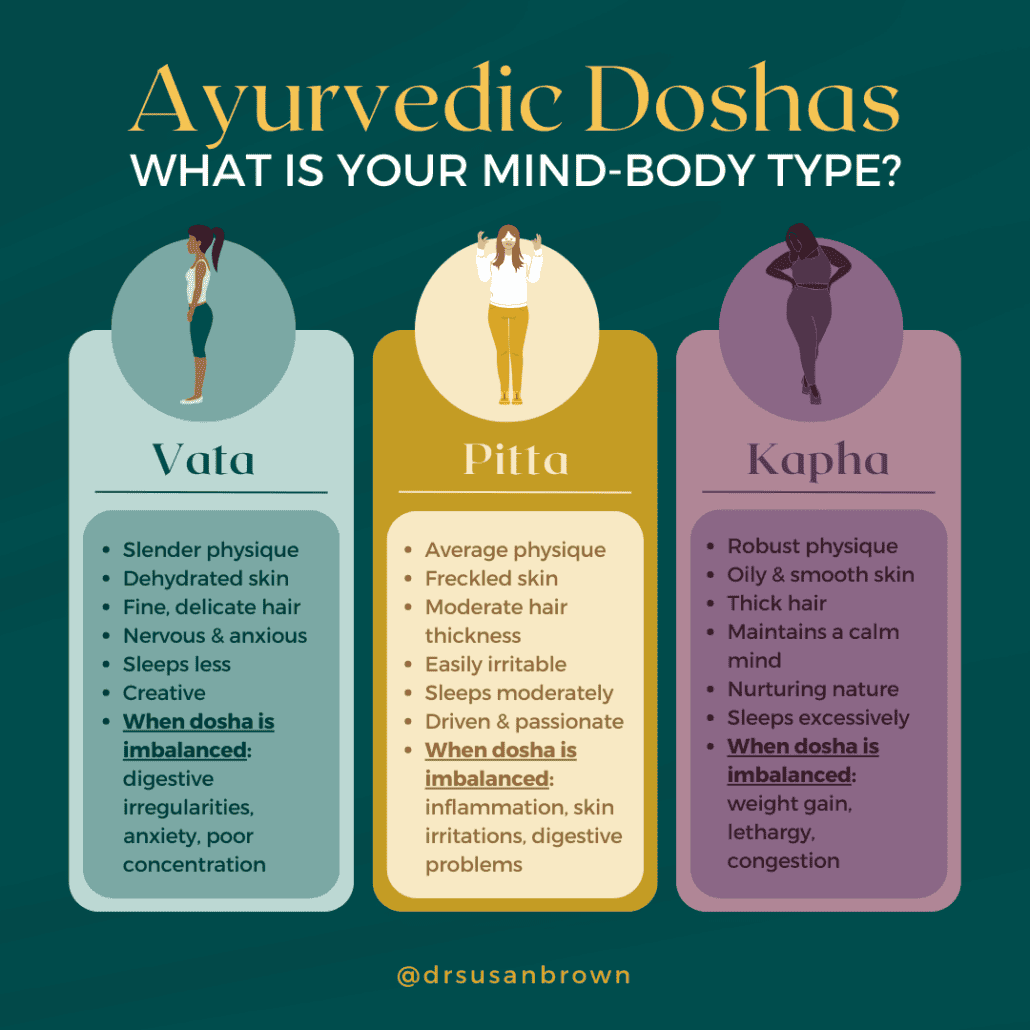
The Ayurvedic model also contains five basic building blocks of life. These are space, air, fire, water and earth. When discussing human health, these five elements are summarized in three ‘doshas’, that is, three different energy patterns or constitution types. These ‘doshas’ or constitutional types are ‘Vata’, associated with the elements of air and space, ‘Pitta’, associated with fire and water, and ‘Kapha’, associated with the elements earth and water.
As Acharya and I discuss the connection between anxiety and osteoporosis, you will see that a certain body type, Vata, is more prone to developing osteoporosis. Comprised of air and space elements, Vata is quick-moving, drying and changeable like the wind, and prone to worry and anxiety. (So my blog title refers to the “wind of worries.”)
Having some degree of ‘Vata’ imbalance myself, I notice bouts of worry when I step back and quietly observe my thoughts. I feel the ‘winds of worry’ and have come to realize that when I focus my attention on them, they become stronger. However, if I relax and take a few deep breaths and then consciously focus my attention on more pleasant thoughts, the wind of worry disappears. I have come to realize the power of choosing what I want to focus my attention on. What about for you? Have you ever felt the “wind of worry” and if so, how do you deal with it?
What is your constitutional balance in the Dosha?
In preparation for this interview with Acharya Shunya, let’s return to the topic of ‘doshas’ or constitutional types and lay a little groundwork for the interview.
Below you will find a chart showing the typical properties of each dosha constitution type. Most of us have some traits of each dosha, of which one predominates. Those of us who exhibit more “Vata” qualities are more prone to developing osteoporosis. In preparation for the upcoming broadcast of my interview with Acharya Shunya, please take a moment to review the schedule below. How many characteristics of each body type describe you?
If you are part of my ‘Thin and Worried Tribe’, or are otherwise concerned about your bone health, Acharya’s talk on the ancient health science of Ayurveda will provide you with simple exercises to help you transition from worry and anxiety to fear-free, self-reliance in to map. powerful mindfulness. I’m charting that path for myself – why not join me?
More information about Acharya Shunya and Ayurveda:
Her website: awakensself.com
Her books:
- Ayurveda lifestyle wisdom: A complete recipe to optimize your health, prevent diseases and live with vitality and joy, Sounds true, 2017.
- Sovereign self: Claim your inner joy and freedom with the empowering wisdom of the Vedas, Upanishads and Bhagavad Gita, Sounds true, 2020.
- Shout like a goddess: Every woman’s guide to becoming unapologetically powerful, prosperous and peaceful, Sounds true, 2022.
 I am Dr. Susan E. Brown. I am a clinical nutritionist, medical anthropologist, writer and motivational coach speaker. Learn my proven 6-step natural approach to bone health in my online courses.




15 Comments