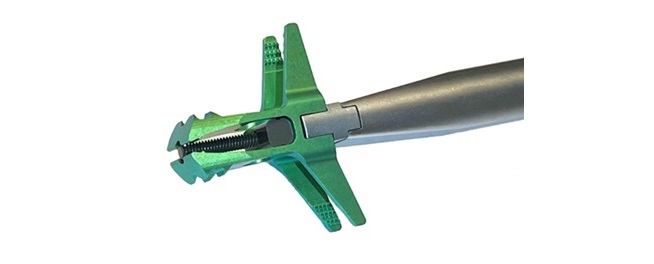
19553869 keylift with inserter

FloSpine Revolutionizes the Treatment of Spinal Stenosis with FDA Approval of the KeyLift™ System


KeyLift is the fifth FDA-approved product developed by FloSpine, all invented at Florida Atlantic University® Research Park

BOCA RATON, FLORIDA, USA, November 1, 2023 / EINPresswire.com / — Together with FloSpine, Florida Atlantic University’s Research Park® is pleased to announce that FloSpine has received 510(k) clearance for its KeyLift™ Expandable Interlaminar Stabilization System from the FDA, and has expanded from the Global Ventures entrepreneurial support center into a new, larger office to support growth.

The newly approved device addresses spinal stenosis, a common and debilitating condition that affects more than 100 million people worldwide, resulting in approximately 600,000 surgeries annually in the United States alone. It occurs when the spinal canal narrows, putting pressure on the nerves and causing severe back and leg pain, weakness and numbness. Traditional treatment options for spinal stenosis often involve invasive surgical procedures with long recovery times. The KeyLift System introduces a less invasive alternative, allowing spine and interventional pain physicians to implement this revolutionary treatment in an outpatient surgery center.

The KeyLift Expandable Interlaminar Stabilization System features an innovative, expandable design that enables precise, patient-specific surgical procedures. KeyLift unlocks the biomechanics of the spine and provides three key benefits:
1. Support – KeyLift provides support on the strongest part of the spine, the lamina. This distinguishes it from existing devices that only support the spinous process, which is difficult in patients with osteoporosis.
2. Lift – With the ability to expand up to 4mm in height, KeyLift effectively distracts and relieves nerves, relieving pain caused by spinal stenosis.
3. Stabilize – Positioned closer to the instantaneous axis of rotation of the spine, KeyLift promotes intervertebral disc health by balancing the discs.

This breakthrough technology not only reduces patient discomfort and pain, but also significantly shortens recovery times by being performed in an outpatient surgery center, allowing patients to return to their daily lives more quickly.

The expandable design of the KeyLift system is the result of years of research, development and rigorous testing by the FloSpine team, supported by Luis Escobar, chief design engineer.

“KeyLift offers a more mechanically stable design in a minimally invasive package,” says Dr. Cheng-Lun Soo, MD, orthopedic spine surgeon and co-inventor of the KeyLift. “As a spine surgeon with more than 25 years of experience, I believe this technology will reach more patients by allowing more interventional physicians to treat mild to moderate spinal stenosis without the fear of major surgery.”

Like the four other products invented by FloSpine and approved by the FDA, KeyLift has a Florida-inspired name. FloSpine is committed to advancing spine health care, and to support its continued growth, the company recently expanded its headquarters to a 5,000-square-foot facility in Florida Atlantic University’s Research Park, after completing its scale-up at Global Ventures. The majority of FloSpine’s hiring comes from Florida Atlantic University’s College of Engineering, and over the next two years it plans to expand from 8 to 18 employees.

“This is the culmination of years of research and development to deliver a medical device that helps improve the lives of patients suffering from spinal stenosis. Our recent move to larger premises in the Research Park at FAU will allow us to train our surgical and distribution partners to become increasingly competitive in the spinal implant market,” said Peter Harris, Founder and CEO of FloSpine. “This marks two significant achievements for our company as we grow in supporting our spine equipment for both interventional pain physicians and spine surgeons. We are confident that KeyLift will become the standard in the treatment of this condition, improving the quality of life for patients overall.”

Andrew Duffell, president of the Research Park at FAU, added, “FloSpine’s growth and expansion of Global Ventures into the Research Park is an inspiration to healthcare entrepreneurs and Florida Atlantic students who see their classmates excel in an exciting, growing industry. We very much look forward to supporting the team as it continues to innovate and contribute to the region’s economy.”

In loving memory of Luis Escobar, Senior Design Engineer and friend.

Andreas Duffel
Research Park at FAU
+1 561-416-6092
email us here
Visit us on social media:
Facebook
LinkedIn
Instagram
YouTube

NOTE: This content is not authored or endorsed by “KLST/KSAN”, its advertisers or Nexstar Media Inc.

For questions or corrections to press releases, please contact EIN Presswire.

Source link

Similar Posts

  • Hospital for Special Surgery and NCH Break Ground on New Orthopedics Center of Excellence in Southwest Florida

      NAPLES, Fla., Nov. 13, 2023 /PRNewswire/ — Hospital for Special Surgery (HSS) and NCH today officially broke ground on the Patty & Jay Baker Pavilion, marking the beginning of construction on the new HSS at NCH musculoskeletal ( MSK) center. Located on the campus of NCH North Naples Hospital, the center promises to provide…

  • |

    Knee replacement rehab timeline

    What if the most critical part of your joint procedure happens after you leave the operating room? We understand that navigating the path to healing can feel overwhelming. Our guide is here to provide the clarity you need for a successful journey. knee replacement rehab timeline Data shows that movement often starts very quickly. Physical therapy typically begins within 24 hours after your procedure. This early step is vital for promoting faster healing and restoring mobility. For most people, the complete process of regaining strength spans several months. It’s a journey from the initial post-operative phase to full recovery, often taking between six and twelve months. We aim to help you manage expectations about the time required to return to the activities you love. While every patient’s experience is unique, understanding the general phases can significantly reduce anxiety. By following a structured plan, you can improve function and regain the independence you enjoyed before joint pain began. Your commitment to rehabilitation directly influences the long-term success of your new joint and overall health. Key Takeaways Physical activity often starts within a day of your procedure to aid healing. The full recovery process generally takes between six months and a year. Your personal journey is unique, but knowing common stages reduces worry. A structured plan is crucial for regaining function and independence. Your dedication to the process directly impacts your long-term results. This guide provides clarity to navigate each stage with confidence. Understanding Knee Replacement Surgery We believe informed patients are empowered patients, starting with the details of the operation itself. Knowing which procedure is right for you is a crucial first step in preparing for your healing journey. Differences Between Total and Partial Knee Replacement A total knee replacement involves resurfacing the entire joint with an artificial structure. Surgeons cut away worn cartilage and bone to create a new surface. In contrast, a partial knee replacement focuses only on the damaged compartment. This targeted approach often leads to a quicker recovery process with less discomfort. What to Expect During Surgery and Initial Recovery During your replacement surgery, the medical team precisely aligns the new components. This careful work is done to restore smooth movement and function. Your personal recovery timeline is influenced by factors like your age and general health. Understanding these differences helps you set realistic goals for after your knee surgery. The ultimate goal of this joint procedure is to provide lasting relief from chronic pain and improve your mobility. Immediate Post-Surgery Recovery The journey to regain your mobility starts the moment you wake from anesthesia. Your active participation is vital from these first hours. immediate post surgery recovery We emphasize that structured support begins almost immediately. This early phase sets the foundation for your entire healing process. Day 1: Initiating Rehabilitation and Mobility Physical therapy often starts within 24 hours of your procedure. Your physical therapist will help you take those first, crucial steps. They guide you in standing and walking with a walker or crutches. These initial sessions focus on basic, safe movements. You’ll practice sitting at the bedside and transferring your weight. This early activity promotes circulation and helps prevent complications. Transitioning from Hospital to Home Your medical team must see you meet specific safety criteria before discharge. You need to manage pain well and demonstrate independent movement. Key goals include standing from a chair and using the bathroom alone. Navigating a short flight of stairs is also a common requirement. Some individuals may leave the hospital on the same day as their operation. This is possible if all safety boxes are checked. Your care team will provide clear instructions for protecting your new joint. They will also give you simple exercises to continue at home. The First Week: Early Rehabilitation Steps Navigating the initial week after your operation requires a clear focus on gentle movement and symptom management. We guide you through this period where your routine prioritizes restoring a natural walking pattern and improving joint flexibility. early rehabilitation steps Guided Physical Therapy Exercises for Range of Motion During the first 48 hours, the primary goal is achieving full extension and increasing flexion. Your physical therapist will recommend specific movements to help. These early exercises are designed to prevent stiffness and promote circulation. Your daily routine is crucial for maintaining flexibility in this joint. Managing Pain, Swelling, and Initial Activity Controlling discomfort is a priority. Your doctor may advise using ice packs, elevating your leg, and taking medication as directed. You must monitor your incision site closely. The American Association of Hip and Knee Surgeons suggests waiting 5 to 7 days before showering if non-waterproof dressings are used. We encourage gentle activity, like using a stationary bike. This helps the area regain strength without overexertion. If you experience severe pain or excessive swelling, stop and consult your physical therapist or surgeon immediately. Following a structured rehabilitation timeline is key for a successful recovery….

  • What is a patient-reported outcome measure or PROM and the KOOS?

    A patient-reported outcome measure (PROM) is a self-reported questionnaire that you typically complete before and after surgery or treatment.[1] It allows you to report your symptoms, level of disability and your health-related quality of life, all from your perspective.[1] The Knee Injury and Osteoarthritis Outcome Score (KOOS) is a PROM specifically designed for people with…

  • |

    Headgear does not help prevent concussions in football and rugby athletes

      Does headgear prevent sports-related concussions? A systematic review and meta-analysis of randomized controlled trials involving 6311 players and 173,383 exposure hours. Al Attar WSA, Mahmoud H, Alfadel A, Faude O. Sports health. May 19, 2023: 19417381231174461. doi: 10.1177/19417381231174461. E-publishing prior to printing. PMID: 37204092. Full text not freely available Take home message Headgear worn…

  • Xtant Medical Announces Record Third Quarter Revenue of $25 Million

      Increases 2023 annual revenue guidance to $88 million – $91 million BELGRADE, Mont., November 09, 2023 (GLOBE NEWSWIRE) — Xtant Medical Holdings, Inc. (NYSE American: XTNT), a global medical technology company focused on surgical solutions for the treatment of spinal conditions, today reported financial and operating results for the third quarter ended September 30,…

  • |

    Plums for your bones – Food for healthy bones

    Eating plums for your bones can help prevent or slow bone loss by reducing inflammation and oxidative stress. There are two delicious recipes on my plum blog. Skelly and I spend a lot of time promoting strong bones and how to nourish them. But many women we meet don’t think about it – until it’s…

2 Comments

Leave a Reply

Your email address will not be published. Required fields are marked *