
football team 1638508 1920
|

Who participates in youth sports?


Organized sports participation among children aged 6–17 years: United States, 2020

Black LI, Terlizzi EP, Vahratian A. National Center for Health Statistics (US). Publication date: 08/11/2022. Series: data overview; No. 441

https://stacks.cdc.gov/view/cdc/119026

Take home message

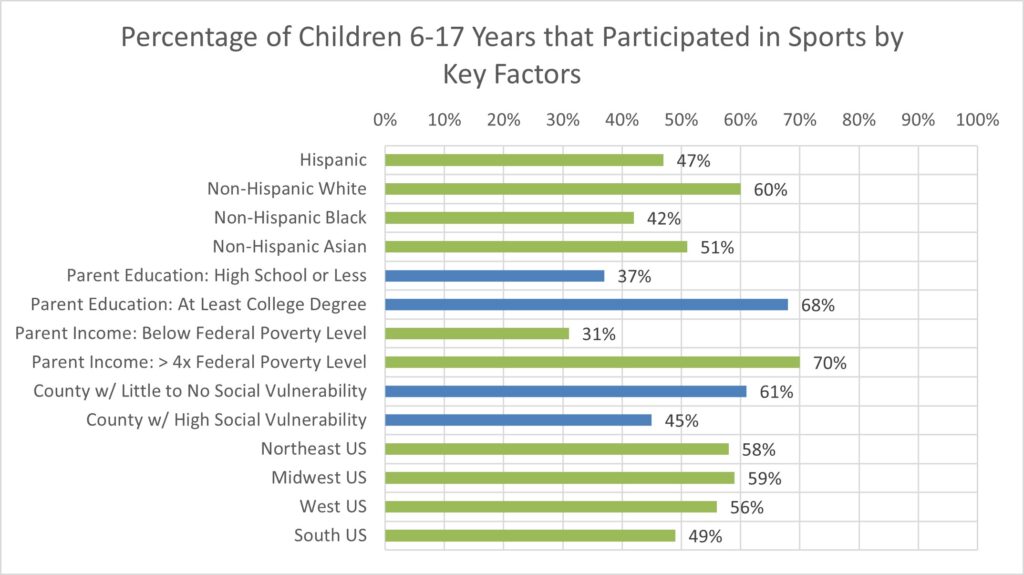
Sports participation was lower among racial and ethnic minority children, children whose parents had lower education or income, children living in counties with greater social vulnerability, and children living in the southern United States.

Background

Youth participation in sports is associated with better physical fitness and mental health. Understanding the differences in sports participation can help inform strategies to promote active lifestyles among children and adolescents, which positively impacts their physical and mental health.

Study aim

Black and colleagues completed an analysis of data from the 2020 National Health Interview Survey to describe disparities in sports participation in the United States.

Methods

The authors analyzed data from the 2020 National Health Interview Survey. This survey is a nationally representative household survey conducted throughout the year. Parents reported whether their child participated in a sports team or club or took sports lessons at school or in the community in the previous 12 months. The authors then collected data on household income as a percentage of the federal poverty level, race and Hispanic origin, geographic region (Northeast US, Midwest US, Southern US, or Western US), social vulnerability of a county, and urbanicity ( urban region). -national classification) of a province.

Results

About half (54%) of children aged 6 to 17 have played sports in the past twelve months (boys: 56%; girls: 52%). The authors reported: “Participation levels were lower among children from racial and ethnic minority groups, children whose parents had lower levels of education and family income, children living in counties with greater social vulnerability, and children living in the South.”
Black Graph

Viewpoints

The results of this letter provide a surprising snapshot of sports participation in the United States. While it is established that early sports participation can have a positive impact on an individual, significant differences still exist. These findings indicate that sports participation is strongly associated with socioeconomic status. Ultimately, a higher socio-economic status can ensure children’s access to sports. This is particularly reflected in the fact that lower parental education, lower parental income and lower geographical area of ​​social vulnerability are all associated with lower participation. These findings complement data from the Athletic Training Locations and Services Database, which shows that these communities also have less access to athletic training services.

This data provided a unique snapshot of 2020, when many sports shut down in the spring due to the COVID-19 pandemic. The survey asked about sports participation over the past year, so it is unclear whether the pandemic could influence these results. Furthermore, not every community is recovering from the pandemic in the same way. The authors acknowledge that it will be essential to replicate these analyzes with data from the 2022 survey to better understand patterns of sports participation after many of the restrictions associated with the pandemic are relaxed/removed.

Clinical implications

Sports medicine professionals should advocate for increased access to sports through local recreation organizations, schools, and other organizations. In regions with high social vulnerability, we should encourage policymakers that investments in youth sports and physical activity can help improve community health.

Questions for discussion

What can we do as doctors to positively influence participation in team sports?

Written by: Kyle Harris
Review by: Jeffrey Driban

related posts

Asian Pacific Society of Cardiology Consensus Recommendations for Pre-Participation Screening in Young Competitive Athletes
A lasting impression: youth sports participation and healthy habits as adults
Previous participation in collision sports is associated with reduced quality of life
Lower socioeconomic status is associated with less access to athletic training services


9 EBP CEU courses

Source link

Similar Posts

  • |

    Anti-inflammatory diet for knee arthritis

    What if the key to easing your joint discomfort wasn’t in your medicine cabinet, but in your kitchen? This question is vital for millions. According to the CDC, arthritis affects 23% of all adults in the United States. That’s over 54 million people. Today, one in four American adults lives with this condition. Most experience pain that interferes with daily life. anti-inflammatory foods for joint health We recognize that managing chronic joint pain is a major priority. The choices we make at the grocery store can be a powerful tool. What we consume directly impacts our body and systemic inflammation. By focusing on the right foods, we can help our overall health. Our goal is to provide a clear, evidence-based path. We want to help you understand the complex link between your plate and your well-being. This approach aims to manage symptoms and improve quality of life through smart nutritional choices. Key Takeaways Arthritis is a common condition, affecting over 54 million adults in the U.S. Daily pain from this issue significantly impacts many people’s lives. The foods we eat play a direct role in our body’s inflammatory response. Making strategic nutritional choices can be a key part of managing discomfort. Evidence-based eating patterns aim to reduce systemic inflammation and support joint health. This guide provides a clear path to using your diet as a tool for better well-being. Understanding Knee Arthritis and Inflammation Our body’s defense system can sometimes turn against us, leading to persistent joint issues. This is the core of many joint health challenges. What is Knee Arthritis? We recognize two main forms. Rheumatoid is an autoimmune condition. The immune system mistakenly attacks joint tissues. Osteoarthritis involves mechanical wear. Protective cartilage wears down, causing bones to rub together. Type Primary Cause Key Characteristic Rheumatoid Arthritis Autoimmune response Systemic inflammation Osteoarthritis Mechanical wear Cartilage degradation understanding knee arthritis inflammation How Inflammation Affects Our Joints Nancy Oliveira, a dietitian at Brigham and Women’s Hospital, explains that inflammation is an essential part of our natural defense. However, chronic inflammation leads to joint pain. Certain foods can reduce this response. When we choose the right options, we influence inflammatory markers. This eating pattern, like the Mediterranean diet, offers significant benefits. It helps manage discomfort for many people. Our focus shows why whole dietary approaches work better than single nutrients for joint health. Anti-inflammatory diet for knee arthritis: Essential Foods Certain powerhouse foods act as natural allies in managing joint discomfort. Our focus shifts to specific categories that deliver potent nutritional support. These items form the core of a joint-friendly eating plan. They provide the building blocks our body needs. Omega-3 Fatty Acids and Fatty Fish Fatty fish are a premier source of omega-3 fatty acids. These essential fats are renowned for their ability to reduce inflammation. Health authorities like the American Heart Association advise eating three to four ounces of fatty fish at least twice weekly. Salmon, mackerel, and sardines are excellent choices. omega-3 fatty acids and fatty fish for…

  • Top Walking Shoes for Knee Pain 2024 Picks

    When dealing with knee pain, finding the right pair of walking shoes can make a significant difference. We have researched and compiled a list of the best walking shoes for knee pain in 2024, taking into account factors such as comfort, support, and relief. These shoes have been highly recommended by experts and have received…

  • Knee Pain Climbing Stairs? Causes And Relief Tips

    If walking around on flat surfaces feels fine but your knees start to ache as soon as you start climbing stairs, you might be wondering what’s going on. While your knees are designed to withstand a lot of pressure, stepping onto a staircase engages different muscles and makes you move at an angle while working…

  • | |

    What is that pain under my kneecap? Understanding Patellofemoral Pain Syndrome – ACL Strong

      Patellofemoral pain syndrome That dull, aching, throbbing, sometimes sharp pain around the knee or kneecap that comes and goes based on activity may be a condition known as Patellofemoral Pain Syndrome. Sometimes associated with cracking and popping, patellofemoral pain can range from not so bad to disabling discomfort causing people of all ages to…

Leave a Reply

Your email address will not be published. Required fields are marked *