Green vegan breakfast meal in bowl with spinach arugula avocado seeds and spr Foxys Forest Manufacture M1 2168774cbd534d9485fda6f23b1c8dc1

A vegan diet containing soy significantly reduces hot flashes in postmenopausal women

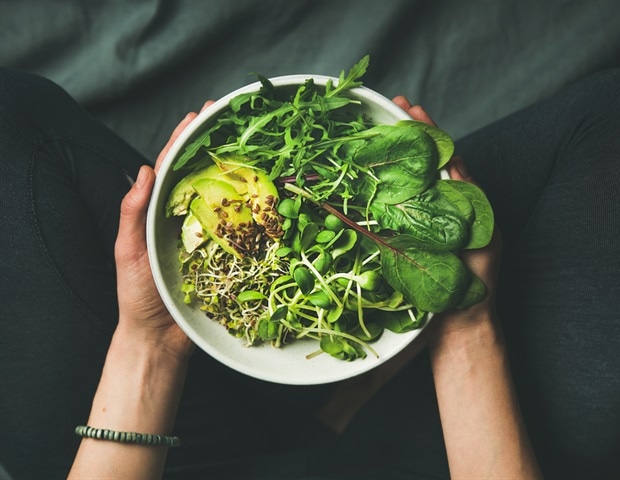
Green vegan breakfast meal in bowl with spinach%2C arugula%2C avocado%2C seeds and spr Foxys Forest Manufacture M1 2168774cbd534d9485fda6f23b1c8dc1

A low-fat vegan diet that includes soy promotes changes in the gut microbiome that reduce postmenopausal vasomotor symptoms, or hot flashes, by 95% overall, according to a new study from the Physicians Committee for Responsible Medicine. A vegan diet also eliminated severe hot flashes, led to a 96% reduction in moderate to severe hot flashes and reduced daytime and nighttime hot flashes by 96% and 94%, respectively. Participants also lost an average of 6.4 pounds.


Women who want to combat hot flashes should nourish the bacteria in their gut with a vegan diet rich in fruits, vegetables, grains and beans, which also leads to weight loss and protects against heart disease and type 2 diabetes.”


Hana Kahleova, MD, PhD, study co-author, director of clinical research at the Physicians Committee for Responsible Medicine


The new research is a secondary analysis of the WAVS study – the Women’s Study for the Alleviation of Vasomotor Symptoms – which the Physicians Committee previously published in the journal Menopause. In the study, 84 postmenopausal women who reported two or more moderate to severe hot flashes daily were randomly assigned to the intervention group that was asked to follow a low-fat vegan diet, including half a cup of cooked soybeans per day, or to the intervention group that was asked to eat a follow a low-fat vegan diet, including half a cup of cooked soybeans per day. the control group who continued their usual diet for twelve weeks.

For the secondary analysis, stool samples from a subgroup of 11 participants were used to perform a gut microbiome analysis at baseline and after 12 weeks on a vegan diet. Changes in the abundance of different families, genera and species of bacteria were found.

The study is the first to show that a reduction in the abundance of Porphyromonas and Prevotella corporis is associated with the reduction of severe daytime hot flashes. Prevotella corporis has also been found in the intestines of people with rheumatoid arthritis and appears to have pro-inflammatory properties.

The decrease in the abundance of Clostridium asparagiforme was accompanied by a decrease in the total number of severe and intense nocturnal hot flashes. Clostridium asparagiforme also appears to produce trimethylamine N-oxide, a compound associated with an increased risk of cardiovascular disease and type 2 diabetes. Reduced abundance of Clostridium asparagiforme may partially offset the beneficial effects of a plant-based diet on cardiovascular health explain and establish a possible link between hot flashes and incident cardiovascular disease.

Changes in the abundance of other bacteria looked at in the study may play a role in relieving hot flashes by stabilizing estrogen levels, reducing inflammation and increasing satiety, among other things.

The authors say larger randomized clinical trials are needed to further investigate these findings.

Source:

Physicians Committee for Responsible Medicine

Magazine reference:

Kahleova, H., et al. (2023). A dietary intervention for postmenopausal hot flashes: a potential role of the gut microbiome. An exploratory analysis. Complementary therapies in medicine. doi.org/10.1016/j.ctim.2023.103002.
Source link

Similar Posts

  • |

    Best knee scooter post-surgery

    Is hopping around on one leg or battling clumsy crutches the only way to get through recovery after a foot or ankle procedure? For many, traditional crutches are a source of frustration and fatigue. They demand considerable arm strength and often lead to instability. This can make you feel trapped and dependent on others. best knee scooter post-surgery There is a more comfortable and popular solution. Studies show that 90 percent of patients prefer using a knee scooter over crutches during their healing period. Occupational therapists highlight a key benefit: these aids keep your injured foot correctly elevated and non-weight bearing. This proper positioning is vital for a smooth recovery. We’ve done the research for you. Our analysis of the current market identifies devices that provide superior mobility and comfort compared to old-fashioned methods. Selecting the right walker helps you maintain your independence. It allows for safer movement around your home and community. A sturdy, well-designed walker is a much more stable alternative to risky hopping. Our expert-driven guide reviews the leading models available. The goal is to help you find reliable equipment that protects your leg while letting you continue with daily life. Key Takeaways The vast majority of patients prefer knee scooters to traditional crutches for recovery. These devices properly elevate the leg, which is essential for non-weight bearing healing. They promote greater independence and reduce reliance on others during your recovery. Choosing a high-quality model significantly improves safety and overall comfort. Our guide provides an expert analysis of the top mobility aids on the market today. A stable walker minimizes the risk of falls and accidental weight-bearing. Informed selection helps you navigate your environment with confidence and ease. Understanding Knee Scooters in Post-Surgery Recovery Patients seeking a stable alternative to crutches frequently turn to rolling walkers with a knee platform. This device, often called a knee scooter or knee walker, has two to five wheels and a padded rest for your leg. It is designed to keep your injured foot correctly elevated. This positioning is completely non-weight bearing, which is vital for healing. Unlike traditional crutches, a knee walker does not demand much arm strength. You simply rest your leg on the cushioned platform and propel yourself forward. This reduces physical exertion dramatically during daily movement. Occupational therapists note an overwhelming patient preference for this mobility aid. We have found that nearly 90 percent of users prefer it over other options. The design helps prevent reinjury caused by balance struggles. Feature Knee Scooter/Walker Traditional Crutches Weight-Bearing Non-weight bearing, leg elevated Partial weight on arms and shoulders Upper Body Strain Minimal; uses leg for support High; requires arm strength Hands-Free Operation Yes; handlebars for steering No; hands occupied Stability on Flat Surfaces Very stable with multiple wheels Less stable; two points of contact Risk of Reinjury Low; proper leg positioning Higher; balance challenges These devices are essential for maintaining independence. They allow you to perform household tasks while your injury heals. By keeping your hands free, a knee scooter lets you carry items and engage in daily life more effectively. Benefits of Using Knee Scooters Over Crutches The journey to regain mobility after surgery doesn’t have to be a struggle against discomfort and instability. While traditional crutches are less expensive, they frequently cause pain and balance issues for active individuals. A knee walker provides a stable base for movement. It allows you to navigate both indoors and outdoors without the constant fatigue linked to crutches. benefits of knee scooter over crutches Occupational therapists emphasize that a knee scooter is a superior choice if you lack upper body strength. Using this device greatly lowers your chance of a fall compared to balancing on underarm crutches. These aids offer a level of freedom that lets you spend time outside. This activity is proven to speed up the healing process. Choosing the right knee walker ensures you can maintain your daily routine. You avoid the physical limits imposed by standard crutches. A quality knee scooter supports your injured leg correctly, promoting safer recovery….

  • The story of chronic traumatic encephalopathy is not as simple as it seems

    Neuropathological and clinical findings in young contact athletes exposed to repetitive head impacts McKee AC, Mez J, Abdulmohammad B, et al. JAMA Neurology. Published online 2023. doi:10.1001/jamaneurol.2023.2907 Full article available for free Take home message Less than half of young adults exposed to repetitive head impacts through sports and who suffered from mental health and…

  • |

    Headgear does not help prevent concussions in football and rugby athletes

      Does headgear prevent sports-related concussions? A systematic review and meta-analysis of randomized controlled trials involving 6311 players and 173,383 exposure hours. Al Attar WSA, Mahmoud H, Alfadel A, Faude O. Sports health. May 19, 2023: 19417381231174461. doi: 10.1177/19417381231174461. E-publishing prior to printing. PMID: 37204092. Full text not freely available Take home message Headgear worn…

  • Antibiotics wreak havoc on athletic performance

      New research shows that by killing essential gut bacteria, antibiotics affect athletes’ motivation and endurance. The UC Riverside-led mouse study suggests that the microbiome is a big factor that differentiates athletes from couch potatoes. Other studies have examined how exercise influences the microbiome, but this study is one of the few to examine the…

  • Golf, hiking and Nordic walking can improve cognitive function in older adults

    Playing a single 18-hole round of golf or completing 6 km of Nordic walking or simply walking can significantly improve direct cognitive function in older individuals, according to a recent study published in BMJ Open Sports and Exercise Medicine. An international team of researchers from the University of Eastern Finland, the University of Edinburgh and…

  • Athletic trainers can assist with communication between coach and athlete

      Provision of concussion information by coaches and attendance of athletic trainers: Findings from the 2021 YouthStyles Survey Daugherty J, Waltzman D, Sarmiento KJ Athl Trein. January 16, 2023. doi: 10.4085/1062-6050-0454.22. E-publishing prior to printing. PMID: 36645830. Full text freely available Take home message More than 40% of adolescents participating in sports reported that their…

Leave a Reply

Your email address will not be published. Required fields are marked *