
Irma Jennings’ Bone Health Test Results (DXA) 2020
DXA 2022
My latest DXA and TBS report has arrived. As a reminder, in 2005 I was diagnosed with osteopenia and given a script for Fosamax. I refused. I was in my fifties. Now I’m in my seventies. My intention was to implement my 7 pillars of bone health for better results:
- Calcium and mineral rich foods
- Supplements (Cal Citrate, Vit. D., Vit K2 – Mk7, Dr. McCormick’s Collagen and Mineral Whey)
- Bioidentical hormones
- Weight-bearing exercise
- Stress reduction
- Sleep hygiene
- Brings joy to my daily life
At that time, Fosamax was a long-term drug. I would have been a long-term user. I am grateful for the work of Dr. Schneider and who has revealed her terrible story below. Because of her work, Fosamax users are now taking a drug holiday.
The story of Dr. Jennifer Schneider
Dr. Jennifer Schneider was standing on a subway in New York City when the train jolted and Schneider felt a kink in her right leg. It was her femur, the strongest bone in the body.
“I shifted to the right to keep my balance and felt a large crack. I felt it in my thigh. There was no doubt that I had broken my femur,” says Schneider, a semi-retired internist from Tucson, whose The fracture was in the upper third of her thigh.
“It’s extremely unusual to break that part of the femur,” she said. “It just doesn’t happen that way.”
Schneider’s femur fracture occurred in October 2001, but it wasn’t until 2005 that she began to suspect the cause of the strange injury: long-term use of the drug Fosamax, which ironically is prescribed to treat and prevent the bone-thinning disease osteoporosis.
Schneider had been taking the drug since 1995, when she was diagnosed with osteopenia, a condition considered by many doctors to be a precursor to osteoporosis.
“The drug suppresses bone loss and in some people, who knows, it may be doing its job too well. It suppresses too much,” Schneider said.
Fosamax drugs from New Jersey-based Merck say there is no evidence of a link between the drug and femur fractures. But in the interest of patient safety, Merck says it voluntarily amended the Fosamax label in July 2009 to include “low-energy femoral shaft and subtrochanteric fractures” in the side effects section of the label. [1]
IMPORTANT:
In June 2023 I will open my:
Pilot program: Strong Bones – Healthy You
A comprehensive bone health program – the whole body approach.
Click HERE to schedule a free 30 minute session.
This conversation will determine if my program is right for you.
DXA from IRMA
My ninety-minute pilgrimage to the University of Pennsylvania hospital yielded an excellent DXA.
Below are my results
Great results for my hips and spine – everything is moving in the right direction over time.
Not so much my forearm.
Note the colors in the report. We are looking for green.
VEGETABLE
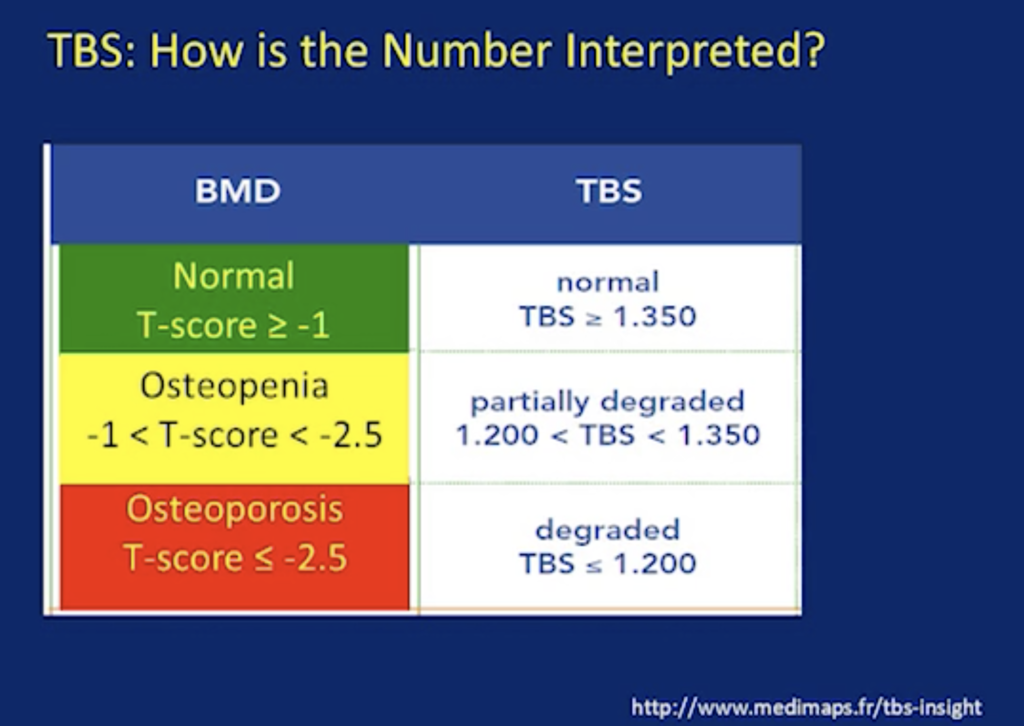
The color chart below will help you understand the ranges.
T-score less than -1 = Normal | COLOR GREEN
T-score between -1 to -2.5 = osteopenia | COLOR YELLOW
T-score greater than -2.5 = Osteoporosis | COLOR RED
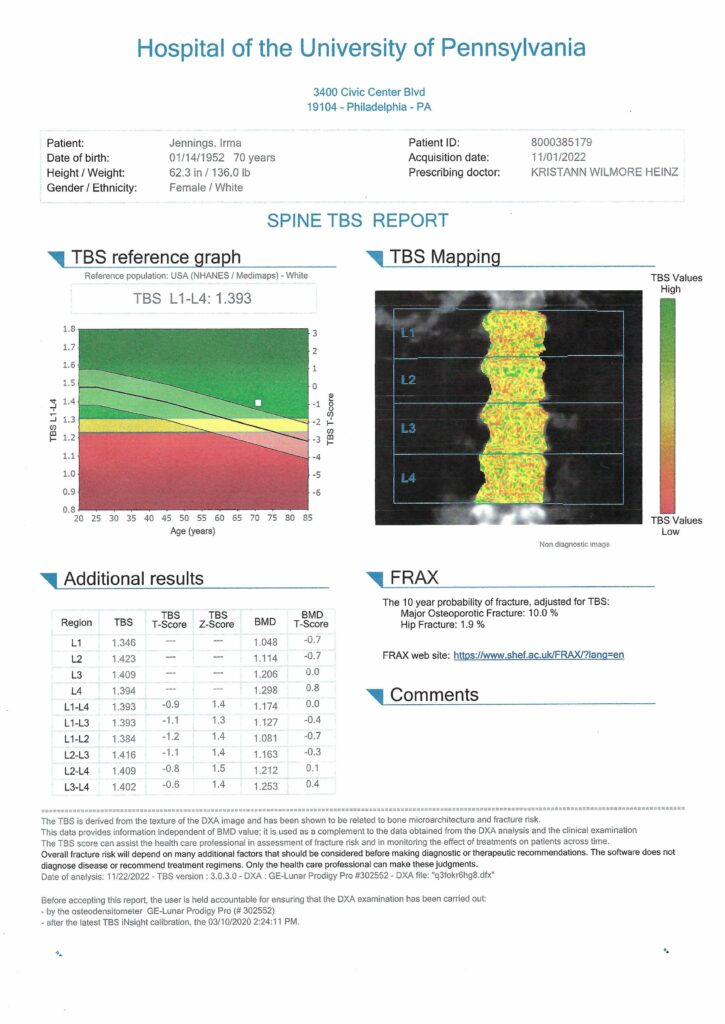
TBS L1-L4 = 1.393 (normal is 1.35 and higher)
Below you will find the Trabecular Bone Score or TBS report of my spine. Simply put, the TBS measures the inner bones, while DXA measures the outer bones. Color falls into the vegetable normal area. My inner bones look good.
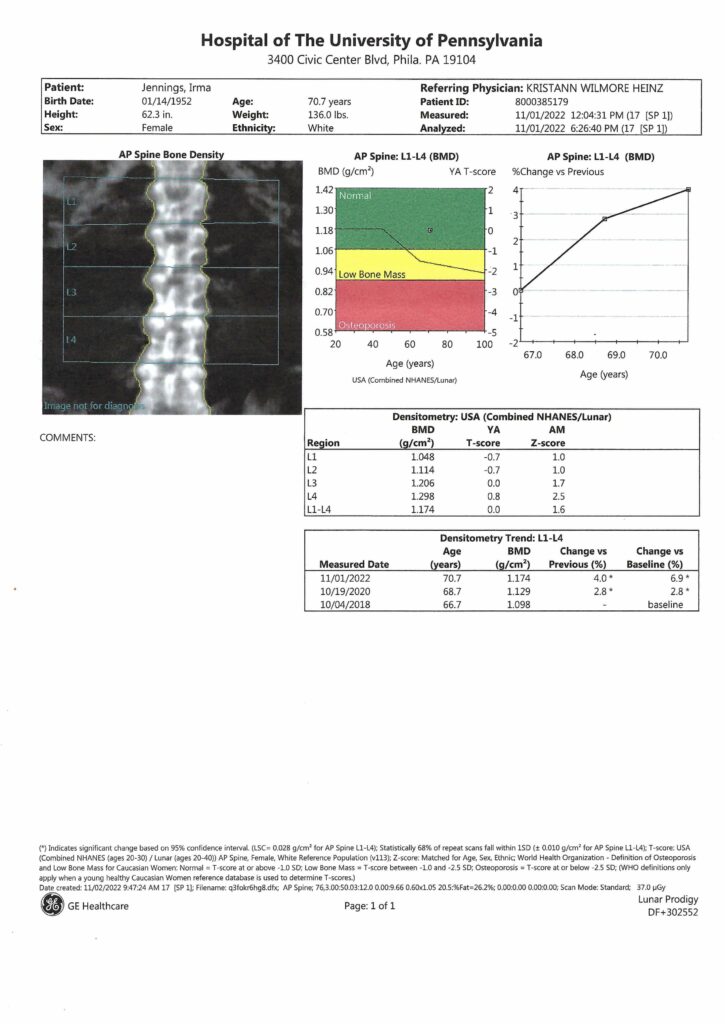
DXA spine – Normal range L1-L4 = T-score 0.0
Below is my DXA for my spine. It also falls into the vegetable (normal) part.
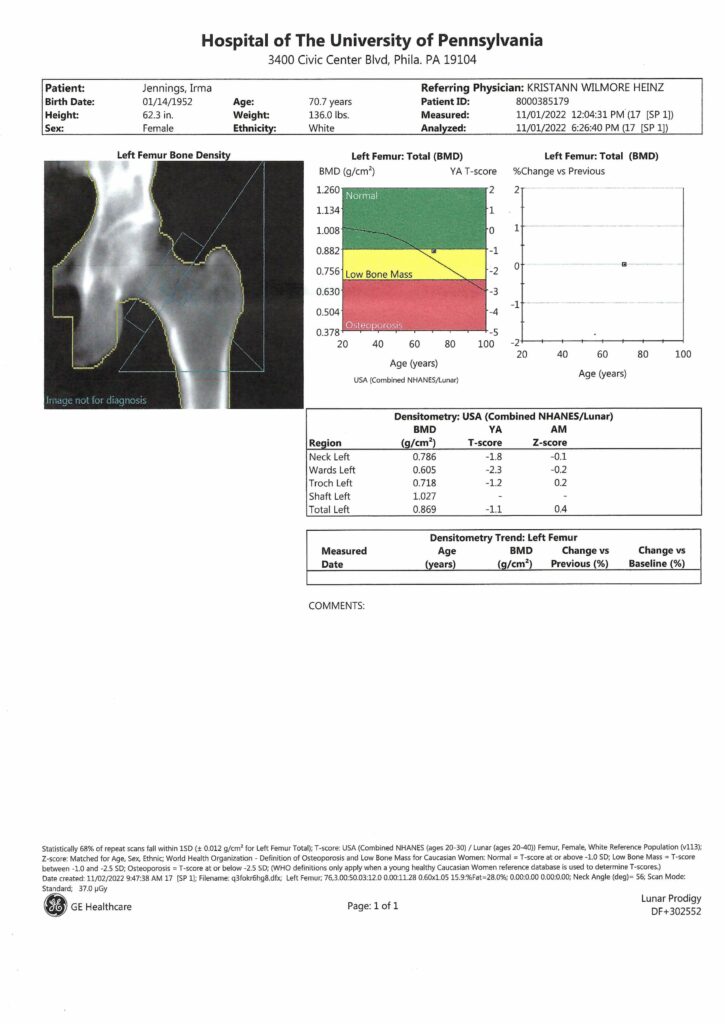
DXA hip –
Femoral neck -1.8 Total left hip -1.1
YELLOW – Osteopenia
Also measures in the normal yellow range. Note the DOT in the yellow section.
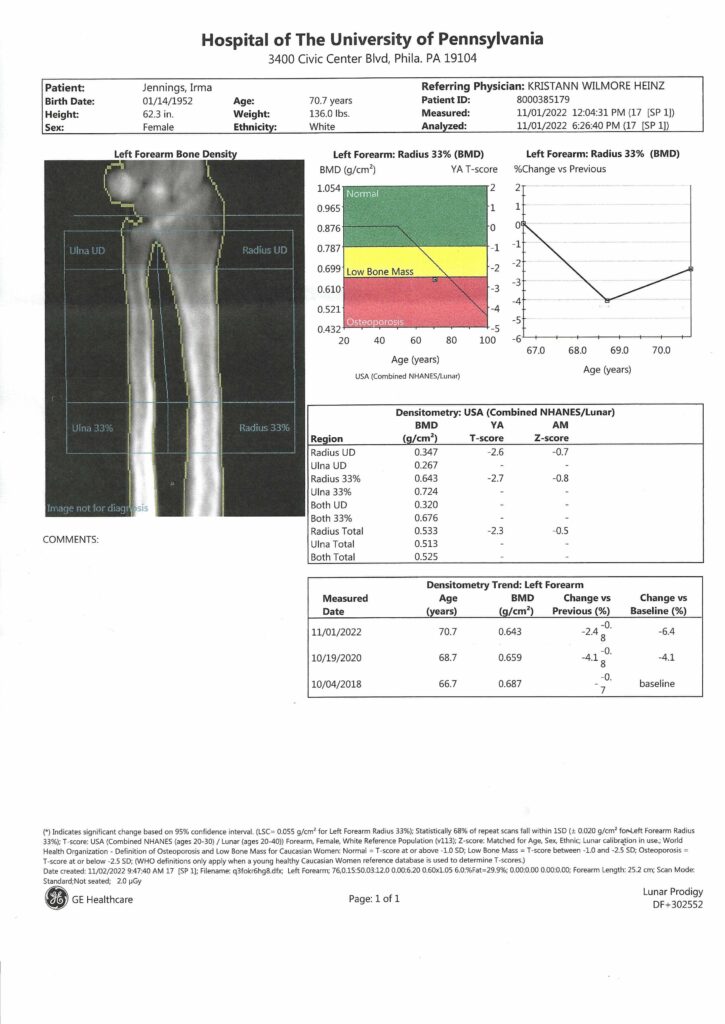
Forearm
RED – Osteoporosis
Radius 33% = -2.7
Radius 33% is the size used for the forearm.
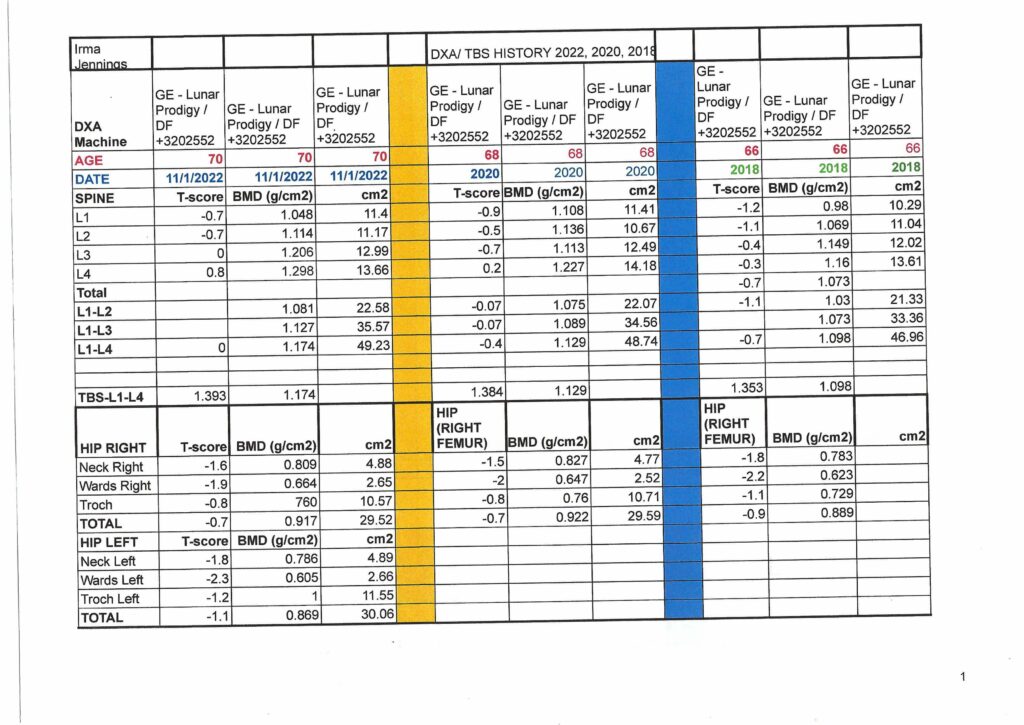
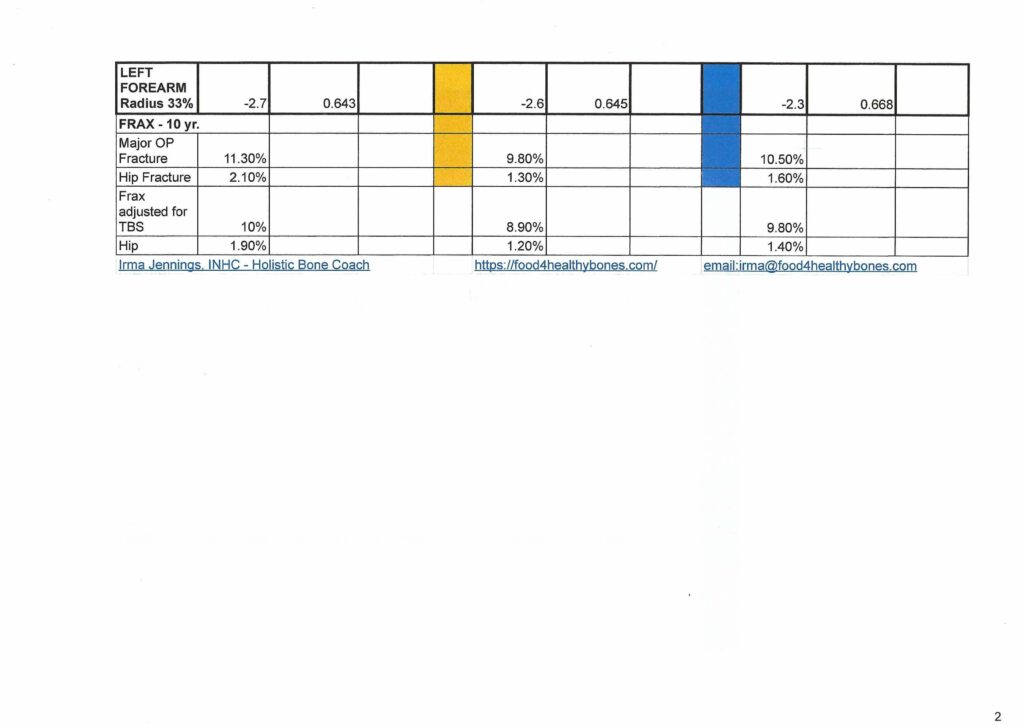
Irma’s tracking schedule
Click on the image for a better view.
For my readers who like to track their DXA, below is my tracking chart. The diagram shows the type of machine used. Each machine has a serial number. When looking at a DXA comparison, it is essential to know the DXA machine and its serial number. That serial number can usually be found in the lower right corner of your DXA report. All my tests were on GE Lunar Prodigy with the same serial number.
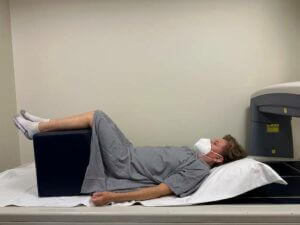
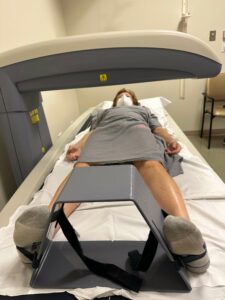
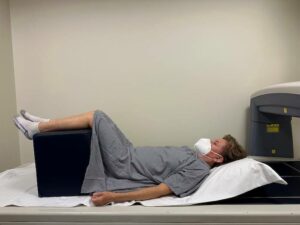
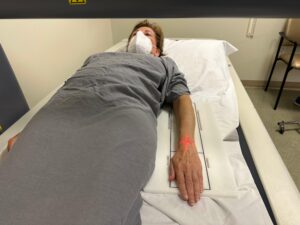
How to get a good DXA
Hips
The legs are turned inward, allowing a good DXA measurement.
Spine
The box places my back flat on the table
Forearm
Next steps
My annual CMP (Comprehensive Metabolic Panel) blood test next year. This test measures the calcium levels that I monitor.
Dr. McCormick uses blood tests to delve deeper into bone health.
Also, my friend, Dr. Lani Simpson, DC, CCD, who has been in the osteoporosis trenches for decades, before I would get and follow bone markers:
- CTX (full name Carboxyterminal cross-linking telopeptide or bone collagen) is a bone resorption marker.
- My CTx was:
- 346 (27-10-22 – Lab Corp)
- 304 (2/22/22) Quest Labs (within the range offered in my Bone Marker presentation
- P1NP (full name Procollagen type 1 N propeptide) measures bone formation. If my doctor does not write a script for this test, I will receive the script through Evexia or Life Extension.
- My previous P1NP was 34
- Vitamin D: I test twice a year – after summer and after winter
- My last test showed 44.9 ng/ml
Dr. Lani Simpson suggested an x-ray of my spine because arthritis makes a DXA look better than it is. My x-ray was taken by Dr. Kim Zambito, who reported mild arthritis in my spine and wrist.
It takes a community.
Forearm
Why is the non-dominant forearm added to the DXA/TBS report?
The spine and hip may have arthritis, but the DXA shows stronger results. The forearm can be a possible indication of problems with the parathyroid gland.
Your forearm consists of 80 to 100% cortical bone. When a person has hyperparathyroidism, too much parathyroid hormone is pumped out. What does that degrade?
That degrades cortical bone more than trabecular bone. And that’s why when you look at someone with hyperparathyroidism, their forearms often have low bone density.
- “Primary hyperparathyroidism: Although this is a systemic disease that affects the entire skeleton, the lowest BMD is often the forearm, which may be the only site where the BMD is less than -2.5. In this case, the result should influence the decision regarding the surgical treatment of primary hyperparathyroidism (PHPT).” [i]
Tests show negative for hyperparathyroidism. Bones are complicated.
We are all different
Several members of my Bones Tribe are on medication because it was deemed necessary based on a complete and comprehensive intake and blood work reviewed by their bone doctor. My Bones Tribe members seek other opinions before making a decision about medication based on knowledge versus fear of a decision.
TIPS
My DXA/TBS score was run on:
The Hospital of the University of Pennsylvania
3400 Civic Center Blvd. – Ground floor
Philadelphia, PA
phone: 215-662-3000 to book a DXA (ask for radiology to book your DXA).
My script reads:
- DXA bone density, axial CPT 77080
- DXA bone density/peripheral CPT: 77081
- Includes TBS and peripheral forearm.
I asked for one full colored copy of my reports Before I left.
I have a good feeling about the results.
MEMORY:
I open my:
Pilot program: Stronger bones – Healthy you
My 8-week Comprehensive Bone Health Program – The Whole Body Approach promises to educate you on every aspect of bone health. From DXA/TBS, bone markers, blood tests, calcium rich foods, exercise. You gain knowledge, a deep understanding of the terminology and move on to empowerment.
Click HERE for a free 30 minute consultation to confirm that my program is right for you.
I hope my shared experience is helpful to you and your beautiful bones.
From my loving bones to yours,
Irma Jennings, INHC, holistic bone coach
e-mail: [email protected]
[1] https://www.drug-injury.com/drug_injury/2010/09/doctor-files-suit-says-bone-drug-leads-to-breaks.html
Let me support your bones
Receive an in-depth, tailor-made private session
Book a private coaching with Irma now
Join our amazing Bone Tribe community
Get the support and information you need to live fearlessly with your bone diagnosis



5 Comments