download 2026 03 22T112309.880
|

Relevance of circulating semaphorin 4A to rheumatoid arthritis response to treatment


Analysis of cohort 1 from Cochin Hospital, Paris

Study population

Between May 2016 and February 2018, a total of 101 patients (85 women, 84%) with established RA were included. These patients had a mean age of 58 ± 13 years, a mean disease duration of 14 ± 11 years, and a mean follow-up age. -from 41 ± 15 months. Positive rheumatoid factors and anti-CCP antibodies were detected in 80 (79%) and 83 (82%) patients, respectively. Erosions were present in 63 (62%) patients; 70 patients (69%) received corticosteroids (including 9 at a dose > 10 mg/day), 78 received conventional synthetic disease-modifying anti-rheumatic drugs (csDMARDs), including 61 (60%) with MTX, and 59 (58%) received targeted biological DMARDs (bDMARDs). During the inclusion visit, 13 patients initiated a first-line bDMARD or switched to another bDMARD due to inadequate disease control. Detailed characteristics of our study sample are shown in Table 1.

Table 1 Characteristics of patients from the two cohorts at baseline.

Results

The number of annual consecutive visits ranged from 2 to 5 (88 patients with 3 visits, 72 with 4 visits, and 65 with 5 visits). Disease flares occurred in 38 patients during the mean follow-up period of 41 ± 15 months. Of these 38 patients, targeted therapy was added or modified in 26 patients due to inadequate disease control: 10 started on a bDMARD or a targeted synthetic (ts)-DMARD and 16 switched from a bDMARD to a new b- or tsDMARD (Table S1) . The mean time to treatment adaptation was 35 ± 13 months.

Primary endpoint: evaluation of the predictive value of SEMA4A for the occurrence of treatment failure

Baseline SEMA4A levels > 94 ng/ml were predictive of treatment failure, defined by the occurrence of flares AND treatment escalation (n = 26 patients), with an HR of 2.73 (95% CI 1.24 –5.96) (Fig. 1A). Results were unchanged after excluding the 13 patients with active disease at baseline who requested addition or change to a bDMARD (HR: 2.83, 95% CI 1.14–7.52).
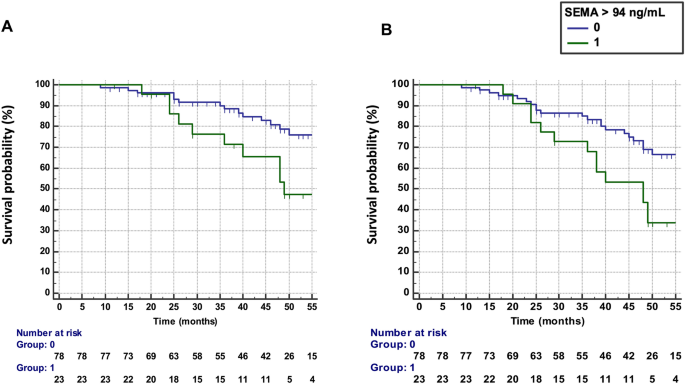
Figure 1
Figure 1

Predictive value of SEMA4A for the progression of rheumatoid arthritis in Paris cohort 1. (a) Time to treatment failure (defined as flares AND treatment escalation) according to circulating SEMA4A concentrations (≤ or > 94 ng/ml). (b) Survival without disease flare according to circulating SEMA4A concentrations (≤ or > 94 ng/ml).

Secondary endpoints

Elevated SEMA4A levels (>94 ng/ml) at baseline were predictive of flare occurrence (n = 34 patients) during the follow-up period (Fig. 1B) with a hazard ratio (HR) of 2.43 (95% confidence interval ). , CI 1.27–4.68). Results were unchanged after excluding the 13 patients with active disease at baseline (HR 2.36, 95% CI 1.15–4.89).

Baseline SEMA4A concentrations were significantly increased in patients who experienced flares during the follow-up period (78 ± 30 ng/ml vs. 60 ± 24 ng/ml, p < 0.001) (Fig. 2A). SEMA4A levels were also significantly higher in the 13 patients with active disease at baseline who requested the addition or modification of a bDMARD, compared with the 88 patients on stable treatment (84 ± 33 ng/ml vs. 63 ± 26, p = 0.011). Although baseline SEMA4A concentrations were higher in patients experiencing flares AND treatment escalation compared to those on stable treatment (75 ± 31 ng/ml vs. 63 ± 26 ng/ml, p = 0.060), this did not reach significance (Fig. 2B). Patients with elevated SEMA4A levels at baseline maintained higher DAS28 levels throughout the follow-up period, with significant differences at visits 1, 2, and 5 (Fig. 2C).
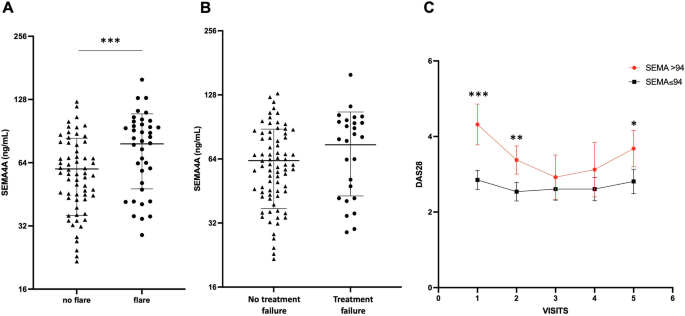
Figure 2
Figure 2

Baseline circulating SEMA4A levels according to the occurrence of (a) disease flare or (b) treatment failure (defined as flares AND treatment escalation) during the prospective follow-up period in Paris cohort 1. (c) Course of the DAS28 during the follow-up period according to baseline SEMA4A concentrations (≤ or > 94 ng/ml). All data are presented as the mean ± SEM. *p < 0.05, **p < 0.01 and ***p < 0.001, determined by Student’s t-test.

Integration of SEMA4A with other predictors of treatment failure

A baseline DAS28 > 3.2 (HR 2.17, 95% CI 1.01–4.72) and the presence of active synovitis, defined by at least grade 2 Doppler activity8, detected at at least one joint on power Doppler ultrasound (PDUS) (HR 3.60, 95% CI 1.07–12.15) were predictive of further treatment failure. These results were not changed after excluding the 13 patients with active disease at baseline.

Baseline age, disease duration, ACPA or RF positivity, smoking status, presence of erosions, series of targeted DMARDs, corticosteroid treatment, and CRP levels were not predictive of treatment failure (Table 2). Multivariate Cox analyzes adjusted for these covariates confirmed that SEMA4A was the only independent predictor of treatment failure (HR 2.71, 95% CI 1.14–6.43).

Table 2 Univariate and multivariate Cox analyzes to identify independent predictors of treatment failure (primary endpoint) and RA flares (secondary endpoint) in Paris cohort 1.

SEM4A was also confirmed as an independent predictor of flares, along with DAS28 and synovial hyperhemia (Table 2).

We then assessed the possible combination of DAS28, PDUS and SEMA4A concentrations to predict the occurrence of treatment failure and flares (Table 3). The combination that provided the best predictive value was a DAS28 > 3.2 and/or presence of active synovitis on PDUS and/or SEMA4A concentrations > 94 ng/ml (HR 10.42, 95% CI 1.41–76 .94 for treatment failure and 4.88, 95% CI 1.50–15.89 for flares) (Fig. 3A,B). Matrix models also highlighted the ability of the combination of these 3 parameters to predict the occurrence of treatment failure and flares (Fig. S1): Treatment failure and flares of RA occurred in 53% and 73% of patients with DAS28 > 3.2 at baseline and the presence of active synovitis at PDUS and SEMA4A concentrations > 94 ng/ml, respectively. Furthermore, only one patient with a DAS28 ≤ 3.2, no active synovitis and SEMA4A ≤ 94 ng/ml experienced treatment failure and RA attacks.
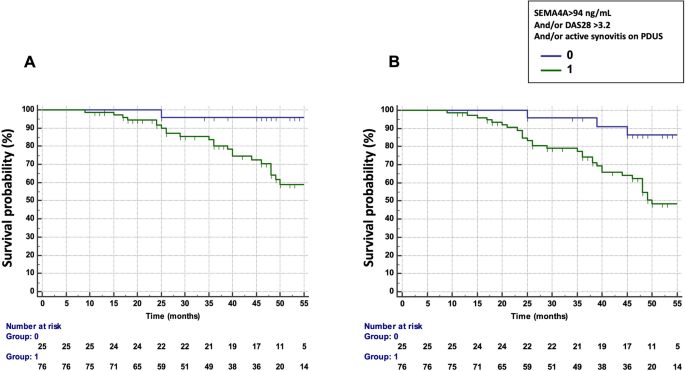
Table 3 Predictive value of circulating SEMA4A alone or in combination DAS28-CRP and/or active synovitis on power Doppler ultrasound for the occurrence of treatment failure (primary endpoint) and RA attacks (secondary endpoint) in Paris cohort 1.
figure 3
figure 3

Predictive value of SEMA4A, alone or in combination with a Disease Activity Score (DAS) 28 > 3.2 and/or the presence of active synovitis on power Doppler ultrasound (PDUS) in cohort 1 from Paris. (a) Time to treatment failure (defined as flares AND escalation of treatment) according to circulating SEMA4A concentrations (> 94 ng/ml) and/or a DAS28 > 3.2 and/or the presence of active synovitis on PDUS. (b) Survival without disease flare according to circulating SEMA4A concentrations (> 94 ng/ml) and/or a DAS28 > 3.2 and/or the presence of active synovitis on PDUS.

Predictive value of SEMA4A in the subgroup of patients with low disease activity or remission

Among the 58 patients with a DAS28 < 3.2 at baseline, treatment failed in 11 (19%) patients during the observation period. In this population, increased SEMA4A concentration was the only variable predicting the occurrence of treatment failure (HR 3.50, 95% CI 1.02–12.01). The presence of active synovitis detected on at least one joint on PDUS and other clinical or biological variables did not predict treatment failure (Table S2).

In the 37 patients with a DAS28 < 2.6, treatment failure occurred in 4 patients (11%) and elevated SEMA 4A showed a trend for predicting treatment failure (HR 3.30, 95% CI 0.82–152.11, p = 0.069).

Elevated SEMA4A concentration was also identified as the only predictor of flares (n = 16, 28%) in this subgroup of 58 patients with DAS28 < 3.2 (HR 3.68, 95% CI 1.33–10.17 ).

Analysis of cohort 2 from Pelegrin Hospital, Bordeaux

Study population

A total of 40 patients (29 women, 73%) were included. These patients had a mean age of 57 ± 14 years, a mean disease duration of 5 ± 6 years, and active disease with a mean DAS28 of 5.12 ± 1.40. Positive rheumatoid factors and anti-CCP antibodies were detected in 27 (79%) and 28 (82%) patients, respectively. Erosions were present in 16 (40%) patients; 26 patients (65%) received corticosteroids. During the inclusion visit, 15 patients started MTX as first-line treatment and 25 started tocilizumab. Tocilizumab initiators were older, had longer disease duration and disease activity, and received corticosteroids more often than MTX initiators. Detailed characteristics of our study sample are given in Tables 1 and S3.

Analysis of the course of SEMA4A serum levels according to response to treatment

Of the 40 patients included, 4 experienced no response to treatment, 10 had a moderate response and 26 had a good response. As previously observed, baseline SEMA4A levels correlated with the DAS28 (r = 0.29, p = 0.038) and a trend was observed with CRP (r = 0.26, p = 0.10). At month 3, SEMA4A concentrations correlated with DAS28 and CRP (r = 0.31, p = 0.029 and r = 0.38, p = 0.017, respectively). Furthermore, baseline SEMA4A concentrations were significantly increased in active patients at inclusion, defined by a DAS28 > 3.2 (Fig. S2A). Interestingly, baseline SEMA4A levels were significantly higher in patients who otherwise experienced no or moderate response (198 ± 30 ng/ml) compared to patients with a good response (176 ± 24 ng/ml, p = 0.035) (Fig. S2B ). It was found that serum SEMA4A levels decreased significantly between m0 and m3, especially in the group of patients with good clinical response (Fig. S2C). This result was observed in the subgroups of patients starting MTX or tocilizumab (Fig. S2D,E).

Source link

Similar Posts

  • |

    Inflammatory diseases do not increase the risk of clotting after COVID, research shows

      This is evident from a recent study published in the journal JAMA network openedResearchers in Canada investigated whether coronavirus disease 2019 (COVID-19) patients with immune-mediated inflammatory diseases (IMIDs) were at higher risk of experiencing venous thromboembolism after recovery from severe acute respiratory syndrome coronavirus 2 (SARS-CoV- 2) infections compared to COVID-19 patients without IMIDs….

  • Finding a new way: Orienteering can train the brain and help combat cognitive decline

      The sport of orienteering, which relies on athleticism, navigation skills and memory, could be useful as an intervention or preventive measure to combat cognitive decline related to dementia, according to new research from McMaster University. Researchers hypothesized that the physical and cognitive demands of orienteering, which integrates exercise and navigation, may stimulate parts of…

  • Bone Health and Fractures – Food for Healthy Bones

    Article reposted with permission from Dr. Lani Simpson: https://lanisimpson.com/blogs/news Article Summary: • Fractures can be a sign of poor bone health, although they are common. • Bones are living tissues that require a balance of resorption and formation to remain healthy. • Factors that can contribute to poor bone health include age, gender, genetics, diet…

  • |

    Anti-inflammatory diet for knee arthritis

    What if the key to easing your joint discomfort wasn’t in your medicine cabinet, but in your kitchen? This question is vital for millions. According to the CDC, arthritis affects 23% of all adults in the United States. That’s over 54 million people. Today, one in four American adults lives with this condition. Most experience pain that interferes with daily life. anti-inflammatory foods for joint health We recognize that managing chronic joint pain is a major priority. The choices we make at the grocery store can be a powerful tool. What we consume directly impacts our body and systemic inflammation. By focusing on the right foods, we can help our overall health. Our goal is to provide a clear, evidence-based path. We want to help you understand the complex link between your plate and your well-being. This approach aims to manage symptoms and improve quality of life through smart nutritional choices. Key Takeaways Arthritis is a common condition, affecting over 54 million adults in the U.S. Daily pain from this issue significantly impacts many people’s lives. The foods we eat play a direct role in our body’s inflammatory response. Making strategic nutritional choices can be a key part of managing discomfort. Evidence-based eating patterns aim to reduce systemic inflammation and support joint health. This guide provides a clear path to using your diet as a tool for better well-being. Understanding Knee Arthritis and Inflammation Our body’s defense system can sometimes turn against us, leading to persistent joint issues. This is the core of many joint health challenges. What is Knee Arthritis? We recognize two main forms. Rheumatoid is an autoimmune condition. The immune system mistakenly attacks joint tissues. Osteoarthritis involves mechanical wear. Protective cartilage wears down, causing bones to rub together. Type Primary Cause Key Characteristic Rheumatoid Arthritis Autoimmune response Systemic inflammation Osteoarthritis Mechanical wear Cartilage degradation understanding knee arthritis inflammation How Inflammation Affects Our Joints Nancy Oliveira, a dietitian at Brigham and Women’s Hospital, explains that inflammation is an essential part of our natural defense. However, chronic inflammation leads to joint pain. Certain foods can reduce this response. When we choose the right options, we influence inflammatory markers. This eating pattern, like the Mediterranean diet, offers significant benefits. It helps manage discomfort for many people. Our focus shows why whole dietary approaches work better than single nutrients for joint health. Anti-inflammatory diet for knee arthritis: Essential Foods Certain powerhouse foods act as natural allies in managing joint discomfort. Our focus shifts to specific categories that deliver potent nutritional support. These items form the core of a joint-friendly eating plan. They provide the building blocks our body needs. Omega-3 Fatty Acids and Fatty Fish Fatty fish are a premier source of omega-3 fatty acids. These essential fats are renowned for their ability to reduce inflammation. Health authorities like the American Heart Association advise eating three to four ounces of fatty fish at least twice weekly. Salmon, mackerel, and sardines are excellent choices. omega-3 fatty acids and fatty fish for…

  • |

    Sleeping after knee replacement

    What if the key to a faster recovery isn’t just what you do during the day, but how you rest at night? We understand that getting proper rest following an operation can be a major hurdle. In fact, research shows about half of all patients report significant discomfort when trying to find a comfortable position. sleeping after knee replacement This cycle of fatigue and increased sensitivity can slow down your progress. That’s why quality rest is not a luxury—it’s a critical part of the healing process, as emphasized by Christynne Helfrich, PT, DPT at Hinge Health. Our guide is designed to break this cycle. We provide expert-backed strategies for managing discomfort and improving your overall rest quality. This includes proven positions and techniques for the crucial first weeks. By addressing the root causes of post-operative disturbances, we aim to help you achieve the restorative rest your body needs. For a comprehensive plan, explore our detailed resource on how to sleep after knee replacement. Key Takeaways Quality rest is a powerful, non-negotiable part of the healing journey after surgery. Many individuals experience increased pain at night or struggle to find a comfortable sleep position. Targeted exercises and proper sleep hygiene can significantly improve your comfort and rest quality. Effective pain management, including techniques like icing, is crucial for uninterrupted sleep. Guidance from your physical therapist and surgical team is essential for a safe and effective recovery. Patience and consistency with your nightly routine are key to long-term success. Understanding Knee Replacement Recovery Your body begins a detailed repair process immediately after joint surgery. A nerve block often provides comfort for the first 18 to 30 hours post-procedure. This offers a valuable window before typical sensations begin. knee replacement recovery Post-Surgery Healing and Body Changes Significant changes occur as you heal from this operation. Natural inflammation and swelling around the new joint are common. Your system is working hard to integrate the artificial components. We note that many individuals report increased difficulty starting around day four. Challenges can persist for up to ten weeks in some cases. Discomfort may also travel to areas like the shin or hip at night. This is a normal part of the adjustment process. Your body is adapting to its new mechanics. How Sleep Supports Recovery Quality rest is vital for repair. Your body focuses on mending the joint and surrounding muscle tissue during deep rest. This is when the most intensive healing occurs. As healing progresses, your sleep quality should gradually improve. Research shows most people see significant progress by the three-month mark. The first month is often the most difficult. We encourage you to stay active during the day. Gentle movement promotes blood flow and prevents stiffness. This daily activity supports better rest at night. Understanding that your body is working hard post-operatively helps manage expectations. Consistency with your routine is key for long-term success. Common Sleep Challenges After Knee Replacement The quiet of the night often amplifies the physical sensations that accompany post-operative healing. We see that nearly half of all individuals report severe disturbances during this critical time. This makes addressing these hurdles a top priority. common sleep challenges after knee replacement Nighttime Pain and Discomfort Without daytime distractions, you may become more aware of persistent sensations. This heightened awareness can make falling asleep difficult. Anxiety about your new joint is also common. Worrying about movement can further disrupt your rest cycles. Dealing with Swelling and Stiffness Inflammation is a natural response to an operation. It often increases when you are lying down for extended periods. Limited mobility prevents natural position shifts. This lack of movement allows stiffness to set in by morning. Challenge Primary Cause Typical Effect Nighttime Pain Increased sensory awareness Difficulty initiating sleep Swelling Post-surgery inflammation Discomfort in bed Joint Stiffness Immobility during rest…

  • Presentation on fall risk factors and prevention, followed by a short Tai Chi session – Bone Talk

    Thursday, September 21 at 4:00 PM ET Helen Hayes Hospital Auditorium, Route 9W, West Haverstraw, NY Falls Prevention Awareness Week takes place September 18-22, 2023. Join the NYSOPEP Osteoporosis Support & Education Group on September 21, 2023 at 4:00 PM ET as they review the latest information on falls risk factors and prevention, followed by…

Leave a Reply

Your email address will not be published. Required fields are marked *