download 22
|

Anti-TNF-α therapy induced psoriasis in patients with rheumatoid arthritis according to FDA postmarketing surveillance data


FDA Adverse Event Reporting System (FAERS)

The United States Food and Drug Administration Adverse Event Reporting System (FAERS) is a data repository that collects voluntary drug-related reports from healthcare professionals, consumers, and legal representatives. In cases where the adverse reaction (AE) is reported to the manufacturer, the manufacturer is required to forward the report to FAERS. At the time of the survey, FAERS contained 17,392,666 AE reports collected from the first quarter of 2004 (including historical reports since 1982) through the second quarter of 2022. The reports are available online: https://www.fda.gov/ medications/questions-and-answers-fdas-reporting-system-faers-side-effects/fda-reporting-system-faers-last-quarter-data.

Data preparation

FAERS reports are added quarterly and stored in a set of text files. Subsets of data are organized by specific report fields (demographics, drug, side effects, outcome, etc.) and their respective case IDs. The data format is not uniform and has changed several times since its inception. Therefore, appropriate changes have been made. Moreover, as the side effect reports are collected from all over the world, the respective brand names of drugs are translated into the generic equivalents19,20,21.

Study results

The MedDRA Dictionary version 25.1 was searched to define the measured study outcomes using higher-level terms such as “immune-associated conditions not elsewhere classified (NEC)” and “psoriatic conditions.” All psoriasis-associated preferred terms (PT) were used in the search. To avoid indication-related confounding effects, psoriatic conditions associated with RA, such as psoriatic arthropathy, were excluded from the MedDRA PT list. The following PTs were used for the definition psoriasis in the analysis: erythrodermic psoriasis, guttate psoriasis, nail psoriasis, psoriasiform dermatitis, pustular psoriasis and psoriasis.

Cohort selection

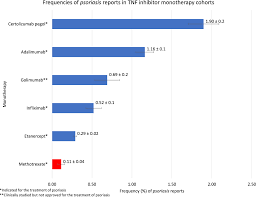
Of the total 17,392,666 adverse event reports in FAERS, a total of 881,182 reports included RA indications, and for 663,922 of these, RA was listed as the sole indication. These data were further broken down by monotherapies and only reports from physicians, pharmacists and other healthcare professionals were included to avoid bias and increase clinical relevance. The final monoindication + monotherapy sets were as follows: certolizumab pegol (n = 5168), adalimumab (n = 9221), golimumab (n = 2899), tocilizumab (n = 4819), abatacept (n = 7574), infliximab (n = 5579), rituximab (n = 2519), etanercept (n = 89543), tofacitinib (n = 10686), and methotrexate (n = 6142). Demographic analysis was performed for TNF inhibitors and methotrexate RA AE cohorts (Tables 1 and 2). The following terms for psoriasis are included: erythrodermic psoriasis, guttate psoriasis, nail psoriasis, psoriasiform dermatitis, pustular psoriasis and psoriasis. These psoriasis type terms describe the psoriasis Adverse event rates were calculated for each drug cohort: certolizumab pegol (n = 98), adalimumab (n = 107), golimumab (n = 20), tocilizumab (n = 29), abatacept (n = 40), infliximab (n = 29 ), rituximab (n = 11), etanercept (n = 260), tofacitinib (n = 24), and methotrexate (n = 7). A disproportionality analysis was performed using the reported AE rates to calculate the reporting odds ratios (RORs). These figures were used to calculate psoriasis reported frequencies. Methotrexate was selected as a control cohort because of its unique mechanism of action (MOA) as an immunosuppressant that inhibits the conversion of folic acid to folic acid cofactors, and because of its common use as a monotherapy in RA.

Demographic analysis

Gender (Table 1).

Table 1 The total number of reports of TNF inhibitors and methotrexate in the combined RA cohorts, separated by reported gender.

Age (Table 2).

Table 2 The total number of reports of TNF inhibitors and methotrexate in the combined RA cohorts, separated by reported age.

static analysis

Descriptive statistics

The frequencies for each side effect examined (Figs. 1, 3) were calculated using the following equation:

$$\textFrequency = \left( \textnReports\,\text with \,\textpsoriasis \,\textin \, \texta \,\textcohort \right)/\textnReports\,\text in \,\texta \,\ textcohort*100$$

(1)

Frequency error:

$$\textError = \left( \sqrt \textnReports \,\textwith\, \textpsoriasis\,\text in \,\text a\, \textcohort \right)/\textnReports\,\text in\,\text a \,\textcohort*100$$

(2)

Comparative statistics

The numbers of psoriasis reports were compared via the Reporting Odds Ratio (ROR) analysis for Fig. 2, 4 and 5 and Tables 3, 4 and 5 using the following equations:

$$\mathrmROR=(\mathrma/\mathrmb)/(\mathrmc/\mathrmd)$$

(3)

where Number of cases in exposed group with psoriasis, Number of cases in exposed group without psoriasis, Number of cases in control group with psoriasis, Number of cases in control group without psoriasis.

Table 3 RORs and 95% CIs were calculated based on comparisons between each TNF inhibitor monotherapy cohort and the methotrexate cohort.
Table 4 RORs and 95% CIs were calculated based on comparisons between each monotherapy cohort examined and the methotrexate cohort.
Table 5 RORs and 95% CIs were calculated based on comparisons between the certolizumab pegol monotherapy cohort and each of the other monotherapy cohorts studied.

$$\mathrmLnROR=\mathrmLn(\mathrmROR)$$

(4)

Standard error of odds ratio for log reporting;

$$\mathrmSE_\mathrmLnROR=\sqrt1/\mathrma+1/\mathrmb+1/\mathrmc+1/\mathrm d$$

(5)

95% confidence interval;

$$95\text\%CI = \left[ {\textexp\left( \textLnROR – 1.96 \times \textSE_\textLnROR \right),\textexp\left( {\textLnROR + 1.96 \times \textSE_{\textLnROR} } \right)} \right]$$

(6)
Source link

Similar Posts

  • |

    Knee replacement complications

    What if the key to a successful recovery isn’t just about the surgery itself, but what you know beforehand? Every year, over 790,000 people in the United States choose this medical procedure to regain their mobility. It’s a major step toward a life with less pain. knee replacement complications We recognize that while this operation is common, understanding what can happen after is vital. This knowledge transforms a patient from a passive recipient into an active partner in their own care. Our goal is to provide clear, empowering information about the possible risks. This helps you approach your healing journey with eyes wide open and confidence high. Modern advancements have made this intervention safer and more effective than ever. Still, being informed allows you to spot any warning signs early and seek help promptly. This guide is your comprehensive resource. We aim to support you in taking charge of your long-term joint health and overall well-being. Key Takeaways Over three-quarters of a million knee replacement surgeries are performed annually in the U.S. Being informed about potential issues is a crucial part of patient preparation and empowerment. Knowledge of risks helps in early identification of any post-operative warning signs. Modern surgical techniques and care have significantly improved the safety profile of this procedure. An active understanding of your care plan contributes greatly to a successful long-term outcome. This information is designed to build confidence as you move forward with your medical decision. Understanding Knee Replacement Surgery Before diving into the details, let’s build a clear picture of what this surgical process entails. Over 790,000 of these operations happen each year in the United States alone. understanding knee replacement surgery What Is a Knee Replacement? This common operation replaces all three compartments of a damaged joint. Surgeons remove worn bone and cartilage. They then fit precise metal and plastic implants. This creates a new, smooth gliding surface. Aspect Detail Primary Goal Relieve chronic pain and restore joint function Artificial Components Metal and medical-grade plastic Typical Anesthesia General or spinal Average Hospital Stay 1 to 3 days Initial Recovery Period 6 to 12 weeks The Overall Procedure and Its Benefits This intervention is designed to help people regain independence. Most patients report a major improvement in their quality of life. The main benefit is lasting relief from persistent pain. Many return to daily activities and hobbies they love. Understanding the mechanics helps set realistic expectations for recovery and long-term performance. Key Knee Replacement Complications Statistics offer great comfort, but a complete picture includes understanding what could go wrong, even if it’s unlikely. Research confirms a very high success rate for this operation. Over 95% of people recover without any major issues. This statistic highlights the overall safety of the procedure. key knee replacement complications Overview of Common Risks Every medical intervention carries some inherent risks. These can include infection, blood clots, or stiffness. Your surgical team is trained to both prevent and manage these known challenges. They are a standard part of the pre-operative discussion. Why Awareness Matters We believe knowledge is power. Understanding potential warning signs allows you to partner with your care team. You can seek help promptly if something doesn’t feel right. This proactive approach helps prevent minor concerns from becoming serious problems. It’s crucial to discuss your personal health history with your doctor. This conversation helps assess your individual risk profile before surgery….

  • Testing the athletic shoulder with Ben Ashworth

      Standardized tests are often performed in the health and performance world to establish baselines, monitor performance, or help an athlete return to sports. The lower extremity has received the most attention, but the ASH test, or athletic shoulder test, popularized by Ben Ashworth, is a great option for the upper extremity. In this episode…

  • COVID-19 pandemic cancellations have taken a heavy toll on teen athletes, whose mental and physical health improved significantly after sports resumed, research shows

      High rates of depression and anxiety among adolescent athletes whose sports were canceled during the COVID-19 pandemic improved significantly a year later when they were able to return to sports, according to new research. The author of an abstract, “The Influence of Return to Sport on Mental Health, Physical Activity and Quality of Life…

  • MCRA Announces Launch of Integrated AI & Imaging Center

      Led by former FDA Imaging Experts, MCRA AI & Imaging Center is the first and only integrated solution covering the medical device lifecycle with 24/7 customer support WASHINGTON , Nov. 27, 2023 /PRNewswire/ — MCRA, the leading private independent Clinical Research Organization (CRO) and medical device, diagnostics and biologics consulting firm, is pleased to…

Leave a Reply

Your email address will not be published. Required fields are marked *