
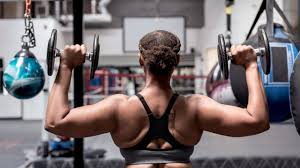
Less gym time, same results: why ‘lowering’ weights is all you need to do
Good news for those who struggle to fit a gym workout into their day: You may be able to cut your weight routine in half and still see the same results.
New research from Edith Cowan University (ECU) has shown that one type of muscle contraction is most effective at increasing muscle strength and size – and instead of lifting weights, the focus should be on lowering them.
The team, which also included researchers from Niigata University and Nishi Kyushu University in Japan and Londrina State University in Brazil, had groups of people perform three different types of dumbbell curl exercises and measured the results.
It turned out that those who only lowered a weight saw the same improvements as those who increased and decreased their weight – despite only performing half the number of repetitions.
Professor Ken Nosaka from ECU said the results reinforce previous research showing that a focus on “eccentric” muscle contractions – where activated muscles are lengthened – is more important for increasing the strength and size of muscles, rather than volume.
“We already know that just one eccentric muscle contraction per day can increase muscle strength if performed five days a week – even if it only lasts three seconds per day – but concentric (lifting a weight) or isometric muscle contraction (holding a weight) does not produce such an effect,” said Professor Nosaka.
“This latest study shows that we can be much more efficient in the time we spend training and still see significant results by focusing on eccentric muscle contractions.
“In the case of a dumbbell curl, many people may believe that the lifting action provides the most benefit, or at least some benefit, but we found that concentric muscle contractions contributed little to the training effects.”
Crunching the numbers
The study consisted of three groups that performed dumbbell curls twice a week for five weeks, plus a control group that did nothing.
Of the training groups, one group performed exclusively eccentric muscle contractions (lowering weight), another performed exclusively concentric muscle contractions (lifting weight), and another performed both concentric and eccentric muscle contractions (alternating lifting and lowering weight).
All three saw improvements in concentric strength, but this was the only improvement for the concentric-only group.
The eccentric-only and concentric-eccentric groups also saw significant improvements in isometric (static) strength and eccentric strength.
Most interestingly, despite the eccentric-only group doing half as many reps as those who lifted and lowered weights, the gains in strength were very similar and the eccentric-only group also saw greater improvement in muscle thickness , an indicator of muscle hypertrophy: 7.2 percent compared to the 5.4 percent of the concentric-eccentric group.
“Understanding the benefits of eccentric training can allow people to spend their time exercising more efficiently,” said Professor Nosaka.
“With the small amount of daily exercise needed to see results, people don’t necessarily need to go to the gym — they can incorporate eccentric exercises into their daily routine.”
Putting it into practice
So how can we use this knowledge in the gym?
When using a barbell, Professor Nosaka recommends using two hands to assist with the concentric phase (lifting weight), before using one arm for the eccentric phase (lowering weight), when performing:
- Biceps curls
- Overhead extension
- Front elevation
- Shoulder press
Using leg weight machines, Professor Nosaka recommends using the same concentric/eccentric technique when performing:
- Knee extensions
- Leg curls
- Calf goes up
Taking care of bodies in the home
Luckily, Professor Nosaka says you don’t need gym weights to apply the same principles to a workout and has come up with some simple exercises you can do at home.
During the exercises, feel the contracting muscles being gradually stretched from the beginning to the end of the range of motion.
After each eccentric muscle contraction, minimize the effort to return to the starting position (i.e. concentric muscle contraction).
Repeat 10 times for each exercise.
Chair sitting: From a semi-squat position, slowly sit down on a chair for three seconds (narrower and wider positions will create different effects). If this becomes easy, try sitting with one leg.
Chair recline: Sit on the front of a chair to create space between your back and the backrest and slowly lean back for three seconds (arms can be crossed on the chest or held at the back of the head).
Uneven squat: Stand behind a chair, lean to one side to put more weight on one leg, then squat down for three seconds.
Heel down: Still behind a chair, lean forward and lift your heels. Then lift one leg off the ground and lower the heel of the other leg for three seconds.
Wall kiss: Lean against a wall with both arms fully extended. Slowly bend the elbow joint for three seconds until your face comes close to the wall.
Forward lunge: Place one leg in front of the other and bend the knees deeper for three seconds.
‘Comparison between concentric only, eccentric only and concentric-eccentric resistance training of the elbow flexors for their effects on muscle strength and hypertrophy’ was published in the European Journal of Applied Physiology.


4 Comments