Knee Joint Pain Exercises: A Comprehensive Guide
Introduction
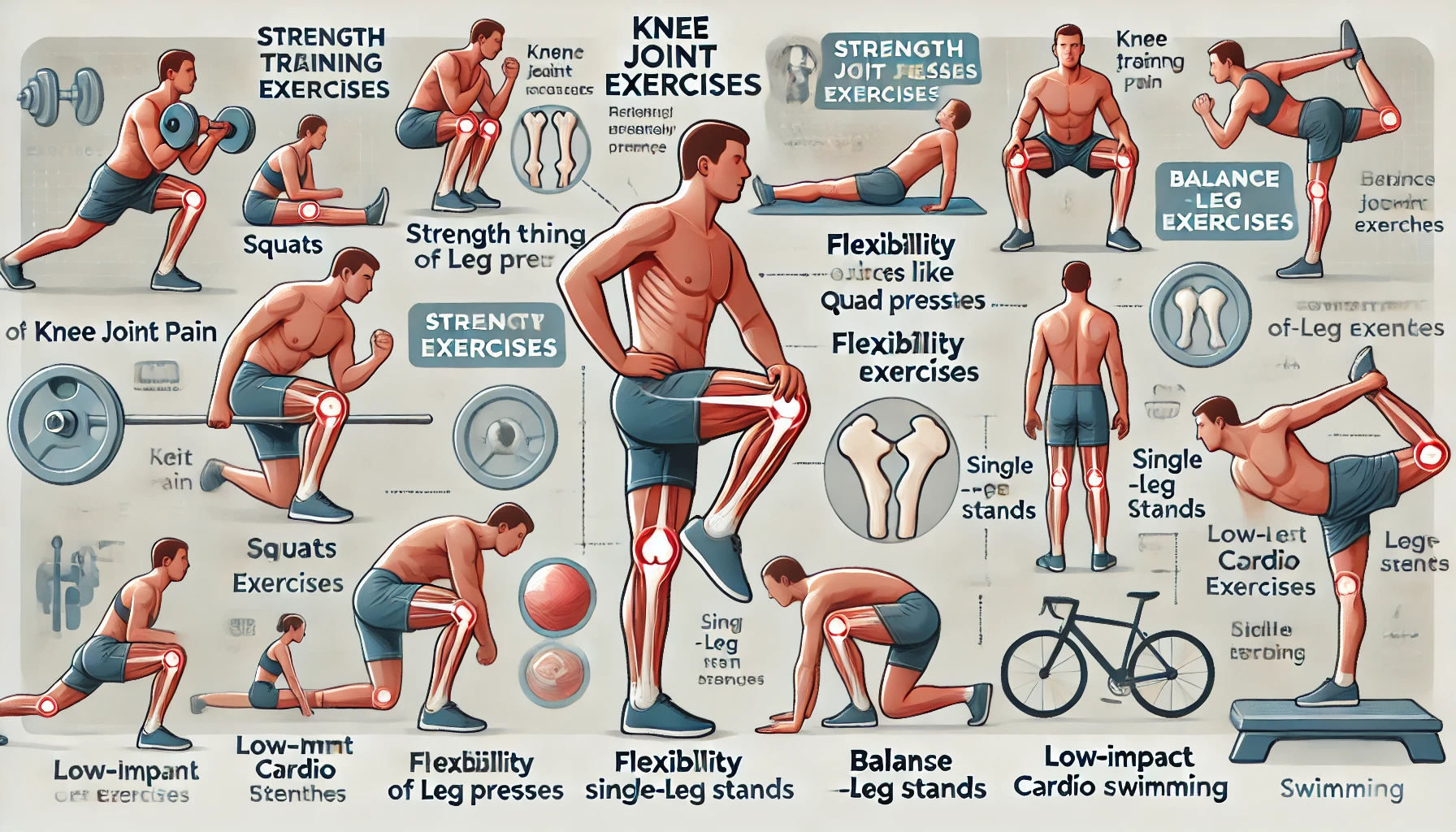
Exercise is a cornerstone of managing knee joint pain, offering numerous benefits for those suffering from various knee conditions. By incorporating specific exercises into your routine, you can enhance knee strength, flexibility, and stability, leading to reduced pain and improved mobility. This comprehensive guide outlines various types of exercises, including warm-ups, strengthening, flexibility, and balance activities, to help manage knee pain effectively.

It’s important to note that while exercise is generally beneficial for knee health, individuals with existing knee conditions should consult with a healthcare professional or physical therapist before starting any new exercise regimen. This ensures that the exercises are appropriate for your specific condition and are performed correctly to maximize benefits and minimize the risk of further injury.
The Importance of Exercise for Knee Health
Before diving into specific exercises, let’s explore why exercise is crucial for maintaining healthy knees and managing knee pain:
- Strengthens supporting muscles: Strong muscles around the knee joint provide better support and stability.
- Improves flexibility: Enhanced flexibility reduces stress on the knee joint during movement.
- Increases blood flow: Better circulation promotes healing and reduces inflammation.
- Maintains healthy cartilage: Movement helps nourish cartilage and keep it healthy.
- Aids weight management: Maintaining a healthy weight reduces stress on the knees.
- Enhances proprioception: Improved body awareness helps prevent injuries.

Warm-Up Exercises
Proper warm-up is essential before engaging in any knee exercises. Warm-ups prepare your body for more intense activity, increasing blood flow to the muscles and improving flexibility.
Gentle Stretching
Start with gentle stretches to prepare the muscles around the knee:
- Standing Quadriceps Stretch:
- Stand holding onto a chair for balance.
- Bend one knee, bringing your heel towards your buttocks.
- Hold for 15-30 seconds, then switch legs.
- Standing Calf Stretch:
- Stand facing a wall, hands on the wall at shoulder height.
- Step one foot back, keeping it straight with heel on the ground.
- Lean forward, feeling the stretch in your calf.
- Hold for 15-30 seconds, then switch legs.
- Seated Hamstring Stretch:
- Sit on the edge of a chair with one leg extended.
- Reach towards your toes, keeping your back straight.
- Hold for 15-30 seconds, then switch legs.

Low-Impact Aerobics
Follow stretching with light aerobic activity to increase heart rate and further warm up the muscles:
- Marching in Place:
- Stand tall and march in place, lifting your knees high.
- Continue for 1-2 minutes.
- Arm Circles:
- While marching, add arm circles to engage upper body.
- Rotate arms forward for 30 seconds, then backward for 30 seconds.
- Gentle Knee Lifts:
- Stand holding onto a chair for balance.
- Slowly lift one knee, then lower it.
- Alternate legs, performing 10-15 lifts per leg.
Remember, the goal of these warm-up exercises is to gently prepare your body for more intense activity, not to push yourself to the point of pain or discomfort.
Strengthening Exercises
Strengthening the muscles around the knee is crucial for providing support and stability to the joint. Focus on exercises that target the quadriceps, hamstrings, and calf muscles.
Quadriceps Exercises
- Straight Leg Raises:
- Lie on your back with one leg bent, foot flat on the floor.
- Keep the other leg straight and lift it to the height of the opposite knee.
- Hold for 3-5 seconds, then lower slowly.
- Perform 10-15 repetitions, then switch legs.
- Wall Sits:
- Stand with your back against a wall, feet shoulder-width apart.
- Slide down the wall until your thighs are parallel to the ground.
- Hold this position for 20-30 seconds.
- Gradually increase hold time as you build strength.
- Step-Ups:
- Use a sturdy step or platform.
- Step up with one foot, bringing the other foot up to meet it.
- Step back down and repeat.
- Do 10-15 repetitions, then switch lead legs.

Hamstring Exercises
- Hamstring Curls:
- Stand holding onto a chair for balance.
- Bend one knee, bringing your heel towards your buttocks.
- Hold for 3-5 seconds, then lower slowly.
- Perform 10-15 repetitions, then switch legs.
- Bridge Exercise:
- Lie on your back with knees bent, feet flat on the floor.
- Lift your hips off the ground, squeezing your glutes.
- Hold for 3-5 seconds, then lower slowly.
- Repeat 10-15 times.
- Swiss Ball Hamstring Curl:
- Lie on your back with heels on a Swiss ball.
- Lift your hips and roll the ball towards your buttocks.
- Slowly straighten your legs to return to the starting position.
- Perform 10-15 repetitions.
Calf Exercises
- Calf Raises:
- Stand with feet hip-width apart, holding onto a chair for balance.
- Rise up onto your toes, then lower slowly.
- Perform 15-20 repetitions.
- Seated Calf Raises:
- Sit with feet flat on the floor.
- Place a light weight on your thighs near your knees.
- Lift your heels off the ground, then lower slowly.
- Perform 15-20 repetitions.

Remember to start with light weights or body weight and gradually increase as you build strength. Always maintain proper form to maximize benefits and minimize the risk of injury.
Flexibility Exercises
Maintaining flexibility in the muscles and tendons surrounding the knee is crucial for reducing strain on the joint and improving overall knee function.
Hamstring Stretches
- Seated Hamstring Stretch:
- Sit on the edge of a chair with one leg extended.
- Reach towards your toes, keeping your back straight.
- Hold for 30 seconds, then switch legs.
- Repeat 2-3 times per leg.
- Standing Hamstring Stretch:
- Place one heel on a low step or stool.
- Keeping your leg straight, lean forward from your hips.
- Hold for 30 seconds, then switch legs.
- Repeat 2-3 times per leg.
Quadriceps Stretches
- Standing Quad Stretch:
- Stand holding onto a wall or chair for balance.
- Bend one knee, bringing your heel towards your buttocks.
- Grasp your ankle with your hand and gently pull.
- Hold for 30 seconds, then switch legs.
- Repeat 2-3 times per leg.
- Lying Quad Stretch:
- Lie on your side with knees bent.
- Grasp the top ankle and gently pull your heel towards your buttocks.
- Hold for 30 seconds, then switch sides.
- Repeat 2-3 times per leg.

Calf Stretches
- Wall Calf Stretch:
- Stand facing a wall, hands on the wall at shoulder height.
- Step one foot back, keeping it straight with heel on the ground.
- Lean forward, feeling the stretch in your calf.
- Hold for 30 seconds, then switch legs.
- Repeat 2-3 times per leg.
- Step Calf Stretch:
- Stand on a step with your heels hanging off the edge.
- Lower your heels below the step level.
- Hold for 30 seconds.
- Repeat 2-3 times.
Remember to stretch gently and never bounce or force a stretch. You should feel a gentle pull, but never pain. If you experience pain, ease off the stretch immediately.
Balance and Stability Exercises
Improving balance and stability is crucial for preventing knee injuries and managing existing knee pain. These exercises help enhance proprioception (your body’s ability to sense its position in space) and strengthen the small stabilizing muscles around the knee.
Single-Leg Balance
- Basic Single-Leg Stand:
- Stand on one leg, holding onto a stable surface for support if needed.
- Try to maintain balance for 30 seconds.
- Switch legs and repeat.
- As you improve, try closing your eyes or standing on an unstable surface like a foam pad.
- Single-Leg Clock Reach:
- Stand on one leg.
- Imagine you’re standing in the center of a clock.
- Reach your free leg to 12 o’clock, then back to center.
- Continue reaching to 3, 6, and 9 o’clock positions.
- Perform 5-10 repetitions, then switch legs.

Step-Ups
- Forward Step-Ups:
- Stand in front of a sturdy step or platform.
- Step up with one foot, bringing the other foot up to meet it.
- Step back down and repeat.
- Perform 10-15 repetitions, then switch lead legs.
- Lateral Step-Ups:
- Stand sideways next to a step.
- Step up sideways onto the platform.
- Bring your other foot up to meet it, then step back down.
- Perform 10-15 repetitions, then switch sides.
Bosu Ball Exercises
A Bosu ball is a versatile tool for improving balance and stability. Always ensure you have something stable nearby to hold onto if needed.
- Bosu Ball Squats:
- Stand on the flat side of the Bosu ball, feet shoulder-width apart.
- Perform a squat, keeping your knees aligned with your toes.
- Return to standing position.
- Perform 10-15 repetitions.
- Bosu Ball Single-Leg Stand:
- Stand on the flat side of the Bosu ball on one leg.
- Try to maintain balance for 30 seconds.
- Switch legs and repeat.

As with all exercises, start with the basic versions and progress to more challenging variations as your strength and balance improve. Always prioritize proper form over the number of repetitions.
Cool Down
Cooling down after your exercise routine is just as important as warming up. It helps your body transition back to a resting state and may reduce muscle soreness.
Gentle Stretching
Repeat some of the stretches from your warm-up routine, holding each stretch for 30-60 seconds:
- Quadriceps stretch
- Hamstring stretch
- Calf stretch
Walking
End your routine with a few minutes of gentle walking to gradually bring your heart rate down.
Relaxation Techniques
Incorporate some relaxation techniques to help reduce overall tension:
- Deep Breathing:
- Sit or lie comfortably.
- Inhale deeply through your nose for a count of 4.
- Hold your breath for a count of 4.
- Exhale slowly through your mouth for a count of 6.
- Repeat for 5-10 cycles.
- Progressive Muscle Relaxation:
- Starting with your feet, tense the muscles for 5 seconds, then relax.
- Work your way up through your body, tensing and relaxing each muscle group.
- Pay particular attention to the muscles around your knees.

Creating a Routine
To effectively manage knee joint pain through exercise, it’s important to create a balanced routine that includes all the components we’ve discussed. Here’s a sample routine you can adapt based on your needs and fitness level:
- Warm-up (5-10 minutes):
- Gentle stretching
- Light aerobic activity (marching in place, arm circles)
- Strengthening Exercises (15-20 minutes):
- Choose 1-2 exercises each for quadriceps, hamstrings, and calves
- Perform 2-3 sets of 10-15 repetitions for each exercise
- Flexibility Exercises (10-15 minutes):
- Perform stretches for hamstrings, quadriceps, and calves
- Hold each stretch for 30 seconds, repeating 2-3 times
- Balance and Stability Exercises (10-15 minutes):
- Choose 2-3 balance exercises
- Perform each exercise for 30 seconds to 1 minute, repeating 2-3 times
- Cool Down (5-10 minutes):
- Gentle stretching
- Walking
- Relaxation techniques
Aim to perform this routine 3-4 times per week, allowing for rest days in between. As you build strength and endurance, you can gradually increase the duration or intensity of your exercises.
[Image: A weekly calendar showing a suggested exercise schedule, with workout days and rest days clearly marked.]

Precautions and Tips
While exercise is beneficial for managing knee joint pain, it’s important to exercise safely to prevent further injury. Here are some key precautions and tips to keep in mind:
- Start Slowly: If you’re new to exercise or returning after an injury, start with gentle exercises and gradually increase intensity.
- Listen to Your Body: Some discomfort during exercise is normal, but sharp or severe pain is a sign to stop.
- Use Proper Form: Ensure you’re performing exercises correctly to maximize benefits and minimize injury risk. Consider working with a physical therapist or certified trainer initially.
- Stay Consistent: Regular exercise is key to seeing improvements in knee pain and function.
- Wear Appropriate Footwear: Supportive shoes can help reduce stress on your knees during exercise.
- Stay Hydrated: Proper hydration helps maintain the flexibility of your muscles and joints.
- Modify As Needed: If an exercise causes pain, try modifying it or choose an alternative that doesn’t provoke symptoms.
- Ice After Exercise: Applying ice to your knees for 15-20 minutes after exercise can help reduce any swelling or discomfort.
Conclusion
Exercise plays a crucial role in managing knee joint pain, offering benefits such as increased strength, improved flexibility, and enhanced stability. By incorporating a variety of exercises – including warm-ups, strengthening exercises, flexibility work, and balance training – you can create a comprehensive routine to support your knee health.
Remember, the key to success is consistency and gradual progression. Start with exercises that are comfortable for you and slowly increase the intensity and duration as your strength and endurance improve. Always listen to your body and consult with a healthcare professional if you experience persistent pain or have concerns about your exercise routine.
With patience and dedication, many individuals find that regular exercise significantly reduces their knee pain and improves their overall quality of life. Whether you’re dealing with osteoarthritis, recovering from an injury, or simply aiming to maintain healthy knees, a well-designed exercise program can be an powerful tool in your knee health arsenal.

Related Articles

About the author: Mokhtar Sahraoui
Mokhtar Sahraoui is the founder and editor of Knee Hurt. He researches and writes practical, easy-to-understand guides on knee pain, knee injuries, arthritis and recovery, based on trusted medical sources. Knee Hurt articles are general information and are not a substitute for advice from your doctor or physical therapist.